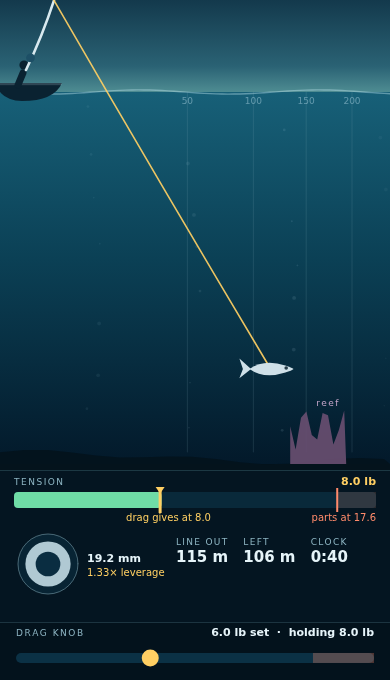
A fishing drag is a stack of friction washers. Friction washers hold a torque. The line comes off a radius. Everything else in this piece is those two sentences colliding.
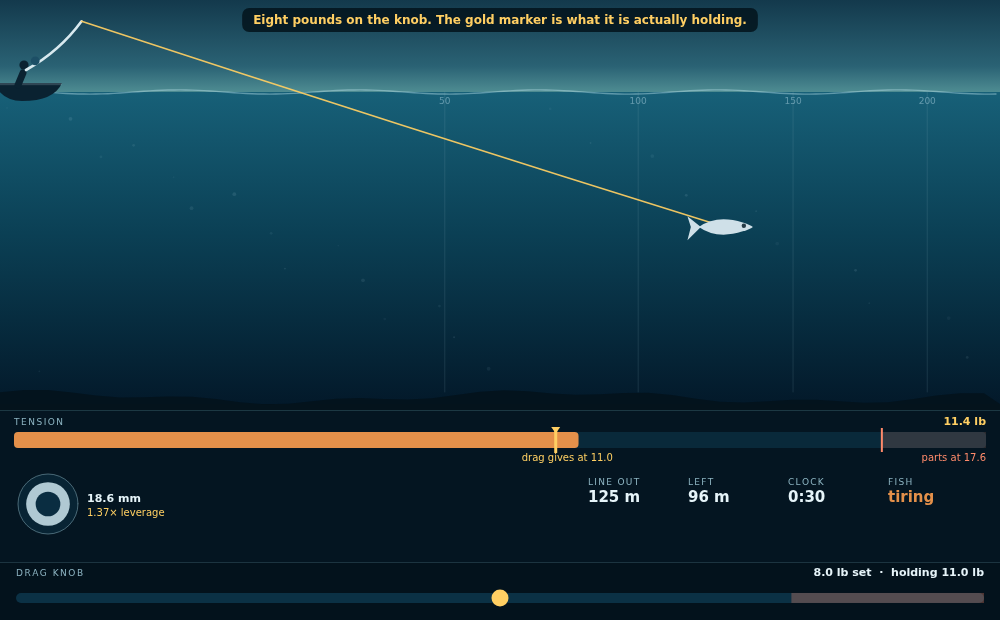
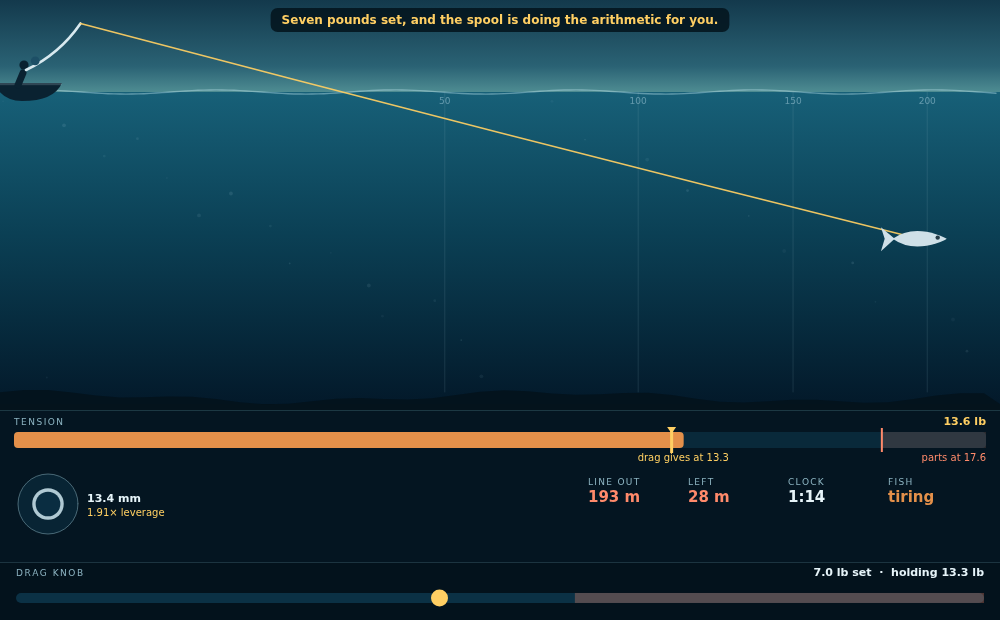
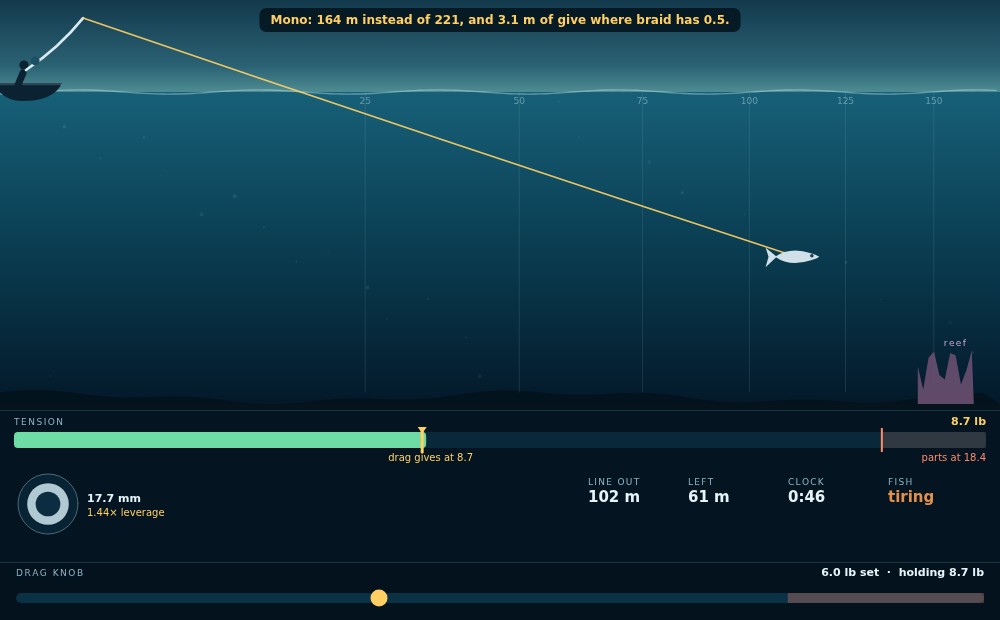
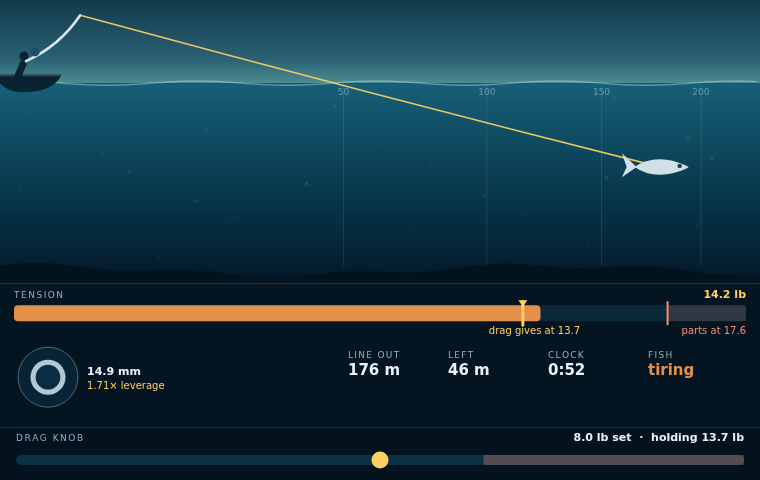
You set the knob with a spring scale against a full spool — six pounds, say, a bit under a third of what twenty-pound braid is rated for, exactly as every book tells you. Then the fish runs, and the pack of line on the spool gets thinner, and the radius the torque is working against gets smaller, and the tension on the line goes up. Not at the end. Continuously, the whole way out, on a reel with no instrument that reads it.
line out    radius    leverage    a 6.0 lb knob holds    % of breaking
     0 m    25.5 mm     1.00×             6.00 lb      34.1%
    50 m    23.0 mm     1.11×             6.66 lb      37.8%
   100 m    20.2 mm     1.27×             7.59 lb      43.1%
   150 m    16.9 mm     1.51×             9.08 lb      51.6%
   200 m    12.7 mm     2.00×            12.01 lb      68.3%
   220 m    10.6 mm     2.40×            14.41 lb      81.9%
That table is not a model. It is
r² = arbor² + L·d²/(4·W·packing) — the cross-section of an annulus — and
the only numbers in it are the spool’s dimensions and the diameter printed on
the line’s box. Everything that follows is this one piece of arithmetic
happening while you are busy.
The four things that fall out
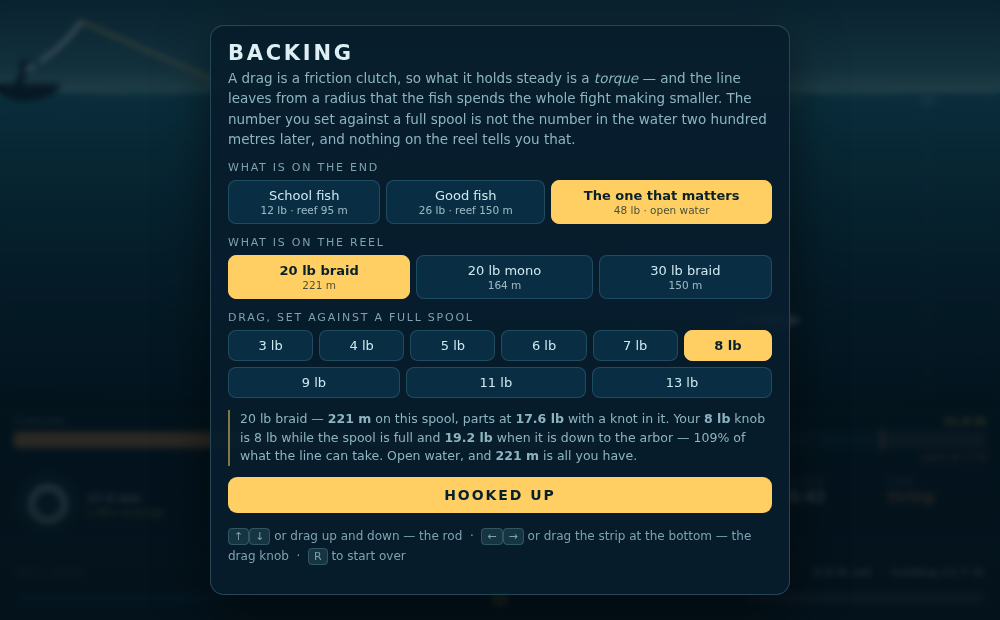
One fixed setting lands the big one, and it wins by nearly losing. A 48 lb fish in open water, 221 m of 20 lb braid on the reel, twelve seeded fish per row against the same reference angler:
knob     outcome                        mean fight   line out   parts at   predicted
 4.0 lb  12 spooled                             —     221 m          —       never
 6.0 lb  9 landed, 3 spooled                 488 s     209 m          —       never
 7.0 lb  12 landed                           420 s     197 m          —       never
 8.0 lb  9 landed, 3 parted                  373 s     183 m      193 m       212 m
10.0 lb  3 landed, 9 parted                  305 s     154 m      152 m       181 m
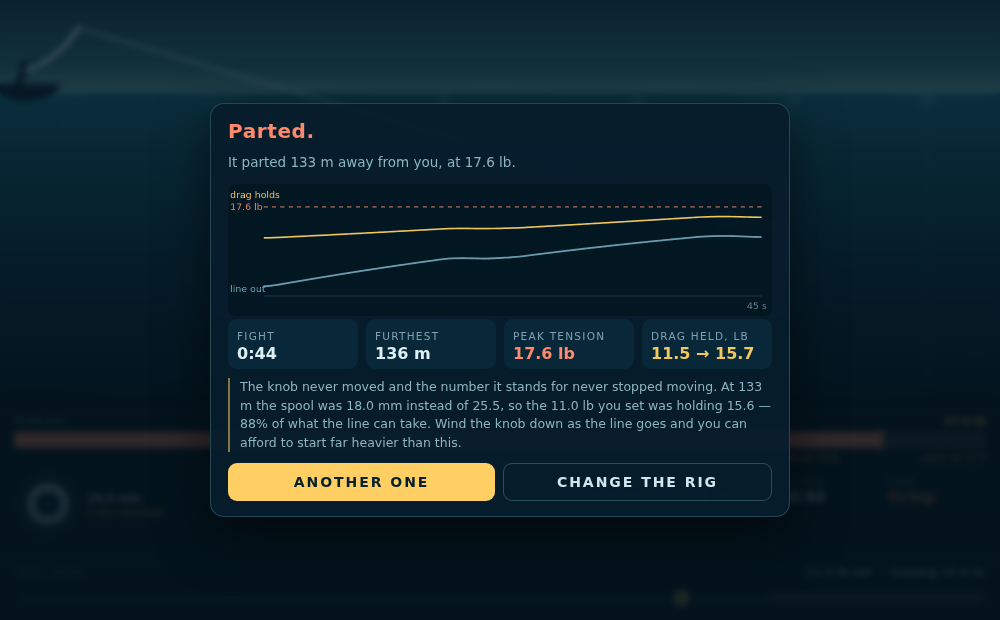
11.0 lb  12 parted                              —     136 m      133 m       163 m
13.0 lb  12 parted                              —      61 m       61 m       121 m
Seven pounds takes every one of the twelve and the worst of them gets to
216 m of the 221 m on the reel — 5 m from the knot, after seven minutes.
The predicted column is not simulated: it is the line out at which that
knob’s slip tension, times the leverage it has picked up by then, first
equals the breaking strain. The sim parts the line 20 to 30 m earlier than
that every time, because the fish and your own rod are supplying the rest.
The drag is not a limit on the fish. It is a limit on you — and it moves.
In steady state the tension is whatever the fish is pulling; the clutch
only decides where on the spool that happens. What the clutch genuinely caps
is everything you do: the rod lift, the crank, the hand that tightens up when
a fish surges. That cap is knob × leverage, and the leverage is the one
term in it that the fish gets a vote on.
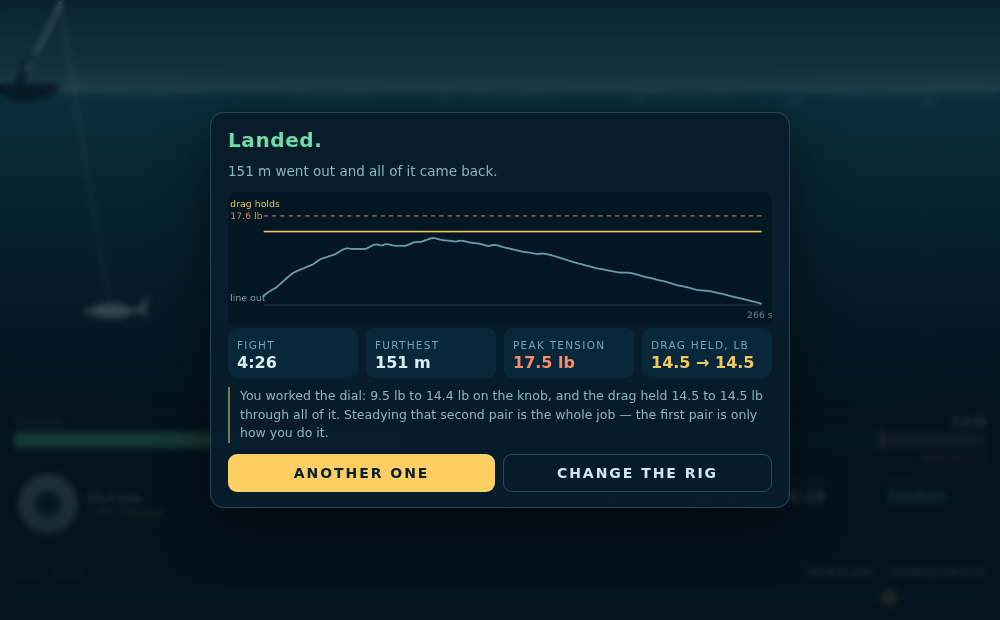
So wind the knob down as the line goes out, and a harder drag stops breaking. Hold the tension at the fish constant instead of the knob — which means starting near the line’s limit, where the spool is full and leverage is 1.00×, and coming back to half of that by the arbor:
held at    outcome                   mean fight   line out   knob at the end
  11.0 lb  9 landed, 3 spooled           381 s     202 m          4.53 lb
  13.0 lb  12 landed                     308 s     173 m          5.75 lb
  14.5 lb  12 landed                     263 s     152 m          7.53 lb
14.5 lb held is 40 out of 40 over a longer run of seeds. Set against the 11 lb knob that parts twelve times out of twelve: the 11 lb knob is the softer drag for the first 113 m of every one of those runs. And set against 7 lb, the one fixed setting that works: 263 s against 420 s, 152 m against 197 m — 37% off the fight and 45 m kept on the spool, for a drag that is never once lighter than the one it beat.
The received rule — set the drag to a third of the line’s breaking strain — turns out not to be advice about the line at all. It is advice about the arbor, quietly priced for the worst moment of the fight and then charged to you for all of it.
The softest spring in the system is the line you have not got back yet. Line stretch and rod bend sit in series, and both are length terms, so the whole shock absorber is strongest where the fish is furthest away:
line               line out    rod      stiffness    fish must move
20 lb braid           15 m     low      164.2 N/m        0.48 m
20 lb braid          150 m     low       19.4 N/m        4.04 m
20 lb mono            15 m     low       26.2 N/m        3.12 m
20 lb mono           150 m     low        2.7 N/m       30.44 m
Braid at 150 m is 8.5× more forgiving than the same braid at 15 m. Mono at 15 m is 6.5× the braid at the same range, from the spool label alone — and 150 m of that mono has 30 m of give in it, which is the same sentence as “you cannot set a hook at that range” said in units. It is why the two hazards in this game sit at opposite ends of the fight: deep, the clutch has stopped protecting you; close, there is nothing left to stretch.
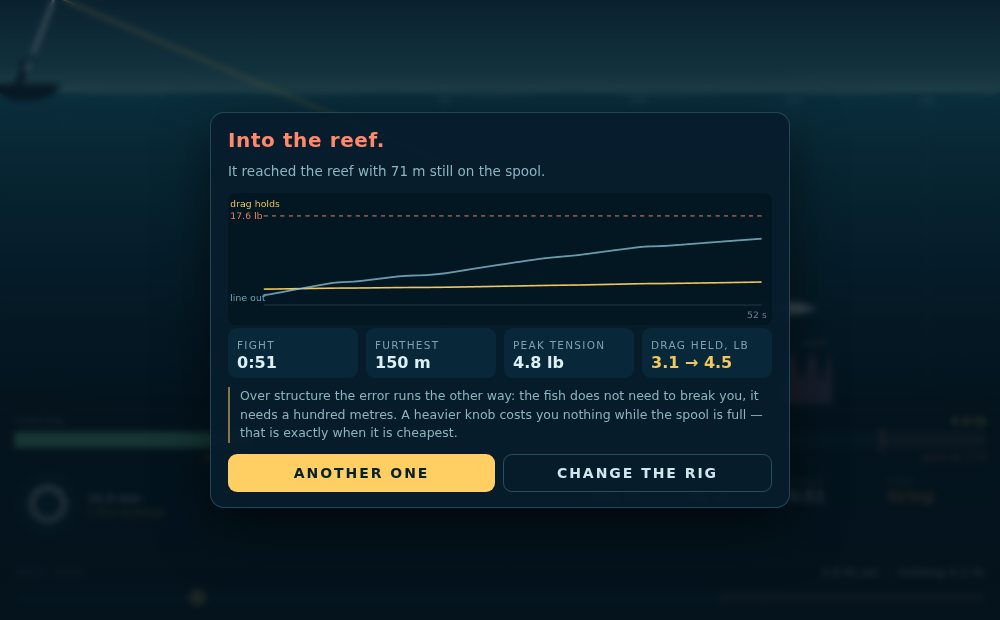
And over structure the error runs the other way
Two of the three fish have a reef to reach, and there the only mistake available is too little drag:
Good fish (26 lb), reef at 150 m
 3.0 lb  12 reefed      4.0 lb  12 reefed      5.0 lb  8 landed, 4 reefed
 6.0 lb  12 landed      7.0 lb  12 landed      8.0 lb  12 landed
Which is the useful shape of the whole thing: the knob has a floor set by where the fish can get to, and a ceiling set by where your line will be on the spool when it gets there, and the ceiling is the one that moves.
Playing it
Two dials and nothing else. Up and down is the rod: lifting it drags the fish in on the tip and loads the softest spring you own, dropping it lets you crank that line onto the spool. You are always winding — the physics decides whether winding gains anything, and it will not gain a centimetre while the clutch is slipping. Left and right is the knob. On a touch screen, drag anywhere for the rod and drag the strip along the bottom for the knob.
Watch the gold marker on the tension bar rather than the number on the knob. That marker is where the drag gives, it starts where you set it, and it walks toward the red line on its own.
What is actually being simulated
src/backing.mjs is headless — no DOM, no canvas, no rendering — and the
demo and scripts/measure.mjs both drive it and nothing else. SI units
internally, pounds-force at the edges because that is what is written on a
spool.
- Spool. Exact annulus geometry: arbor 10.5 mm, lip 25.5 mm, 16.5 mm between the flanges, 0.85 packing efficiency. That gives 221 m of 20 lb braid, 164 m of 20 lb mono on the same spool, and 2.43× of leverage end to end. Nothing here needed calibrating.
- Clutch. Constant torque
knob × lip radius, a breakaway at 1.18× the running torque, and a small viscous term so it gets grabbier the faster it turns. The spool carries 1.3 × 10⁻⁵ kg·m² of its own, which turns out to be negligible — a genuine result, and the reason the model does not blame “startup inertia” for breaks that are really leverage. - Line. A linear spring reaching its rated load at its rated stretch — 3% for braid, 22% for mono — with the knot taking 12% and 8% off the rating respectively. Mono is not really linear and braid is not really elastic, so this is a secant fit to the two points anyone quotes. The ratio between them, which is what the finding rests on, is the ratio of the numbers printed on the spools.
- Rod. 2.13 m, geometric stiffness from 1150 N/m pointed at the fish to 210 N/m loaded up, and 1.10 m of line taken up sweeping between the two. That sweep is the pump.
- Fish. A mass with a motor, a top speed set by its own drag, and an anaerobic budget that only refills on genuinely slack line. Four behaviours — run, headshake, sound, give — weighted by how tired it is, off a seeded PRNG so every number above is reproducible.
Run node scripts/measure.mjs from this folder to regenerate every table on
this page, and node scripts/screenshot-demo.mjs to rebuild the thumbnail and
the shots.
Where the model is a caricature
The honest list. The spool geometry and the clutch arithmetic are exact; past that it thins out.
- One dimension. The fish runs away or comes back. A real one goes sideways, under the boat, and around the motor, and the belly of line that puts in the water adds load the rod tip never sees.
- No hook. Nothing here pulls out, straightens or cuts, which in life is a large fraction of why the textbook third-of-breaking-strain rule exists. Take the “start at 14.5 lb” result as a statement about this reel’s geometry, not as tackle advice.
- No water on the line. Drag on a few hundred metres of braid is real and rises with speed; here it is folded into the fish’s own drag coefficient rather than modelled as a separate term that grows with line out.
- Fatigue is a single scalar. Real exhaustion is lactate, temperature and a fish that may not survive being landed slowly — which is the strongest practical argument for the heavy-early strategy the model arrives at for entirely different reasons.