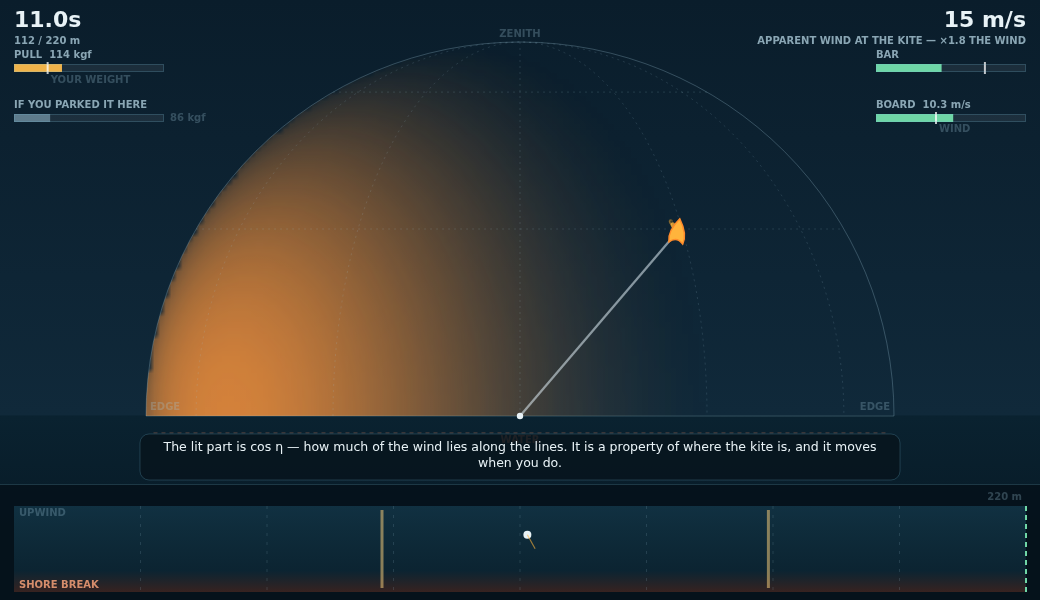
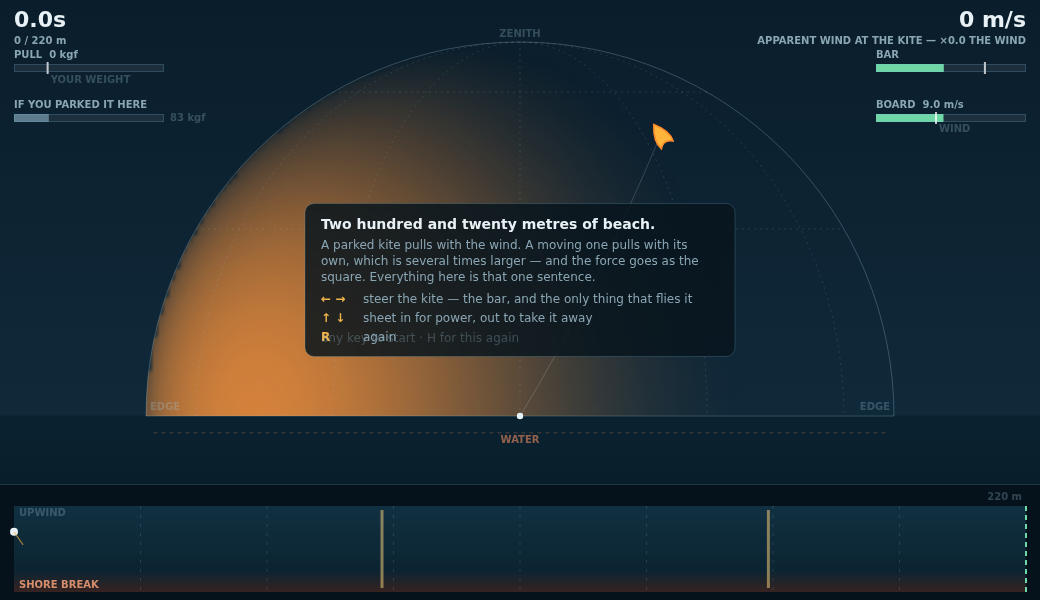
← → steer. ↑ ↓ sheet in and out. That is the whole control scheme, and the second one is not a difficulty setting — it is the only thing standing between a jump and being taken off the water sideways.
The one fact
A kite parked in the sky is a sail. It feels the wind, and what the lines carry is
T = ½ρA·V²·(cl·sin η + cd·cos η)where η is the angle between the lines and the wind, and V is the wind. Move the
same kite across the window and it stops being a sail and starts being a wing: it
now flies in its own apparent wind, and because the tether will not let it move
along the lines, the radial part of that apparent wind is pinned at V·cos η
while the wing makes whatever its glide ratio can of the rest. The result is the
one line the whole file is built on —
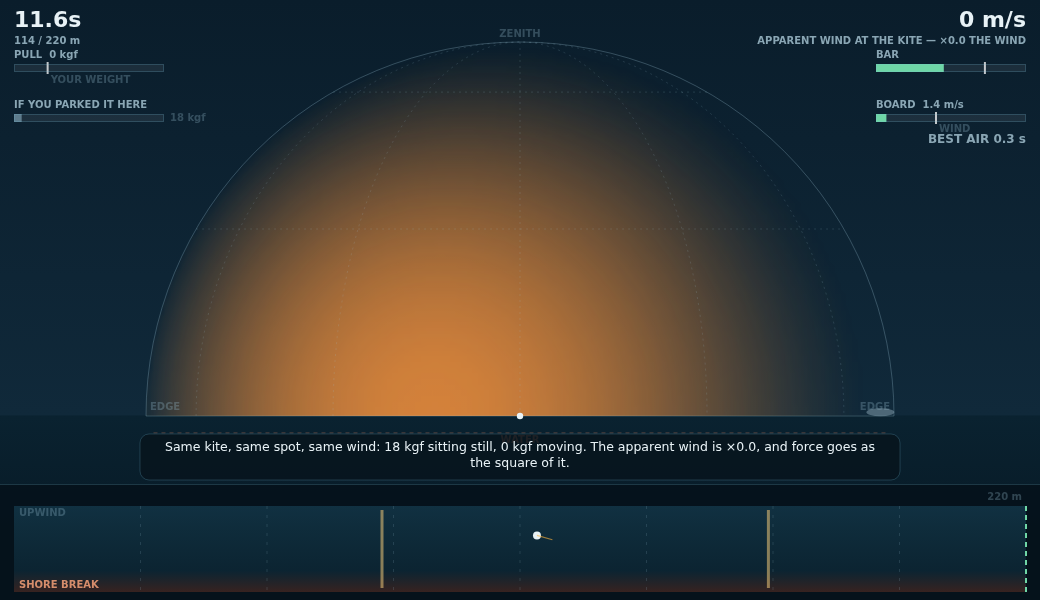
V_a = √(1 + E²) · V · cos η— and since force goes as the square of it, a glide ratio of 5.6 is worth
thirty parked kites. Same kite, same sky, same wind. 02-parked-and-flying.png
catches it at twenty-seven kilos sitting still and two hundred and forty-five
moving.
That is Loyd’s crosswind result from 1980, and it is why kite power stations are a thing people build. Here it is why a board goes one and a half times the speed of the wind that is pushing it.
The window is not where you think it is
Everything in the file goes through one number:
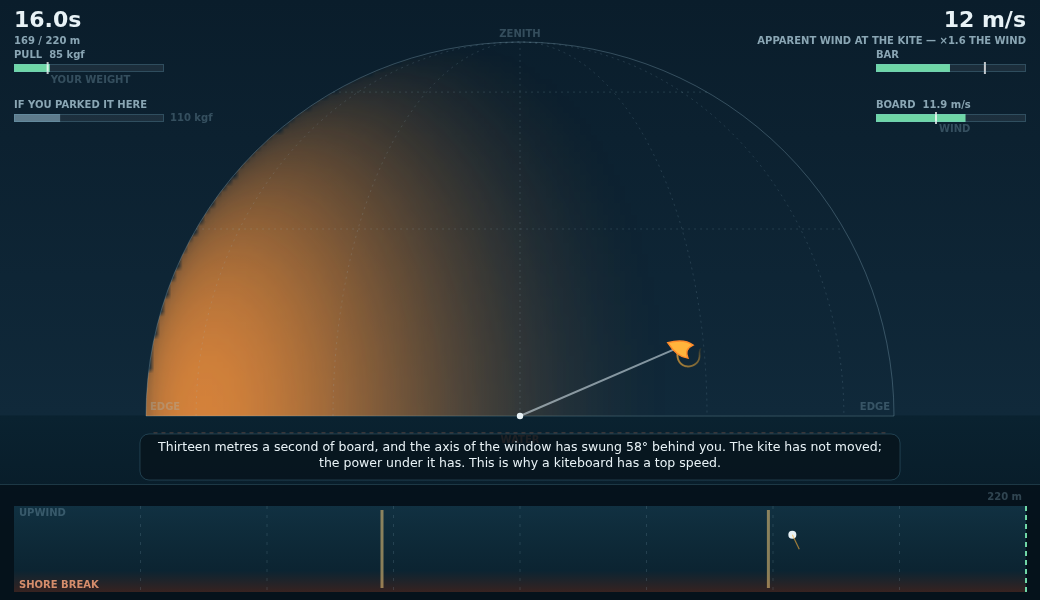
cos η = cos φ · cos(θ − β)Elevation φ, azimuth θ, and β — the direction of the wind the rider feels, which is the true wind minus your own motion. The lit part of the dome in the demo is that number, painted. It is not decoration and it is not a hint: it is the quantity, drawn.
Watch it while you accelerate. At a standstill β is zero and the power sits
straight downwind. At thirteen metres a second the axis has swung fifty-odd degrees
behind you, and the kite you carefully parked has depowered itself without
moving. That swing is the top speed of a kiteboard, and it is one line of
trigonometry. 03-the-window-moves.png.
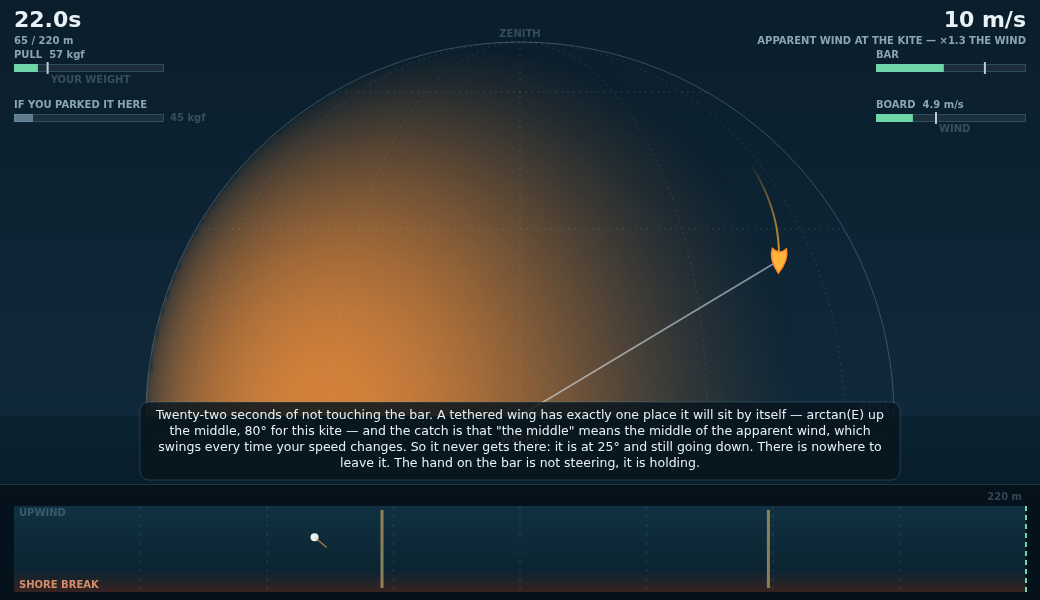
There is nowhere to leave it
Balance the tangential forces on a tethered wing and the lift’s pull up the window
cancels the drag’s pull down it at exactly tan η = cl/cd. So a kite left alone
climbs to an elevation of arctan(E) — 80° for this one — and sits there. That
is not a fact I put in; it is a fact the smoke test finds, and finding it is most
of why the test exists.
It also has a sting in it, which is the third lesson and the one that makes this a
game rather than a diagram. The middle it parks up is the middle of the apparent
wind, and that moves every time your speed does. So the one stable place in the
sky is a place that is always somewhere else. Take your hand off the bar and the
kite does not sit; it sets off after a point that keeps leaving.
05-hands-off.png is twenty-two seconds of exactly that.
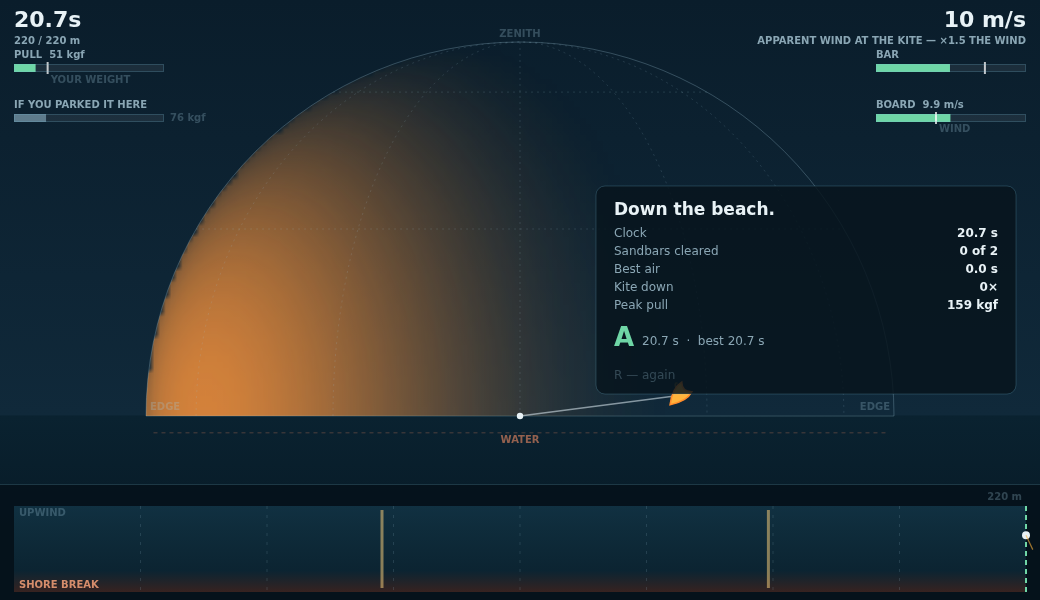
There is a second edge to the same result. At arctan(E) the lift’s tangential pull and the drag’s cancel — which means there is nothing left over to hold the kite up, and gravity gets it at very nearly a full g along the tangent. So the angle that looks like the safe place to park is the angle with no margin at all. Work it a little inside that and the kite flies itself; the bill is that more of the pull points downwind and you give away beach. The smoke test measures both ends of that trade, because if it were not in there the piece would be lying:
| worked at | time down the beach | beach given away |
|---|---|---|
| arctan(E), out at the edge | 24.5 s | 13 m |
| 1.05 rad, inside it | 20.7 s | 4 m |
Why you cannot fly it like a cursor
Turn radius is v / (g_s·V_a), about fourteen metres at speed, on
twenty-four-metre lines. A dive costs R·|sin ψ − 1| of height before the heading
is back to horizontal, so a kite pointed straight down at 30 m/s needs more than
half the window to stop. The pull has to start long before the water looks close,
and the first three times you will not start it early enough.
Jumping, and the thing that is not jumping
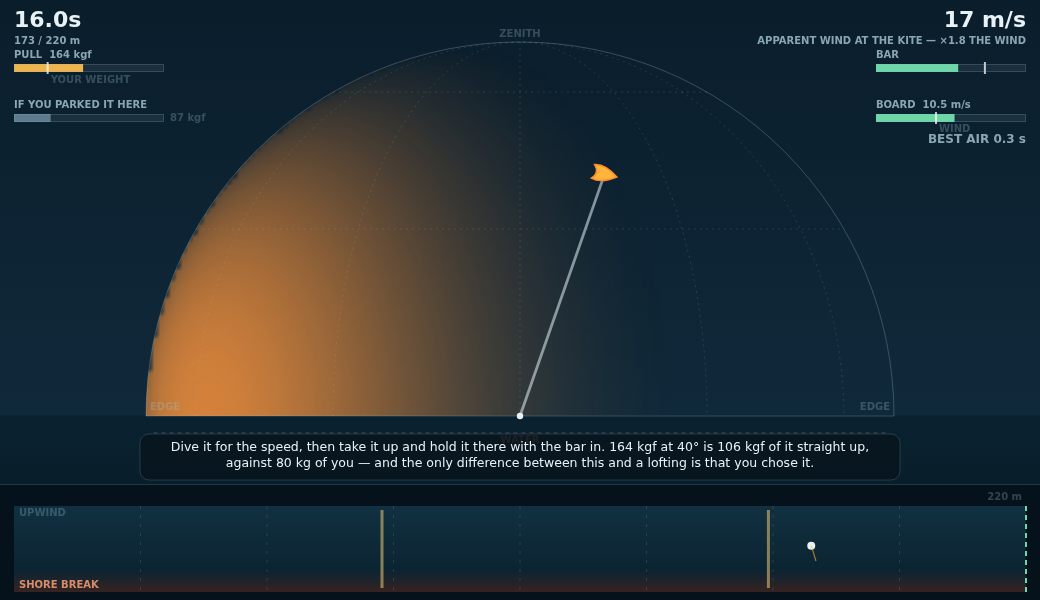
You leave the water when T·sin φ beats 785 N of you. That is the entire jump: a
kite high and still moving, held powered for a second and a half. What puts you
back down is the kite running out of speed rather than anything you do, which is
why kite airtime is measured in seconds and why it feels like hanging rather than
falling.
Nothing in the model distinguishes that from a lofting. Same arithmetic, same force, same geometry; the only difference is whether it was the plan. Above ten metres the run ends, and the message says so.
What is real
- The wind profile. 16 knots at the ten-metre reference with the 1/7-power boundary layer. The kite at the zenith is in 9.4 m/s and the bottom of the window is in 6.6 — so the power zone is where the wind is weakest, and it is still the power zone by a factor of thirty. That is how little of this is about wind speed.
- The wing. Finite-wing lift slope at aspect ratio 5, induced drag, a cd0 of
0.10 for an inflated leading edge and a bridle, and tether drag referred to the
kite as
C_D,line·d·L·n/(4A). It comes out at E ≈ 5.6 trimmed, which is what real kites measure — not the 12 a clean wing of that aspect ratio would get. - Stall, in both directions. Sheet all the way out and cl collapses to 0.16.
Sheet all the way in — past 17° — and the canopy backstalls: cl 1.35 → 0.30, and
it falls out of the sky sitting back on its lines.
KITE.aInis past the stall on purpose. - Canopy flattening under load, which is the only thing that stops the apparent-wind multiplier from compounding forever.
- The board as a plate. Rail lift is
cl_max·sin 2σin the sideslip angle: it peaks at 45° and is zero at 90°, which is exactly the state a waterstart begins in. Crossflow drag sideways, induced drag for the lift, and a planing transition. The grip goes as v², so it is 35 N at walking pace and 3.5 kN at riding speed — and that single factor is the whole reason you cannot hold what you cannot outrun.
What is not
Two things on the kite side are stand-ins for effects a point mass cannot have, and both are labelled in the file where they sit.
KITE.cArc — a point-mass kite is laterally neutral at its own parked position,
necessarily, because that position is exactly where the sideways terms cancel. Real
kites are not, because they are swept anhedral wings on a bridle and they
weathercock into the flow. The stand-in is 1.2% of a lift coefficient aimed at the
window’s axis, and the size of it is set by a rule rather than by taste: it has to
be well under the bar’s authority, or the stabiliser outvotes the pilot.
KITE.cBar — and this is the honest one. The bar’s side force ought to scale
with the apparent wind, and at speed it does. But that makes a slow kite’s bar
weakest at exactly the moment the tangential force pushing it back to twelve
o’clock is stiffest, and the result is a kite that can only ever be steered
upward — which is not a kite. Real ones answer a slow bar because they are soft:
pulling it changes the wing’s shape, not only its attitude. So the steering gets a
second term referenced to the wind, faded out by 1/(1+(V/8)²) as the canopy
pressurises. It costs fidelity in the loop radius — eight metres at 30 m/s
where the turn-rate law says fourteen — and it buys a kite you can fly.
Everything on the water side of the harness is fitted. The whole RIDER block:
the rail area, the drag budget, the planing transition, the crash thresholds. Fitted
against what GPS traces of real sessions say — about 1.3 to 1.5 times the wind speed
on a reach, holding ground upwind — rather than against feel. What is structural
rather than fitted is the shape: that a board shoved sideways is a different
object from a board going forwards, and that rail lift is paid for in induced drag,
which is why upwind is slow everywhere that anybody sails anything.
The aerodynamics at very high angles of attack are the largest thing wrong. Lift
is taken perpendicular to the apparent wind in the plane containing the lines,
which is the standard quasi-steady tethered-wing assumption and is right in flight;
it is not right when the flow arrives along the tether, which is what happens to a
slow kite pointed straight down. cBar papers over the consequence rather than
fixing the cause. A real angle-of-attack-versus-flow model, with the wing stalling
when the flow stops coming over it, is the first thing I would put in.
Also: the line is straight. Real lines sag, and a 24 m sag at low tension is a metre or two of kite that is not where the geometry says it is. And the rider has no pop — a jump here is the kite’s lift alone, where a real one loads the board’s edge and releases it. Both would go in before the third thing.
Reusing it
src/kite.mjs is framework-free and has no DOM in it. createRide(),
stepRide(r, dt, {steer, sheet}), evaluate(r). It substeps internally, so any
dt up to about 50 ms is safe. coeffs(α, load), windowFactor(θ, φ, β),
steadyApparent(w, cosη, E) and pullHere(...) are exported on their own and are
the useful pieces if you want a wind window in something else.
autopilot() is a reference pilot. It exists because the tests and the screenshots
need a hand on the bar, but it is also the shortest statement of how the thing is
meant to be flown, and each of its parts is something an instructor says out loud.
It rides; it does not trick. Its send works from the right entry and not from the
wrong one, which is true of the real thing too.
demo/ bundles its own copy of the module, per ADR-0002.
node scripts/smoke.mjs runs the model headless and checks it against the closed
forms it is supposed to contain and never states: that a hands-off kite parks at
arctan(E) (it settles at 79° against a predicted 80°), that a crosswind kite
converges on √(1+E²)·w·cos η (34.5 m/s against 35.6), that flying beats parked by
thirty, that a fast kite needs eight metres to turn where a slow one needs one, and
that the board goes faster than the wind. node scripts/screenshot-demo.mjs boots
the demo in a real browser and fails on any page error, which is how the pictures
above stay honest — every number in those captions is read out of the running model
at the moment the shutter goes.