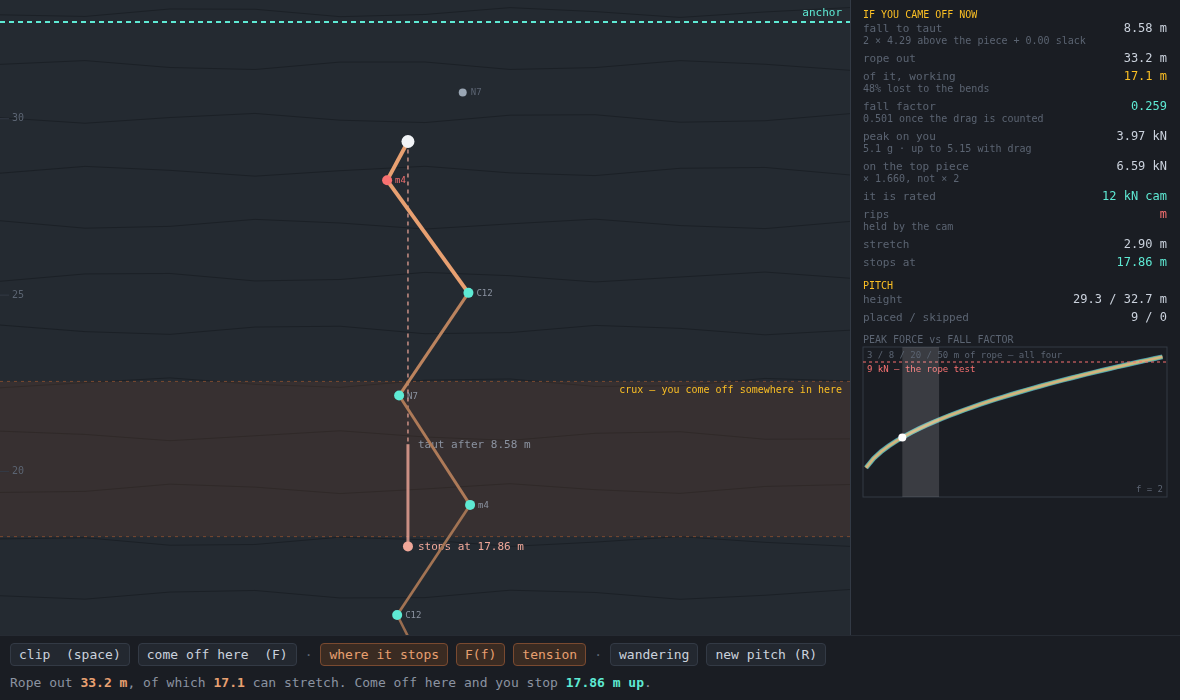
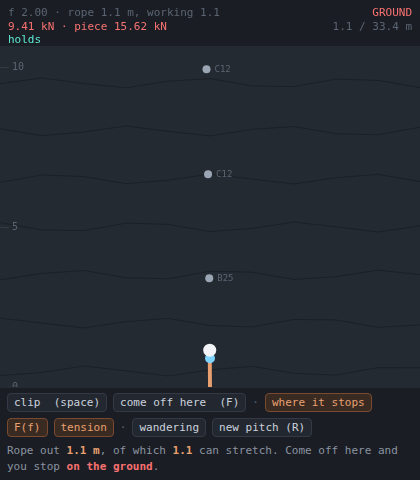
Everyone who leads is handed the same sentence: what matters is the fall factor, not the fall. It is repeated the way folklore is repeated, which is to say correctly and without a reason attached, and it sounds like a slogan about proportion. It is not. It is an exact statement that falls out of one line of algebra, and the reason it is worth having built a simulation for is that the same line quietly predicts three other things nobody says out loud.
One line, and the piece is downstream of it
A rope is a spring whose stiffness depends on how much of it there is. A length
L of rope with modulus c — the force it would take to stretch it to twice
its length, if it survived — behaves as k = c/L. Drop a mass m through a
height h and let the rope arrest it:
m g (h + x) = ½ (c/L) x² and x = F L / cSubstitute the second into the first, divide out L, and solve the quadratic:
F = m g ( 1 + sqrt( 1 + 2 c f / (m g) ) ) f = h / LL is gone. Not approximately, not to leading order — it has cancelled. The
peak force does not know how far you fell. It knows the ratio of the fall to
the rope that has to absorb it, and nothing else.
The integrator agrees, which is the only reason to have one. Five ropes across a thirty-fold range, each dropped on a fall factor of exactly 1:
| rope out | fall | peak force | total distance travelled |
|---|---|---|---|
| 2 m | 2 m | 6.907 kN | 2.59 m |
| 5 m | 5 m | 6.907 kN | 6.47 m |
| 12 m | 12 m | 6.907 kN | 15.53 m |
| 30 m | 30 m | 6.907 kN | 38.82 m |
| 60 m | 60 m | 6.907 kN | 77.64 m |
Zero newtons of spread. The last column is the part the slogan leaves out: the
rope treats those five falls identically and the cliff does not. Stopping
distance is F·L/c, which is the one place L survives, so the 60 m fall
travels 30× as far while being, to the rope, the same event. That is the whole
shape of the danger. Force is a ratio; ground is a distance; they are different
questions and the folklore answers only the first.
What the ratio buys you
| fall factor | on the climber | in g | on the top piece |
|---|---|---|---|
| 0.25 | 3.92 kN | 5.0 | 6.51 kN |
| 0.50 | 5.15 kN | 6.6 | 8.55 kN |
| 1.00 | 6.91 kN | 8.8 | 11.47 kN |
| 1.50 | 8.26 kN | 10.5 | 13.72 kN |
| 1.77 | 8.90 kN | 11.3 | 14.78 kN |
| 2.00 | 9.41 kN | 12.0 | 15.62 kN |
Four times the fall factor is 1.76× the force, not four times, because the factor sits under a square root. That flatness is why a rope catches anything at all, and it is also why the fall factor is a bad control knob: doubling your runout barely moves the number you were worried about, while moving the number you were not.
The last column is the first thing the folklore gets wrong out loud. The rope
turns 180° through the top piece, so that piece carries the climber’s side plus
whatever comes back up the belayer’s side, and everyone rounds this to 2×. Rope
over an anodised carabiner runs at about 66% efficiency through a half-turn;
the capstan relation T_low = T_high · exp(−μθ) turns that one measured number
into a coefficient, μ = 0.1323, that covers every other angle. So the top
piece sees
F · (1 + 0.660) = 1.660 FNot 2. And 0.660 is about to do considerably more damage than a 17% correction.
The rope you have is not the rope that works
Here is the thing no one mentions, and it is the same exponential.
Every bend the rope takes costs tension. A segment carrying ηT stretches by
ηT·L/c rather than T·L/c, so the rope that actually participates in
arresting you is the sum of the segments weighted by the tension that reaches
them:
L_eff = Σ L_j · exp(−μ · Θ_j) Θ_j = the total turn above segment jRun that on a dead straight pitch — eight pieces, no wandering, the rope going up the fall line like a plumb bob — and it still reports 69%. There is only one bend on a straight route, and it is the unavoidable one: the 180° at the top piece, which discards a third of everything below it. Your 26.4 m of rope out is 18.2 m of rope that can stretch.
Now let the route wander, which is what routes do:
| lateral offset | rope out | working | fall factor, nominal | effective | peak |
|---|---|---|---|---|---|
| 0.00 m | 26.4 m | 18.2 m (69%) | 0.182 | 0.263 | 4.00 kN |
| 0.35 m | 27.0 m | 16.1 m (60%) | 0.178 | 0.298 | 4.19 kN |
| 0.70 m | 28.7 m | 15.2 m (53%) | 0.168 | 0.317 | 4.29 kN |
| 1.10 m | 31.6 m | 15.1 m (48%) | 0.152 | 0.318 | 4.30 kN |
Read the two factor columns against each other, because they move in opposite directions. Wandering makes the rope path longer, so the nominal fall factor — the one you can compute, the one in the book — goes down, 0.182 to 0.152. And the fall gets worse, 4.00 kN to 4.30. The extra rope you gained by traversing is rope behind four bends, and it is not coming.
This is the mechanism under “rope drag,” which climbers experience purely as the rope being heavy to pull. It is the same friction, measured on the other side of the event: the drag you feel on the way up is the exact quantity of your rope that has been excused from catching you.
The belayer is the shock absorber. The device is not.
Two more things are widely believed to soften a catch, and the simulation ranks them in the opposite order to the received wisdom. A factor-1 fall, 80 kg, 20 m of rope, against a rigid anchor and then against a belayer who is merely standing there:
| belayer | peak force | lifted |
|---|---|---|
| anchored solid | 6.91 kN | — |
| 90 kg | 5.84 kN (−15%) | 0.74 m |
| 75 kg | 5.61 kN (−19%) | 0.86 m |
| 60 kg | 5.30 kN (−23%) | 0.99 m |
| 45 kg | 4.87 kN (−29%) | 1.12 m |
A body that is free to leave the ground is worth up to 29%, for nothing, from a belayer doing nothing deliberate at all. And the lighter they are the softer the catch — which is the same fact that makes a light belayer the one who arrives at the first piece of gear at speed. There is no version of this where the lightest belayer is not both the best catch and the one in danger.
Against which, the thing belayers are actually coached to do — let rope run through the device:
| rope allowed through at 2.6 kN | peak force |
|---|---|
| none | 6.91 kN |
| 0.25 m | 6.82 kN |
| 0.50 m | 6.73 kN |
| 1.00 m | 6.55 kN (−5.2%) |
A full metre of rope fed through a device under load buys 5.2%. The belayer’s own 60 kg, doing nothing, buys four times that. The soft catch is not a technique of the hands. It is a fact about mass, and the technique is mostly permission to be lifted.
The clip, which is the only thing you control
Everything above happens to you. The one verb in the game is when to clip, and it is a genuine dilemma because both halves of it cost ground clearance.
Standing below a piece at 9 m with your last one at 6 m: you can clip now, which means pulling the rope up to it and holding a reach of slack; or you can climb until it is at your waist, which means climbing further above the thing that would catch you.
| your stance | reach | holding on, you stop at | mid-clip, you stop at |
|---|---|---|---|
| 7.8 m | 1.20 m | 2.82 m | 1.26 m |
| 8.1 m | 0.90 m | 2.38 m | 1.21 m |
| 8.4 m | 0.60 m | 1.94 m | 1.17 m |
| 8.7 m | 0.30 m | 1.51 m | 1.12 m |
| 9.0 m | 0.00 m | 1.08 m | 1.08 m |
Two columns descending at different rates, and they meet at the bottom. The clip is always the more exposed instant — reaching 1.2 m for it costs 1.56 m of clearance right then — but waiting costs 1.73 m of clearance permanently, and by the time the piece is at your waist you are worse off (1.08 m) than you would have been mid-clip 1.2 m lower down (1.26 m). The moment everybody is frightened of is real and it is also the cheaper of the two.
What the force column is for
A pitch of bolts would end the piece here, because bolts do not care: 25 kN
against a factor-2 maximum of 15.62. So the game is a trad pitch, and the gear
holds what real gear holds — cams at 12 kN, wired nuts at 7, brass micros at 4.
Now 1.660 F is not trivia. Inverting the closed form gives the fall factor at
which each thing on the rack reaches its rating:
| placement | rated | comes out above a fall factor of |
|---|---|---|
| brass micro | 4 kN | 0.055 |
| wired nut | 7 kN | 0.303 |
| cam | 12 kN | 1.110 |
| bolt | 25 kN | 5.51 — which a single rope cannot reach |
A micro comes out in essentially any fall at all; a bolt cannot be pulled by this rope at any fall factor, because the ceiling is 2. That gap is the entire difference between the two sports, and it is four numbers.
And when a piece comes out, the fall does not stop. It is arrested by the next
one down — from a lower anchor, so a longer fall, on barely more rope, so a
higher factor than the one that just failed. The cascade is not a special case
in the code; it is a while loop around the same three lines, and it explains
itself: each failure makes the next arrest harder than the one that failed.
Once started, there is no reason for it to stop.
Except that it never does. Across 9 466 falls — every fall height, in 5 cm steps, on 24 pitches — with the rack in the order a climber would place it:
| rack | rips a piece | rips two | reaches the ground |
|---|---|---|---|
| as placed — solid low, thin high | 15.2% | 0.0% | 9.6% |
| reversed | 24.5% | 16.6% | 30.3% |
Same routes. Same falls. Same pieces, same ratings, same physics. The only thing changed is which end of the rack they are on, and the ground-fall rate triples.
The reason is the whole point of the loop above: with the solid gear low, a piece that rips hands the fall to something stronger, and the cascade dies on its first step. Reverse it and every failure lands on something weaker than the thing that just proved insufficient. “Good gear low” is taught as a rule about the consequences of the first piece failing. It is really a rule about monotonicity, and it is worth more than the rack is.
Four beliefs about when to clip
The game layer is thin on purpose: climb the pitch, and somewhere in a crux band you can see, at a height you cannot, you come off. Nothing in it knows any of the physics above except through one function. So the measure script replays every route under four policies and takes the fall at every height, not at the one the route happened to pick — the exposure profile of a belief rather than the luck of a run. 24 pitches, 9 466 falls each:
| belief | reaches the ground | rips gear | mean force | mean clearance | clips |
|---|---|---|---|---|---|
| clip it the moment you can reach it | 3.5% | 6.8% | 2.38 kN | 14.3 m | 6.42 |
| wait for your waist | 9.6% | 15.2% | 3.92 kN | 11.6 m | 6.08 |
| clip early while the ground is reachable | 3.5% | 14.0% | 3.24 kN | 12.2 m | 6.08 |
| clip early while a fall would deck or rip | 3.6% | 6.8% | 3.13 kN | 13.0 m | 6.17 |
Waiting for the waist — which is the comfortable, efficient-feeling habit, and the one that saves 0.34 clips a pitch — reaches the ground 2.7× as often and rips gear 2.2× as often.
The interesting row is the third. Reasoning carefully about the ground gets the ground-fall rate exactly right — 3.5%, identical to clipping everything on sight, which is the best anyone does. And it still rips 14.0%, barely better than not thinking at all. You cannot protect the gear by thinking about the ground, because they are different quantities: clearance is a distance and failure is a force, and above the deck zone the distance stops mattering while the force does not. The fourth belief is the third one with the force column added, and it recovers the entire gap for 0.09 extra clips a pitch.
What is physics here, what is measured, and what is neither
- Derived:
F = mg(1 + sqrt(1 + 2cf/mg))and the cancellation ofL;x = FL/c; the capstan propagation of tension through every bend and theL_effthat follows from it; the1 + ηload on the top piece; the two-body catch with the belayer as a second mass over a frictional pulley; the zipper, which is just the arrest applied to its own output. - A measured input: the 66% efficiency of rope over a carabiner at 180°,
which is a published measurement and the source of
μ = 0.1323; the gear ratings, which are what is stamped on the gear. The rope modulus,c = 23 500 N, is calibrated to one point — a rated impact force of 8.90 kN at the standard drop, 80 kg on a fall factor of 1.77 — and not fitted to make anything else come out nicely. - The one honest asymmetry. Every bend both stiffens the system (less
rope working, which raises the force) and dissipates energy in friction
(which lowers it).
ropeLengthsmodels the first and not the second, so the drag-corrected number is an upper bound rather than an answer. The demo draws both ends of that band instead of a single figure it cannot justify, and the game — including every zipper above — runs on the nominal factor, which is the optimistic end. A real rack does worse than this piece says. - Deliberately not modelled: rope ageing and the fact that a real rope is nonlinear and rate-dependent, which is why the standard drop is rated in number of falls and not just force; knots, which absorb a little; the belayer hitting the wall, which is capped here at 2.5 m of lift and is in reality an injury rather than a boundary condition; and the climber as anything other than a point mass, which is a polite way of saying that 12 g through a harness is reported as a number and not as what it is.
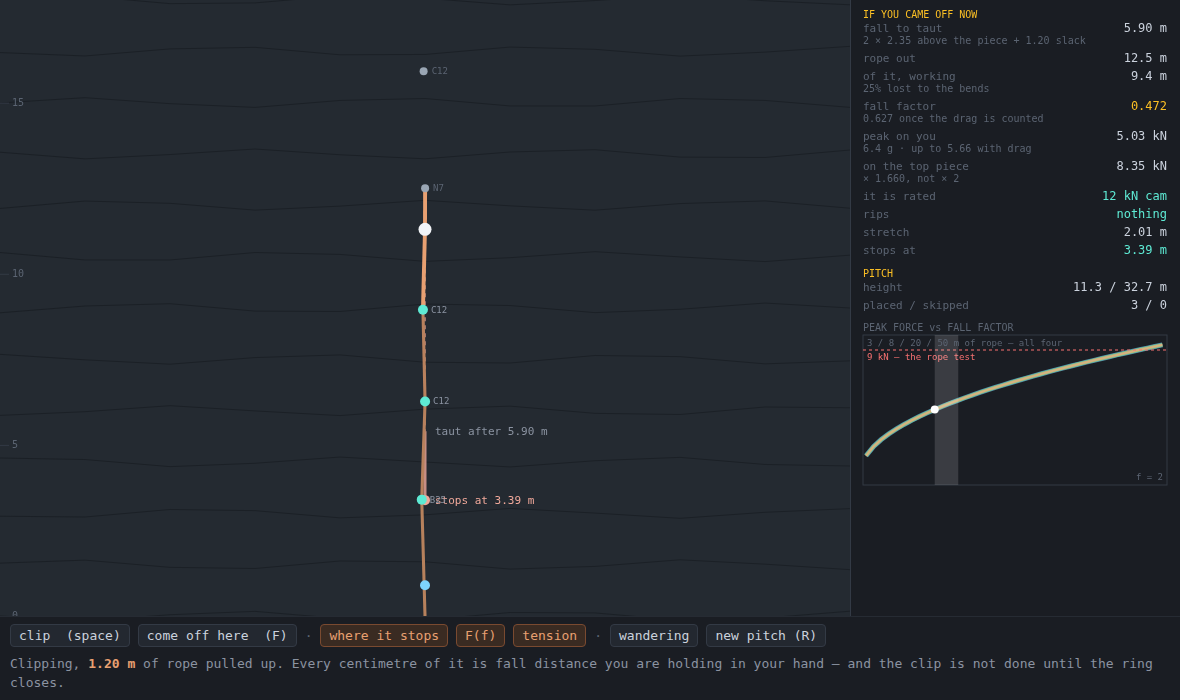
- A route, not a cliff: the wall is flat, so a fall is a vertical drop with no ledges in it. Ledges are what actually hurt people, and they are exactly the hazard this model’s “stops at 3.39 m” cannot see.
Reuse
src/paidout.mjs is framework-free, has no DOM in it, and is SI throughout.
peakForce(f, m, c)/factorForForce/elongation(F, L, c)— the closed forms. If you want the physics and not the game,peakForceis four lines and is the only one you need.capstan(θ, μ),REDIRECT,anchorLoad(F, η)— tension through bends.ropePath/ropeLengths/fallGeometry— the geometry. Note thatfallGeometrycomputes lengths from the standing shape and bend angles from the fallen shape: the rope out is fixed when you come off, but the 180° at the top piece only exists once you are below it. Getting that backwards makes a straight route report a bend at every runner.catchFall(opts)— the two-body integrator, at 20 µs steps, with optional belayer mass and device slip.lengthCollapse,factorLadder,dragLadder,belayerLadder,slipLadder,clipWindoware the studies; every table above is one of them called once.makeRoute/newGame/stepGame/resolveFall— the game as a pure state machine, so a player and an autopilot run the same code.PILOTS,exposureProfile,scorePilotsandzipperStudyare what score it.
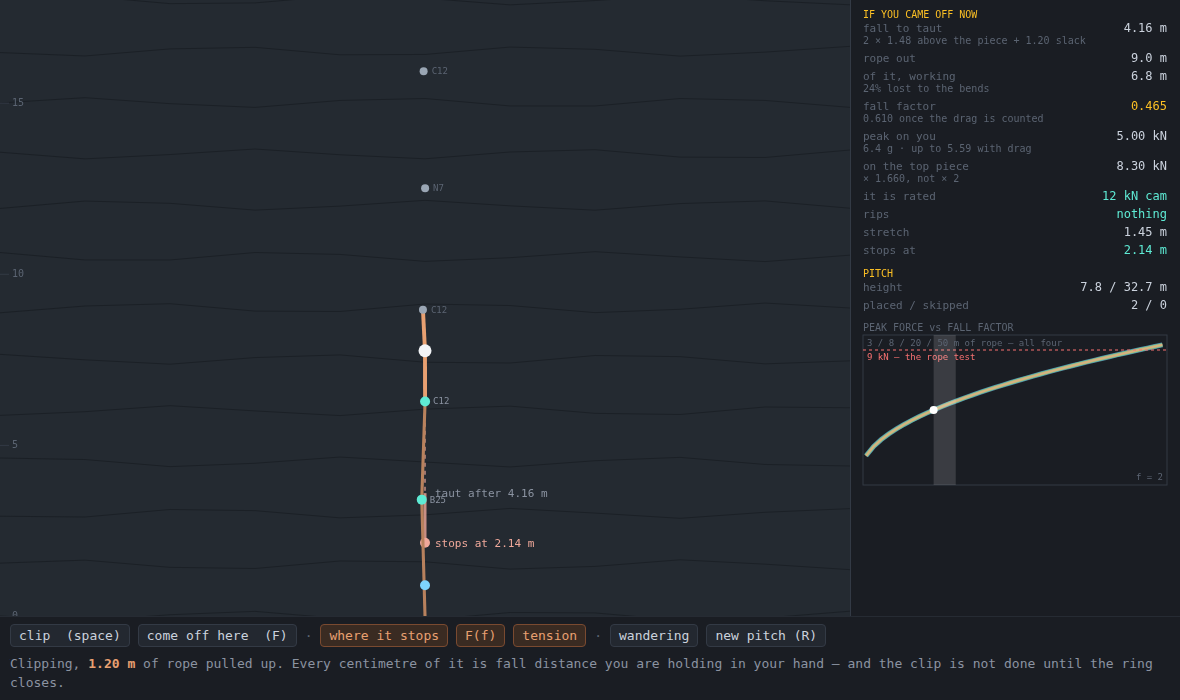
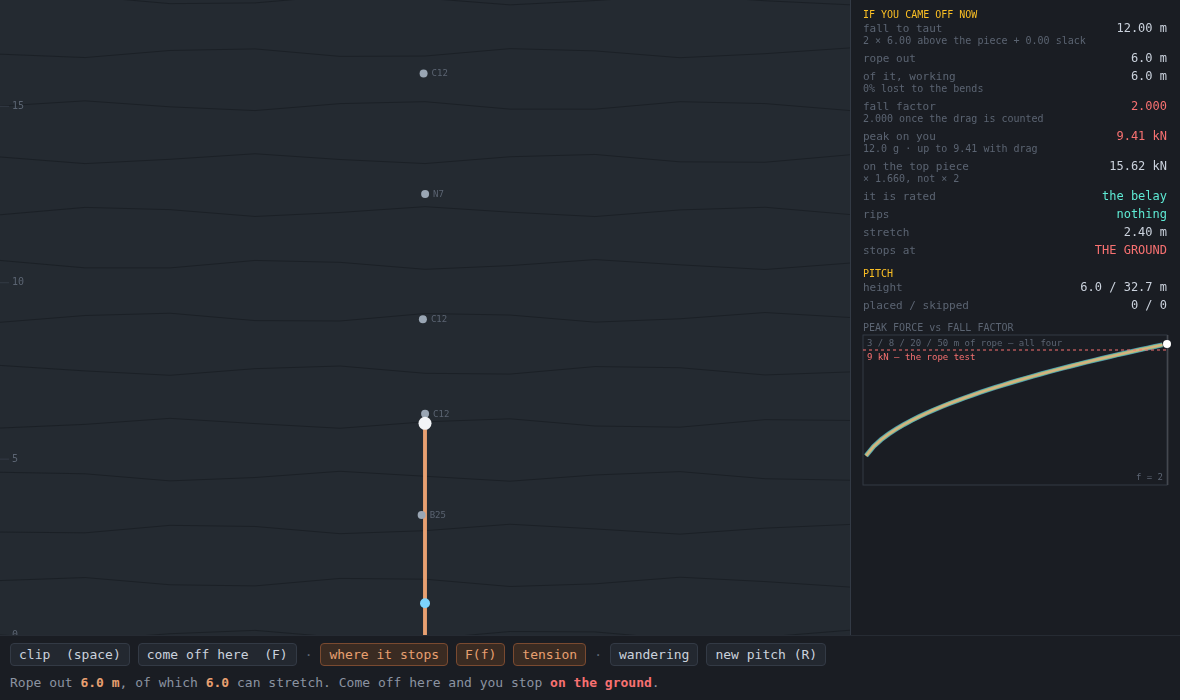
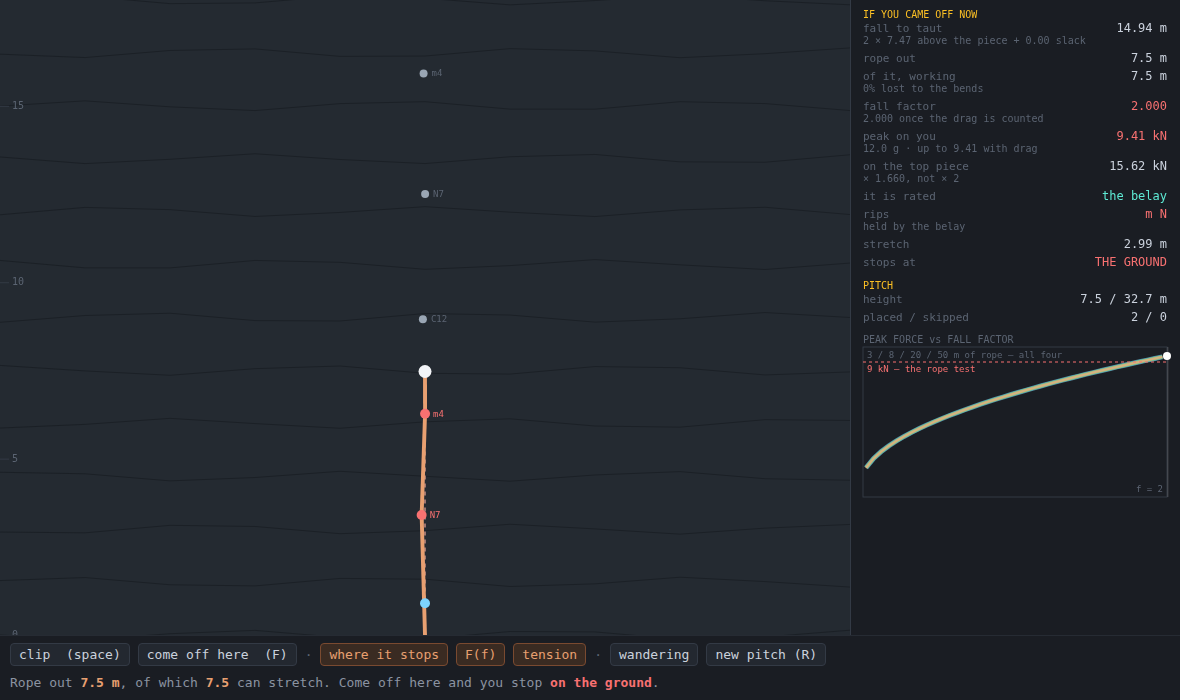
The demo is demo/index.html with its own copy of the module (ADR-0002): space
or tap to clip, F to come off wherever you are standing, R for a new pitch.
The rope is drawn at the brightness of the tension that reaches it, so the
dimming down the wall is L_eff; placements light red when the fall you would
take right now would pull them.
Port notes for DragonRuby: peakForce and resolveFall are pure arithmetic and
translate directly. Two things bit me and will bite anyone. catchFall’s
termination — the first version ran to a fixed horizon and reported a 45 kg
belayer being lifted 54 metres, because nothing stopped integrating at the
bottom of the catch. And the bend angle: the deflection at a runner is the angle
between the two strands’ directions, not π minus it. With the sign flipped, a
dead-straight pitch reported a 180° bend at every piece and claimed 30% of the
rope was working, which is wrong in a way that looks plausible right up until
you notice it does not change when you straighten the route.
The harness
node scripts/screenshot-demo.mjs boots the demo in a real Chromium,
regenerates thumb.png and media/, and asserts 50 claims against the
running page, exiting non-zero if any stops being true. Every number above is in
there: the 0.000 N of spread across a thirty-fold range of rope, the integrator
matching the closed form at five lengths, the 66% redirect and the 1.660 that
follows, the 69% of a straight pitch, the sign flip between nominal and
effective factor on a wandering one, all five belayers, the 5.2% that a metre
through the device is worth, both clip-window columns and the fact that they
cross, the 0.0% against 16.6% of the reversed rack, all four beliefs, and a
whole pitch played out through the demo’s own step function.