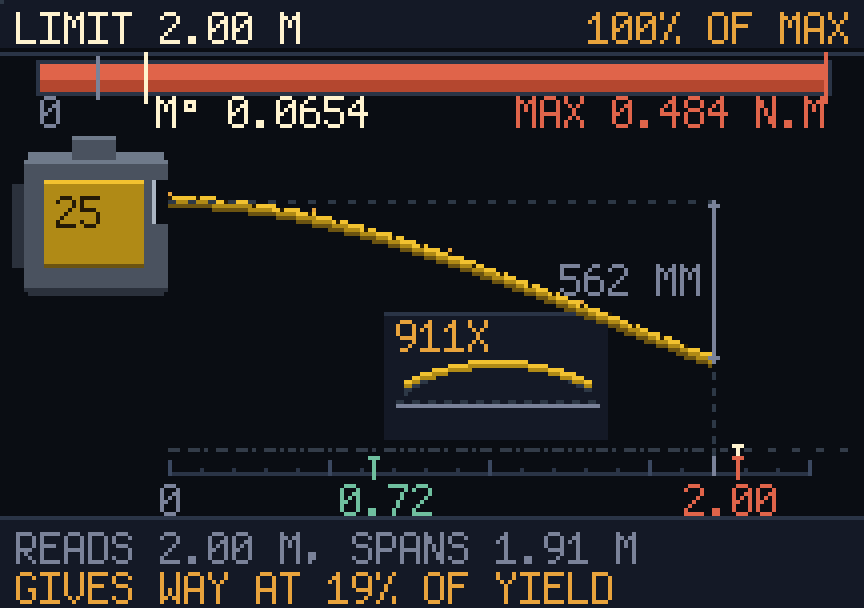






Pull a tape measure out across a room and it holds itself up — two metres of steel 0.13 mm thick, cantilevered off your hand, with nothing underneath it. Pull a little further and it does not sag a little further. It collapses, all at once, and then it is a rag. Push it back out and it stays a rag. You have to wind most of it back into the case before it will stand up again.
Everybody who owns one knows this. The sprite is why.
The arch is the tool
The blade is not flat. It is rolled to a shallow transverse arc — here 25 mm of width wrapped onto a 20 mm radius, subtending 71.6° — and that arc is the entire mechanism.
Flat, the strip’s second moment about the axis it has to bend around is
I_flat = b t³ / 12 = 0.00458 mm⁴Arched, about its own centroidal axis, it is 4.168 mm⁴. Same steel, same amount of it, bent cold into a curve you can flatten between finger and thumb:
×911
That is what you are holding up when you hold a tape measure out. Not strength — shape. The inset in the sprite draws both sections to the same scale, the arch in gold and the developed strip beneath it as a dashed line, because the whole argument is that those two things are made of the same steel.
And it has exactly two states
A cylinder is a developable surface: you can roll it from flat paper, so its Gaussian curvature is zero everywhere, and nothing a thin shell does to itself can change that. The product of the two principal curvatures has to stay zero.
So the blade cannot be curved across and along at the same time. Either it keeps its arc and carries its 4.168 mm⁴, or the section flattens and the longitudinal curvature is free — and then it is a hinge with 0.00458 mm⁴, which is to say no hinge at all, which is to say a hole in the beam.
There is no shape in between. That is why it does not sag gracefully. It stands, and then it folds, and the transition is a snap because the geometry offers nothing to pass through on the way.
What a fold costs, in two lines
The blade’s unstressed state is κlong = 0, κtrans = 1/R — it was made curved. Measure plate bending energy from that state and a flattened fold of longitudinal curvature κ costs, per unit area,
U(κ) = (D/2) [ (κ − 1/R)² + 2(1−ν) κ/R ], D = E t³ / 12(1−ν²)A fold that travels along the blade without changing shape turns b·U of energy into κ of rotation per unit length, so the moment holding it open is M = b U(κ) / |κ|. Minimise that over κ and the stationary point is
κ = 1/R exactlyfor any b, t, E, ν. The fold’s longitudinal radius is the blade’s transverse radius — the thing it is folding out of sets the radius it folds into. Substitute back, with b = αR, and the moment falls out in one line each way:
M*  =  D α (1 + ν)   = 0.06539 N·m     bending against the arc
M*  =  D α (1 − ν)   = 0.03521 N·m     bending with it
Two of the standard tape-spring results out of one minimisation, and the ratio between them is 1.8571 = (1+ν)/(1−ν) — pure Poisson. No b, no t, no R. Drag the radius and width sliders in the demo as far as they go and that number does not move.
Which way up, and why it matters
Held out horizontally the blade sags concave-up while its section is convex-up, so standing out is the opposite-sense case: the strong one, 0.06539 N·m. Roll the tape over and the same blade is working against 0.03521 N·m, and the weak side has essentially no snap-through reserve — it gives way at M*.
arch up      2.000 m
rolled over  0.530 m        a factor of 3.77, for turning it over
That is the flip loop, and it is the whole reason a tape measure has a right
way up. The inset draws the section upside down for it, which is the only thing
in the picture that changes.
The number that is not derived
The peak moment the arch survives before it snaps through is a shell buckling problem, and the energy argument above cannot reach it. It is the one number here taken from the world: a 25 mm blade is sold on about 2.0 m of standout, which pins
M_max = 0.4843 N·m = 7.406 × M*The sprite’s root moment comes from a large-deflection elastica rather than wL²/2, because at full standout the tip is 562 mm below the hand and small deflections are not what this is. Worth saying: all that drooping relieves the root moment by only 3.23% (0.4843 against 0.5004). The droop is where there is no weight left outboard of it.
The demo lets you change the blade, and what it holds fixed when you do is that reserve of 7.41, not the 2.00 m — both the peak and M* scale with Dα, so the ratio is the portable part and the standout is a consequence. Thicken the blade to 0.16 mm and it stands out to 2.57 m. Flatten the arc to R = 30 mm and it drops to 1.64 m.
The hysteresis
Here is the thing nobody is told.
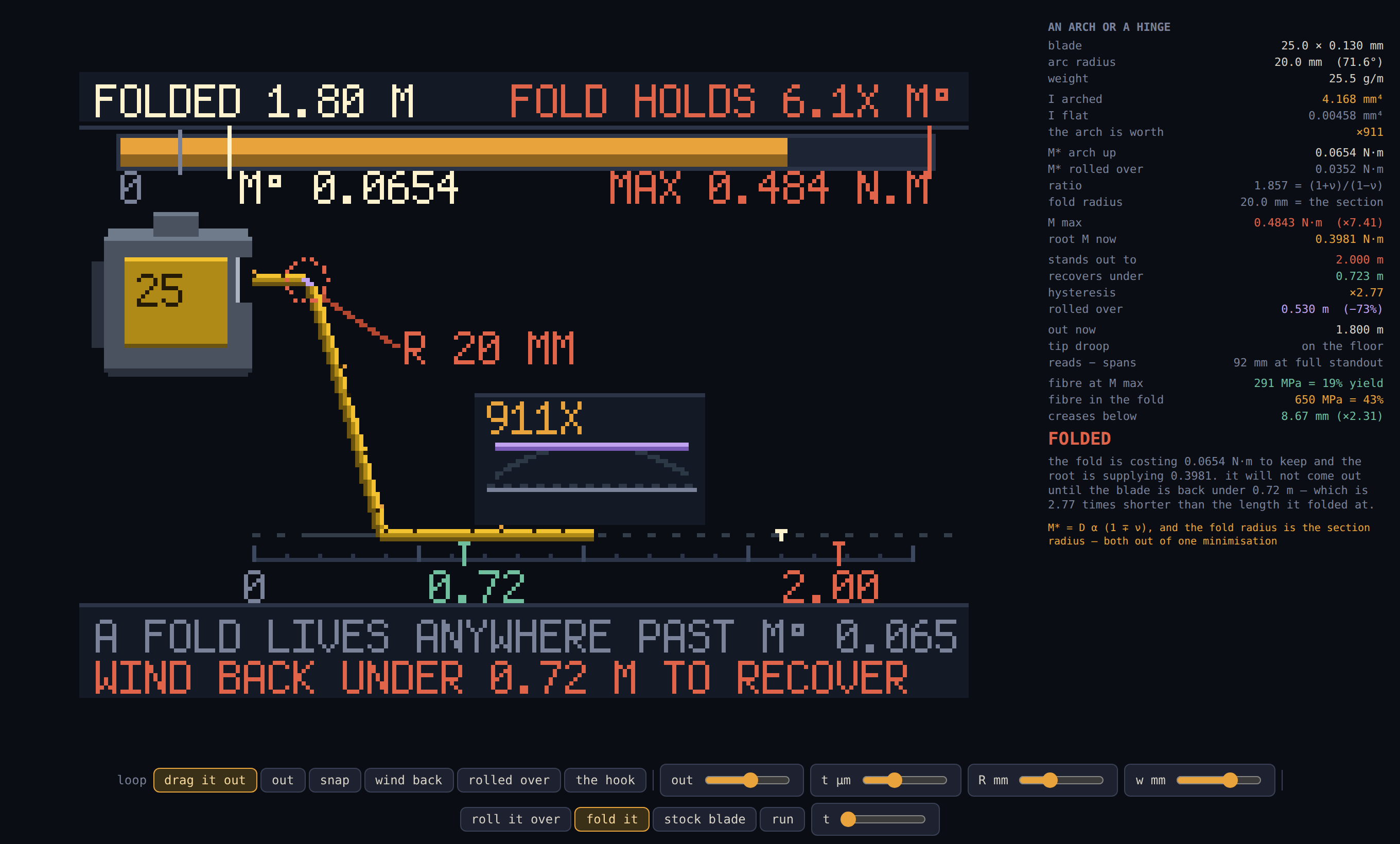
The blade folds when the root moment reaches M_max. A fold, once it exists, survives anywhere the moment exceeds M*. Those are different numbers by a factor of 7.41, and the moment goes as roughly the square of the length, so:
| length | root moment | |
|---|---|---|
| folds at | 2.000 m | 0.4843 N·m |
| a fold still lives at | 1.000 m | 0.1251 N·m — still 1.9× M* |
| stands up again under | 0.723 m | 0.0654 N·m |
×2.77. It collapses at two metres and will not recover until seventy-two centimetres. (The square root of the reserve is 2.72; the extra 1.7% is the large-deflection relief, which helps the long blade and not the short one.)
That is the back loop, and it is the one to watch: the blade winds in, the
meter’s fill slides down from red through orange, the fold holds and holds and
holds at 2.3× M*, 1.9×, 1.4× — and then the bar crosses the line and it stands.
Pushing it back out is not the inverse of pulling it in, because the state you
are in is not a function of the length.
It is not strength that runs out
At M_max the extreme fibre — which is an edge, 2.504 mm from the centroid, not the crown at 1.277 — is at 291 MPa. Spring steel yields near 1500. The blade gives way with four fifths of its strength unused, because what runs out is the shape.
The fold itself is at E t / 2R = 650 MPa, 43% of yield: high, elastic, recoverable, fine. A crease is not. Yield needs a fold radius under
r_crease = E t / 2 σ_y = 8.67 mmand the fold the geometry chooses is 20 mm. A tape measure survives being folded and dies of being kinked, with a margin of 2.31 between the two — which is why the blade comes back from a collapse unharmed and never comes back from being shut in a car door.
And the hook is loose on purpose
Everyone has noticed that the end hook rattles. It is not worn and it is not a defect: its rivets ride in slots with exactly the hook’s own thickness of travel, 1.15 mm.
Hook it over the end of a board and the board bears on the hook’s inner
face. Butt it into a corner and the wall bears on the outer face. Those two
faces are one hook thickness apart, the slot is one hook thickness long, and so
the printed zero lands on the bearing surface either way. The hook loop
draws both measurements at once against one datum, and drags the slop out of
them: at the loose end both readings are wrong by 1.15 mm in opposite
directions, and two pieces cut from them miss each other by 2.30 mm.
A tight hook would be a systematic error — same size, same sign, every time, which is the kind nobody catches.
One more, free
The scale on the blade measures the blade. At full standout the tape reads
2.000 m and the distance it actually spans is 1.907 m: it is 93 mm of
arclength draped through a 562 mm droop. The dashed drop-line in the out loop
lands that 93 mm short of the red mark, every time. Pull it tight or lay it
down.
The loops
| loop | frames | what it is |
|---|---|---|
out | 8 | 0.42 m to the limit. The meter fills, the droop grows, the fibre never gets near yield. |
snap | 6 | The fold forming at 2.00 m. Twenty millimetres of hinge, called out because at this camera it is a pixel and a half. |
back | 8 | Winding in with the fold still in it, and the moment it stands up at 0.72 m. |
flip | 6 | The same blade rolled over. 0.530 m, and no snap-through reserve to spend. |
hook | 6 | Both measurements, one datum, 1.15 mm of slot. |
Reuse
source/standout.mjs is framework-free and has no DOM in it above the drawing
layer. The mechanics are separable from the sprite:
import { propMoment, foldMoment, archSection, rootMoment, factsFor, TAPE }
  from './standout.mjs';

propMoment('opp');                       // 0.06539 N·m — D α (1+ν)
propMoment('eq');                        // 0.03521 N·m — D α (1−ν)
archSection(TAPE).I / flatI(TAPE);       // 910.7
rootMoment(1.2);                         // 0.1799 N·m, large-deflection
factsFor({ ...TAPE, t: 0.16e-3 }).Lout;  // 2.570 m
elastica(L, {EI, w, P, theta0}) is a general heavy-cantilever solver — it
relaxes the shape until the moment distribution and the deflected lever arms
agree, and it is what every blade in every frame is drawn from. factsFor(tape)
is memoised, which is the only reason the demo can put the geometry on sliders.
Everything drawn is derived. validate() re-proves the load-bearing claims on
every render — that the fold moment really is minimal at κ = 1/R (checked at
four curvatures either side), that it lands on D α (1∓ν) there, that the sense
ratio is independent of R, that the elastica agrees with wL²/2 to 0.2% where
deflections are small, that the calibration round-trips, and that the hysteresis
is the square root of the reserve.
node source/render.mjs regenerates every PNG and reprints every number in this
file. node scripts/screenshot-demo.mjs boots the demo in a real browser,
photographs it, and runs 26 assertions against it — including the full
collapse-and-recover cycle driven through the page’s own length control, and two
that count pixels out of the drawing rather than trusting the model.
Gotchas
- The ribbon is a lie about depth. The arched section is 3.78 mm deep and the blade is two metres long, so at this camera the arch is a third of a pixel. It is drawn three pixels thick. The fold is drawn one pixel thick, in violet, which is the only honest thing about the ribbon: it is the change that is real.
- The resting fold angle is staging, not a result. A collapsed tape ends up with its tail on the floor and the sprite puts it there at 72°. Nothing numeric depends on it — what a fold costs is M*, and M* came out of the energy. The draped length past the floor is laid along it rather than solved as a contact problem.
- The fold is parked 170 mm from the case. The moment is largest at the root, so that is where it buckles; 170 mm is far enough out to draw.
M_maxis calibrated, once. Everything else in the file is derived, and the render script prints both so the distinction stays visible.- The equal-sense standout assumes no reserve. Opposite-sense bending has a
peak well above M* and equal-sense has next to none, so
standoutLength('eq')solves against M* itself. It is the right shape of answer and the least defended number here.