Everyone knows to back off exponentially. The received wisdom draws one client and one server, a wait that doubles, and the moral that a polite client stops hammering a sick dependency. Nothing in that picture is wrong and nothing in it is the problem, because the problem only exists in the plural. A retry storm is a property of a cohort, and a cohort is exactly what a shared failure manufactures: everybody failed at the same instant, so everybody is now holding the same clock.
Doubling a wait does not change that. It changes the period and leaves the phase alone — and the phase is the whole hazard.
So this is a simulator rather than an animation. Sixty clients each need one success from a dependency that is hard-down for three seconds and then healthy with a concurrency limit of 8. The same demand is replayed under five retry policies. That is the entire experimental design, and it buys the one claim worth making.
The control
Every policy completes exactly the same work: 60 admissions, 7.2 seconds of service time, not one request more or less. The dependency is identical, the outage is identical, the cohort is identical. Nothing varies except when clients choose to ask. Across 40 seeds:
| backoff | calls | in recovery | peak /100 ms | dependency idle | all done |
|---|---|---|---|---|---|
| flat retry | 2252 | 452 | 60.0 | 36.8% | 4.5 s |
| exponential | 556 | 256 | 60.0 | 95.8% | 25.6 s |
| equal jitter | 421 | 61 | 8.3 | 41.1% | 7.1 s |
| full jitter | 457 | 61 | 7.7 | 15.7% | 6.0 s |
| decorrelated | 442 | 63 | 9.3 | 19.4% | 6.0 s |
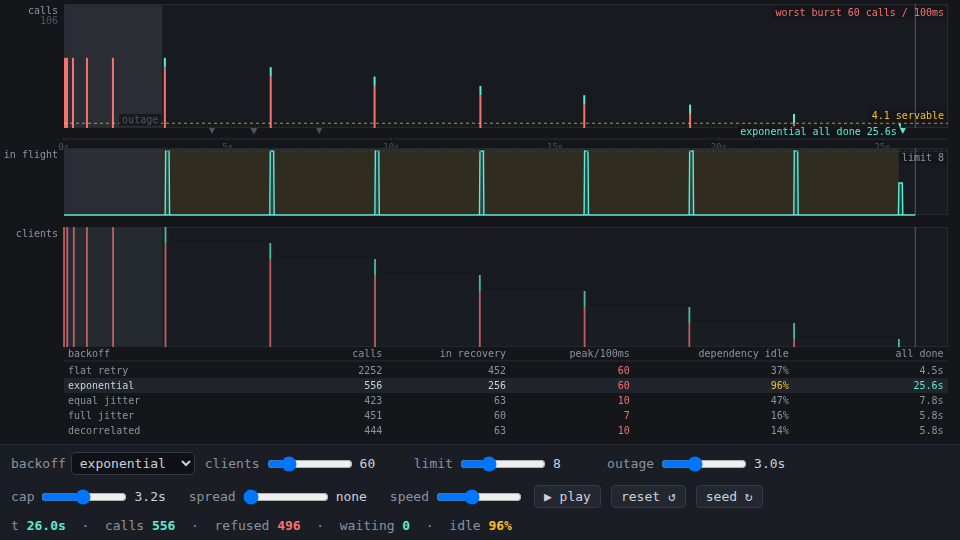
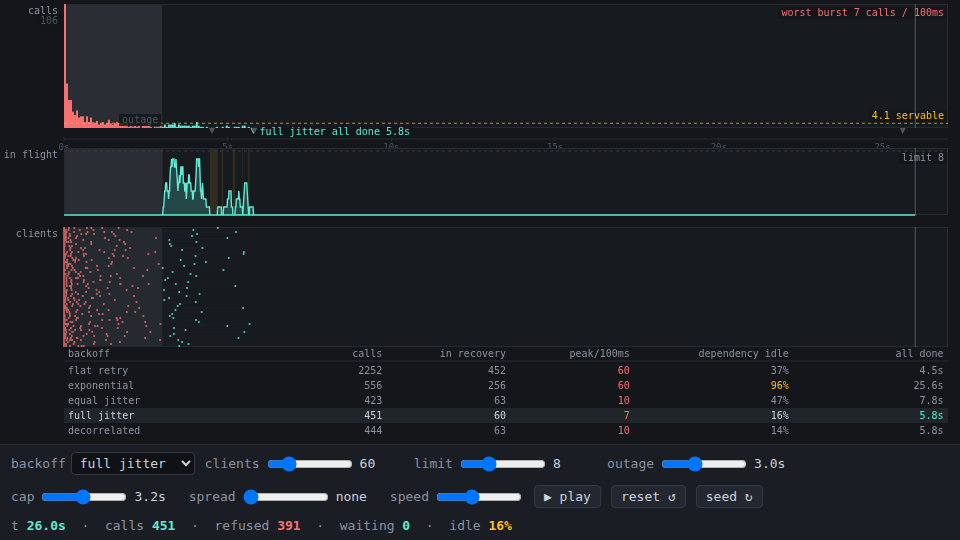
The dependency can serve 8 concurrent requests at 120 ms each, so the entire cohort is 900 ms of work. Exponential backoff turns 900 ms of work into 25.6 seconds, and spends 21.7 of the 22.6 recovery seconds with zero requests in flight. Full jitter spends 61 calls on the recovery — sixty clients, one call each, give or take one — and finishes in 6.0.
Read those two rows together, because the pairing is the point: exponential backoff manages to overload and starve the same machine. Sixty calls land inside one millisecond, which is 7.5× what the dependency could absorb in a hundred. Then nothing for 3.2 seconds. Then sixty again.
Backoff does not de-correlate. It preserves.
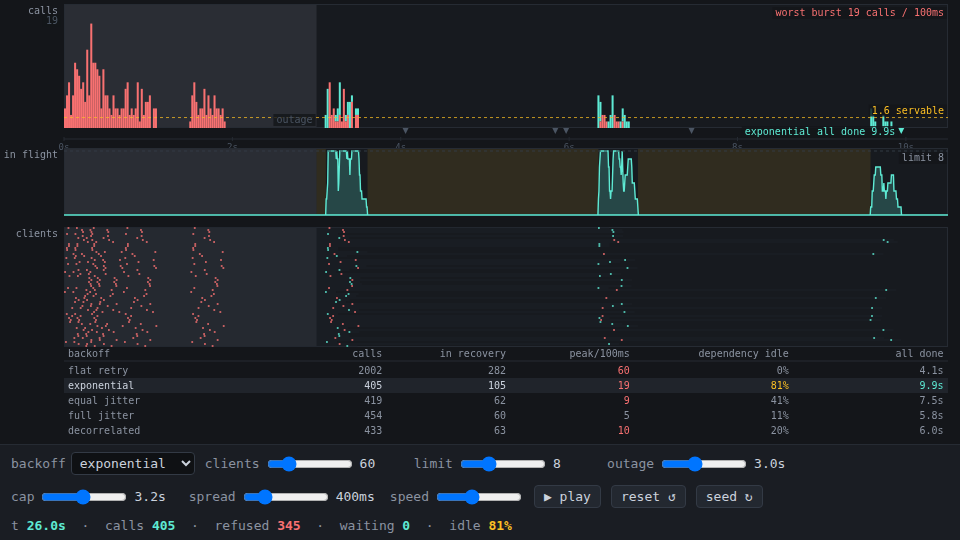
The easiest way to see this is to stop assuming the cohort fails on a single tick. Spread the initial failures over a window and watch what survives (exponential, 40 seeds):
| initial spread | width of the worst burst | peak /100 ms | all done |
|---|---|---|---|
| 0 ms | 1 ms | 60.0 | 25.6 s |
| 50 ms | 49 ms | 60.0 | 25.7 s |
| 200 ms | 194 ms | 35.0 | 17.9 s |
| 400 ms | 387 ms | 20.9 | 11.1 s |
| 1600 ms | 1551 ms | 8.9 | 6.9 s |
The burst is always as wide as the spread it started with. Not approximately — to within 3%, at every setting, after six doublings and a cap. A deterministic wait is a translation: it moves every client in the cohort by the same amount and therefore moves none of them relative to each other. The period grows to 3.2 seconds and the burst stays 49 ms wide forever.
Which is why the fix is not a longer wait. The fix is the only operation that changes relative position, and that is noise.
The dumbest policy is the fastest one
Flat retry — try again every 100 ms, forever, no backoff at all — finishes in 4.5 seconds, sooner than anything else on the board. It costs 2252 calls to do it, five times full jitter’s, and 1800 of those are thrown at a dependency that is hard-down and refusing everything.
This is worth stating plainly because the usual framing has backoff as strictly better behaviour. It is not: backoff buys the dependency protection by spending the client’s latency, and that is a real trade with a real price. What jitter does is make the price reasonable. At a 400 ms cap, full jitter finishes in 4.2 s — faster than flat retry — for 1168 calls; at an 800 ms cap it finishes in 4.5 s, matching flat retry to within 30 ms, for 712 calls. Same recovery, a third of the load.
| backoff cap | exponential | full jitter |
|---|---|---|
| 400 ms | 796 calls · 68% idle · 6.0 s | 1168 calls · 1% idle · 4.2 s |
| 800 ms | 616 calls · 84% idle · 8.8 s | 712 calls · 4% idle · 4.5 s |
| 1600 ms | 556 calls · 92% idle · 14.4 s | 518 calls · 11% idle · 5.0 s |
| 3200 ms | 556 calls · 96% idle · 25.6 s | 457 calls · 16% idle · 6.0 s |
| 6400 ms | never finishes (40/40) | 452 calls · 38% idle · 8.9 s |
A shorter cap mitigates the phase-locked case and never fixes it — the idle fraction is still 68% at the setting where exponential is at its best, because a cohort that sleeps together leaves the machine empty together however briefly it sleeps. And the direction of the cap is a genuine trade for jittered clients and a free lunch for nobody: a tighter cap costs full jitter calls and buys it time.
The outage is not required
Delete it. Start sixty clients at once against a healthy dependency with a limit of 8 and nothing else wrong:
| backoff | calls | peak /100 ms | all done |
|---|---|---|---|
| flat retry | 452 | 60.0 | 1.5 s |
| exponential | 308 | 60.0 | 12.8 s |
| full jitter | 236 | 125.3 | 2.1 s |
| decorrelated | 164 | 60.0 | 1.9 s |
Exponential still takes 12.8 seconds to clear 900 ms of work. The outage was never the cause; it was one way of creating a cohort, and a deploy, a cron minute boundary, a cache expiry or a client library whose clients all started together will do it just as well. Phase comes from a shared event, and failure is only the most memorable kind.
There is an honest caveat sitting in that table, too. Full jitter’s peak here is 125 per 100 ms — worse than exponential’s 60. The first attempt is simultaneous for everybody no matter what policy they hold, because no backoff has happened yet; jitter cannot smooth a burst that precedes it. All it can do is make sure there is never a second one. (Decorrelated jitter looks best on this table because its first wait is already drawn from a range rather than fixed.)
Jitter does not create capacity
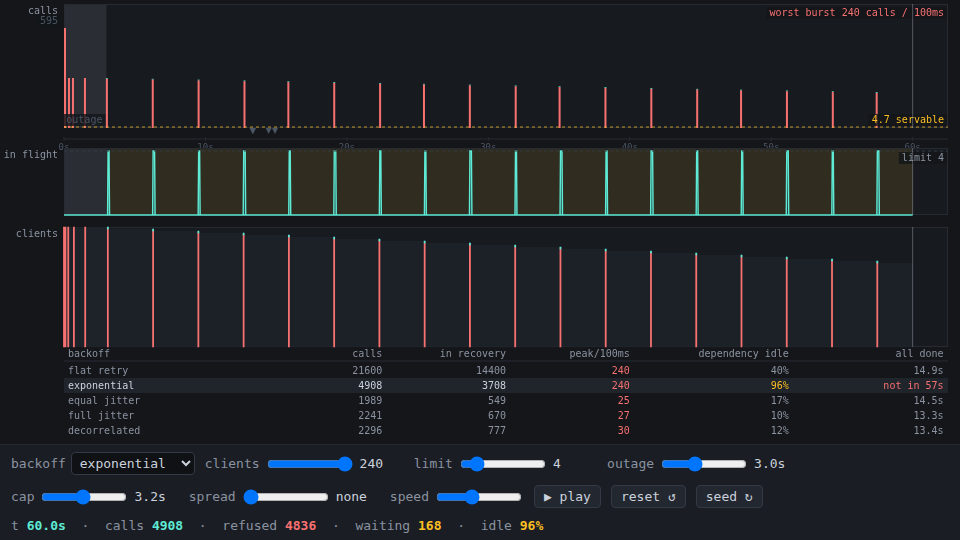
Push it past what the dependency can do — 240 clients against a limit of 4, a floor of 7.2 seconds of unavoidable work (20 seeds, 60-second horizon):
| backoff | calls | peak /100 ms | all done |
|---|---|---|---|
| flat retry | 21600 | 240.0 | 14.9 s |
| exponential | 4908 | 240.0 | never, in 20 of 20 |
| equal jitter | 1997 | 22.8 | 14.9 s |
| full jitter | 2262 | 24.6 | 13.6 s |
| decorrelated | 2329 | 31.1 | 13.3 s |
Every jittered policy lands at roughly twice the work floor, and so does flat retry. Jitter buys nothing in completion time here — the dependency is the constraint and no scheduling of the asking changes that. What it buys is the same 14 seconds for 2262 calls instead of 21600, which is the difference between a saturated dependency and a dependency that is saturated and being asked ten times as often as it can answer.
Exponential, meanwhile, does not recover at all. 168 of the 240 clients are still waiting after a full minute — the same 168 in all 20 seeds — while the machine they are waiting for sits idle 96% of the time.
What’s on screen
Time runs left to right on one ruler, shared by every policy and never rescaled — it spans the slowest policy’s finish, so a run that ends in the first fifth of the panel is making its argument with the empty four fifths. The grey block at the left is the outage. The playhead is a frontier; nothing to its right is drawn.
- calls — attempts per bucket, teal for admitted and red for refused, against a dashed line at what the dependency could actually serve in that bucket. The histogram scale is fixed by the tallest burst any policy produces, so the comparison is in the picture rather than in the axis. The selected run’s own worst burst is labelled, since a flat-looking panel should still have to say its number.
- in flight — concurrency against the limit. The amber wash is capacity
standing unused with work outstanding and nothing wrong: exactly the span the
dependency idlecolumn counts, drawn where it happens. - clients — one lane per client, a mark per attempt, red refused and teal admitted, each lane’s thread going dark when it finishes. Phase is a shape here: vertical stripes under exponential, scatter under jitter.
- the carets on the ruler are every policy’s finish, all five at once, so the comparison never requires remembering a previous run.
- the scoreboard carries all five under the current settings at all times, and clicking a row switches the animation to it.
Notes
src/in-phase.jsis framework-free and has no rendering in it: a dependency that decides, a client that waits, one tick loop over integer milliseconds, andbackoffMs— the five-line function the entire piece is about.sweep()produces every table above.- A refusal is free: it costs the dependency no capacity at all. That is deliberately generous to the policies that generate the most refusals, which is to say the results above are the best case for phase-locked retrying. A real server pays something for every 503 it sends, and the 60-calls-in-one- millisecond row is the one that would degrade first.
- An admitted request always succeeds. The failures here are queueing failures, not bugs, because mixing the two would let a reader attribute the result to flakiness rather than to timing.
- Every number in this write-up is produced by the module and 19 of the claims
are re-checked against the running demo by
scripts/screenshot-demo.mjson every build — including several that assert something is identical or never finishes, since those are the ones that would rot quietly. - Equal jitter spends the fewest calls and finishes a second behind full jitter: its minimum wait is half the exponential, so the last few stragglers are still sleeping 1.6 s at a time when the dependency is wide open. Decorrelated jitter is the best all-rounder on most settings here, which matches the AWS result it is lifted from.