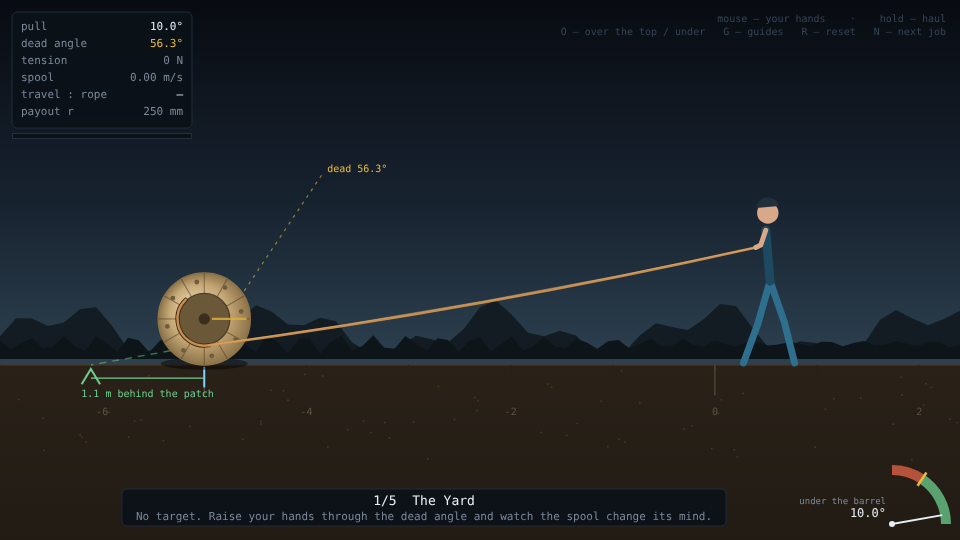
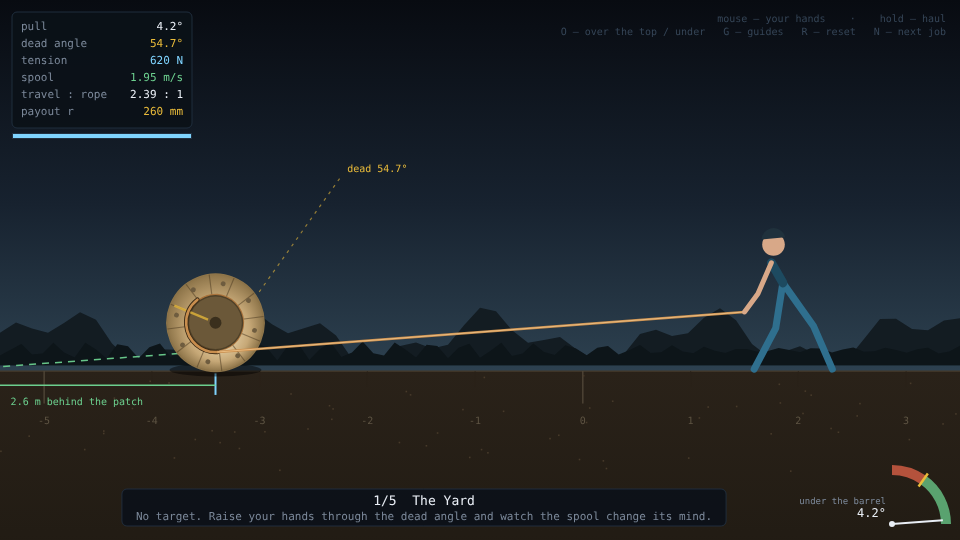
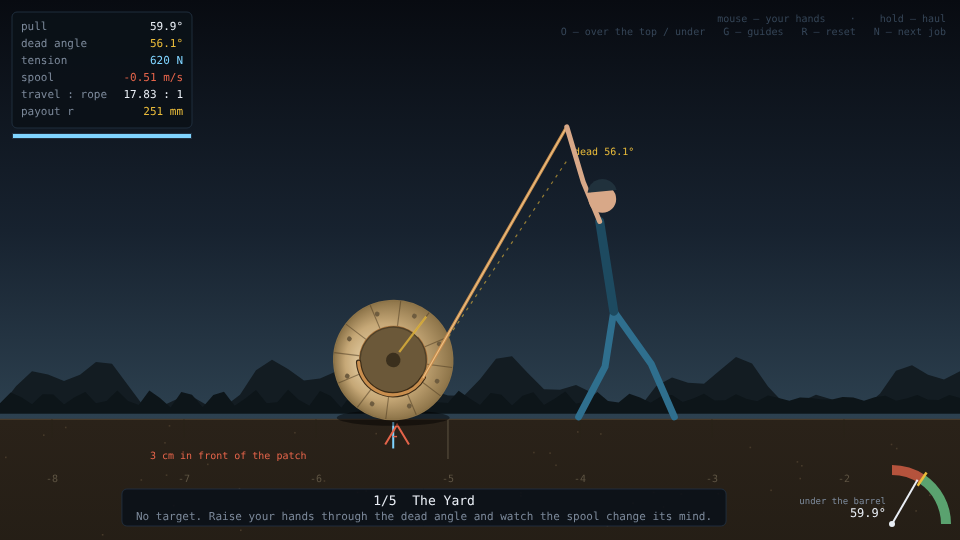
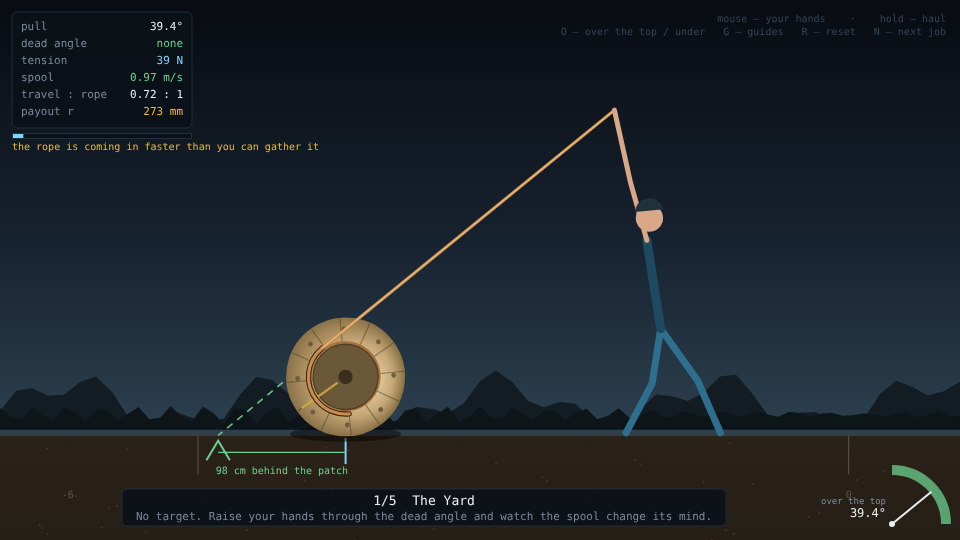
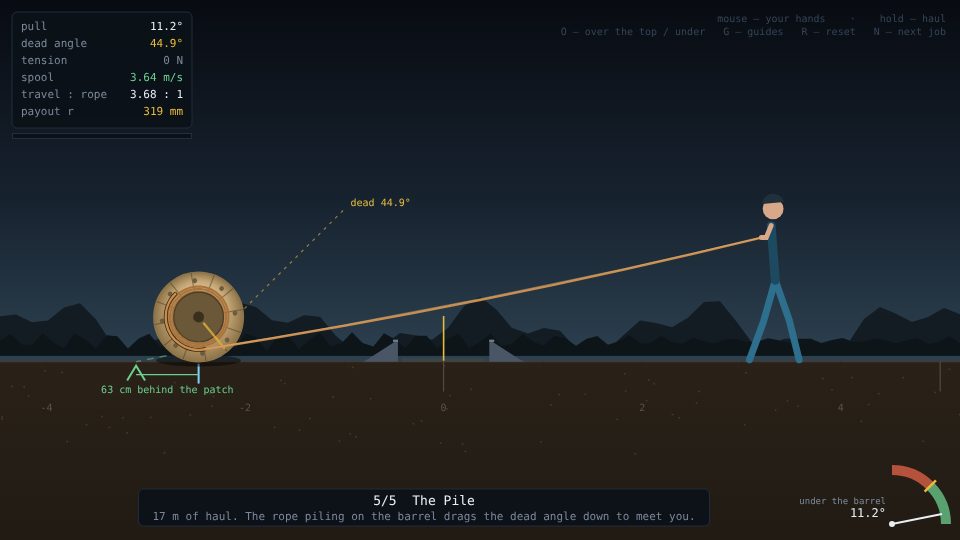
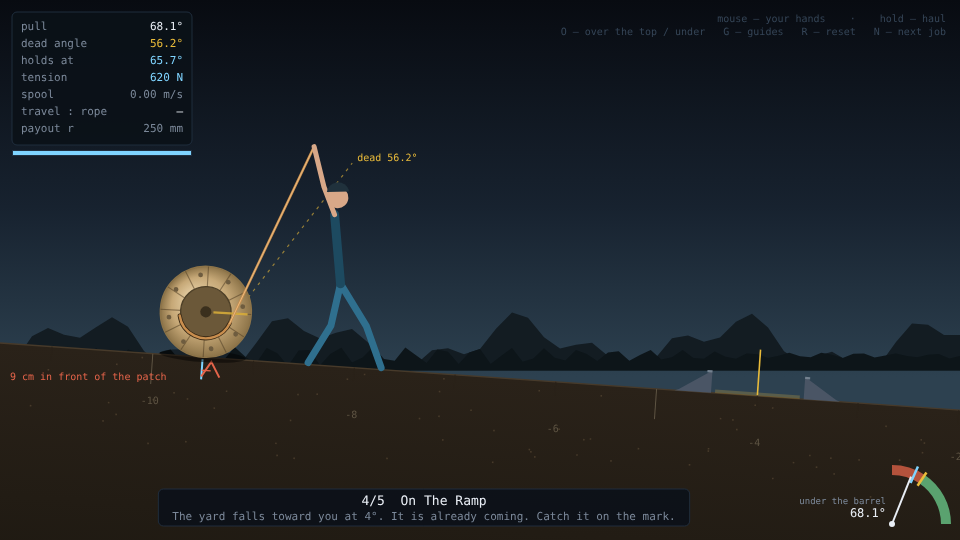
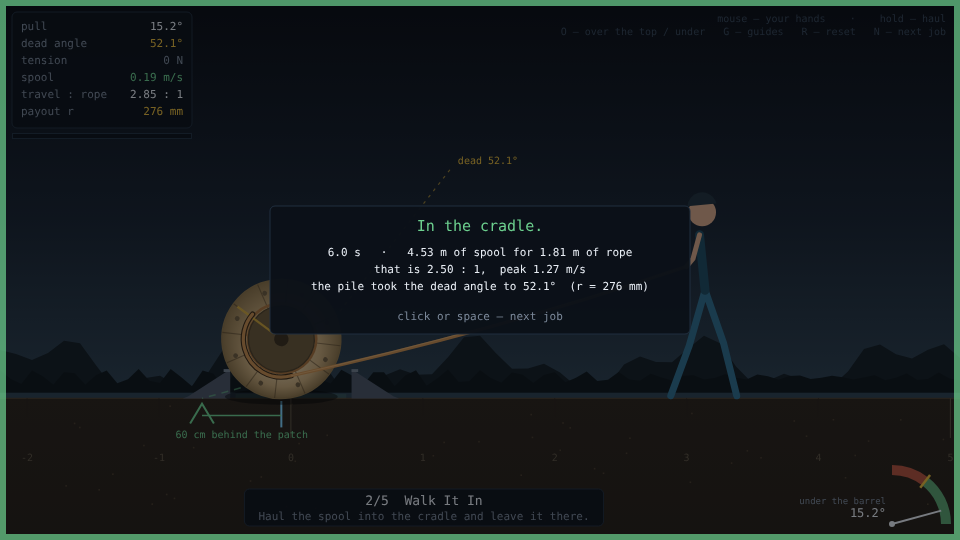
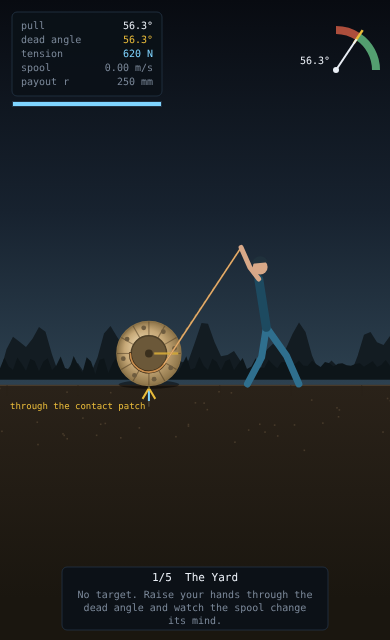
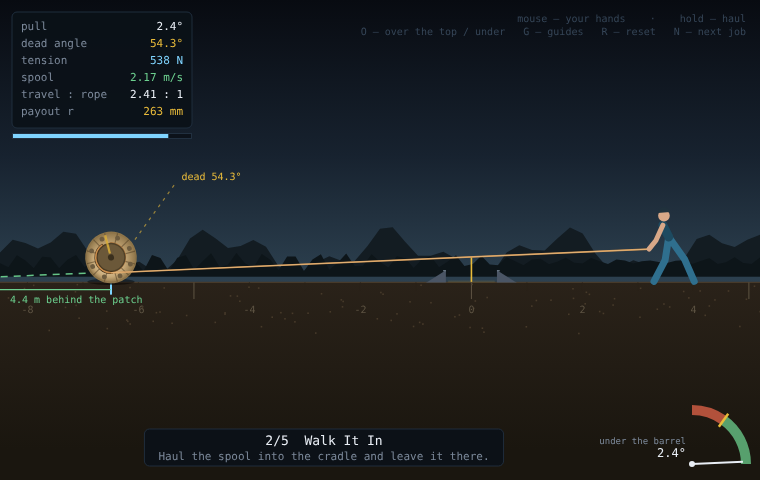
An empty cable spool on its side in a yard, a rope taken round the barrel, and one job: get it where you want it. The only controls are where your hands are and how hard you lean back.
Everyone’s first instinct — pull it up and toward you, because that is how you move anything — is the move that sends it away.
Moments about the ground, not about the axle
Take moments about the contact patch P rather than the axle and the
rope’s contribution is one expression:
M_P = T·(r − R·cos θ)R is the flange that rolls, r is the radius the rope leaves at, θ is the
rope’s elevation. Everything else here is that bracket changing sign.
It is worth being precise about why the axle is the wrong pivot. About the
axle, a rope off the under side always makes the same clockwise torque T·r,
which would say the spool always rolls one way. It does not, because the
friction at the patch also makes a torque, and the two have to be solved
together. Taking moments about the patch does that for you in one line, and the
line says the answer depends on θ.
The dead angle
r − R·cos θ = 0 gives
θd = acos(r/R) = acos(250/450) = 56.25°and that is the only thing the spool’s mass, its inertia, the rope, and the ground have no say in. It is the arccosine of a ratio of two radii.
The demo draws it rather than stating it. Run the rope’s line of action backwards, under the spool, to where it crosses the ground:
- crosses behind the patch → the spool rolls toward you
- crosses in front of it → the spool rolls away
- crosses through it → nothing, at any tension
At the dead angle you can put 620 N into a 130 kg spool and watch the readout sit at 0.00 m/s. That is the thing worth feeling, and it is why the dial has a gold tick on it.
Rolling resistance turns the point into a band. At full haul the spool will not move anywhere between 53.24° and 59.16° — about six degrees wide — which is both a nuisance and the only reason a real rigger can ever hold one still.
You are geared against yourself
The tangent point moves backwards as the spool rolls forwards, so the rope comes in slower than the spool travels. One metre of rope is
R / (R·cos θ − r) metres of spooland the force arriving at the ground is the reciprocal of that times what you pull. The gearing is not a bonus; it is the same fact as the dead angle, written as a ratio instead of a sign.
| θ | travel : rope | force at the ground (620 N in) | tension needed to start it |
|---|---|---|---|
| 0° | 2.25 : 1 | 276 N | 100 N |
| 20° | 2.60 : 1 | 238 N | 113 N |
| 30° | 3.22 : 1 | 192 N | 136 N |
| 40° | 4.75 : 1 | 131 N | 192 N |
| 50° | 11.46 : 1 | 54 N | 391 N |
| 54° | 31.03 : 1 | 20 N | more than you have |
| 56.25° | ∞ | 0 N | ∞ |
| 60° | −18.00 : 1 | 34 N | 520 N |
| 70° | −4.68 : 1 | 132 N | 181 N |
| 89° | −1.86 : 1 | 334 N | 78 N |
Read the last column rather than the first. The dead angle is not a knife edge you can balance on by being careful — it is a region several degrees wide where the tension required to do anything exceeds what a person can pull.
Over the top, which is not a free upgrade
Take the rope off the top of the barrel instead and the bracket becomes
r + R·cos θ, which is positive for every angle there is. No dead angle, at
any θ. The spool follows you whatever you do with your hands, and the gearing
inverts to 0.643 : 1 — a genuine 1.556× force advantage.
The catch is the thing nobody draws in the free-body diagram: a pair of hands gathers rope at about 1.10 m/s, hand over hand, and past that you cannot keep tension on at all. Under the barrel, one metre of rope is 2.25 m of spool, so the spool can run at 3.09 m/s. Over the top it is 0.643 m, so the same hands cap the spool at 0.88 m/s and nothing can run away from you.
Same 8 m of yard, hands fixed at 1.3 m, hauling flat out:
| time | rope gathered | arriving at | |
|---|---|---|---|
| under the barrel | 3.54 s | 2.34 m | 3.29 m/s |
| over the top | 8.67 s | 11.60 m | 0.75 m/s |
Under the barrel is two and a half times quicker and arrives at a speed that goes straight over the chock. Over the top takes five times the rope and arrives at a walk. The mode with no dead angle is also the mode with no brake — the only way to decelerate a spool with a rope is to get above the dead angle, and over the top there is nowhere above it to get.
The dead angle does not hold still
The rope is 24 mm and it is choked in one place, so it piles. The payout radius
follows the spiral, r = sqrt(r0² + L·d/π), and the dead angle follows r:
| rope on the barrel | payout r | dead angle | travel : rope, flat |
|---|---|---|---|
| 0 m | 250 mm | 56.25° | 2.25 : 1 |
| 1 m | 265 mm | 53.95° | 2.43 : 1 |
| 2 m | 279 mm | 51.70° | 2.63 : 1 |
| 4 m | 305 mm | 47.32° | 3.10 : 1 |
| 6 m | 329 mm | 42.99° | 3.72 : 1 |
| 12 m | 393 mm | 29.24° | 7.85 : 1 |
It is a square root, so the first metres move it fastest. The consequence is the Pile stage: hold one angle, walk backwards, and the dead angle walks down to meet you.
| holding | the haul stalls after | it reverses after |
|---|---|---|
| 20° | 11.78 m of rope | 15.23 m |
| 30° | 8.53 m | 11.70 m |
| 40° | 4.59 m | 7.37 m |
| 50° | 0.46 m | 2.77 m |
Note that the stall always comes first, and comfortably first. The spool does not snap into reverse; the haul quietly stops being worth anything — the force arriving at the ground falls below what the yard was already absorbing — and then, several metres later, it starts pushing. Nothing on the rope tells you this is happening. The payout radius does, which is why it is on the panel.
On a slope it is a different angle, and it moves
Gravity contributes its own constant moment about the patch, so the balance
condition becomes T·(r − R·cos θ) = R·m·g·sin α and the angle that holds the
spool stops being a property of the spool:
| tension | holds at |
|---|---|
| 150 N | 92.15° — past vertical, so: nothing holds it |
| 200 N | 83.64° |
| 300 N | 74.99° |
| 450 N | 69.03° |
| 620 N | 65.67° |
Two things follow and both are backwards. Easing off the rope does not hold the
spool more gently, it loses it — the hold angle runs away up the dial as T
falls. And the steepest rope a person can actually make, standing 0.86 m off
the axle with their hands at 2.6 m, is 74.4°, so below 310 N there is no
reachable angle at all and the hill simply takes it.
What does not work, stated plainly
A flat haul outruns its own brake. Haul flat out from 9 m with your hands still at 1.4 m and the rope only reaches the dead angle when the spool is 1.16 m away and doing 3.40 m/s; everything above the dead angle is available to you only in the last metre, and a metre is not enough:
| hands at | dead angle reached | at the boots |
|---|---|---|
| 1.40 m | 1.16 m out, 3.40 m/s | still doing 3.38 m/s |
| 1.80 m | 1.46 m out, 3.37 m/s | 3.30 m/s |
| 2.20 m | 1.76 m out, 3.33 m/s | 3.19 m/s |
| 2.60 m | 2.05 m out, 3.25 m/s | 3.03 m/s |
The same run at 120 N parks itself 2.09 m out after 24.5 s. At 200 N it reaches your boots at 1.40 m/s, and at 620 N at 3.38. There is no setting of your hands that fixes a haul you have already won too hard — the fix is upstream, in not pulling that hard, and the whole of Walk It In is learning where to let go. Coasting sheds 0.240 m/s², so 1.60 m/s — all a 220 mm chock will hold — takes 5.34 m to lose.
The model
src/dead-pull.mjs is framework-free and has no DOM in it.
- Rolling is solved about the contact patch,
(I + mR²)·α = ΣM, then checked: the friction that solution demands must fit insideμN, and when it does not the step is redone with both freedoms loose andf = ±μN. On this spool, at 620 N, it never has to — the skid ceiling at the dead angle is 726 N, which is why the haul is 620 and not 780. A dead pull that quietly skids sideways is not a dead pull. N = m·g·cos α − T·sin θ, so steep hauls are weak hauls well before they are dead ones.- Rolling resistance is a moment about the patch,
crr·N·R, with a static branch: below it the spool simply does not move. Because it acts on the rotating mass as well as the translating one, the coasting deceleration iscrr·g·mR²/(I + mR²)= 0.240 m/s², notcrr·g= 0.343. - The rope is taut and straight from its tangent point to your hands; slack lives in the rigger’s arms, not on the barrel. Rope only goes onto the barrel through the tangent point’s own velocity along the rope, which is where the gearing comes from and is not the same as the spool’s speed.
- The pile stops at the rim: once it is level with the flange the rope spills
over the edge instead and
rstops growing, which floors the dead angle at 18.80°. haulEfficiency()is the person, not the spool: full tension up to 0.825 m/s of rope, nothing at 1.375. Paying out is never limited — letting rope run through your hands is free, which is exactly why braking works at any speed and hauling does not.
Reuse
import { SPOOL, createRun, step, deadAngle, travelRatio, holdAngle } from './dead-pull.mjs';

deadAngle(0.45, 0.25);              // 0.9817 rad — 56.25°
travelRatio(0, 0.45, 0.25, -1);     // 2.25 : 1 under the barrel
travelRatio(0, 0.45, 0.25, +1);     // 0.643 : 1 over the top
holdAngle(620, SPOOL, -4 * Math.PI / 180);   // 1.1462 rad — 65.67° on the ramp

const run = createRun({ x: -8, side: -1, hand: { x: 0, y: 1.3 } });
step(run, 1 / 480, 620);            // newtons along the rope
run.cross;                          // where the line of action meets the ground
The reusable piece is not really the spool. It is unitMoments() plus
groundCrossing(): any rolling body pulled by a line that does not pass
through its centre has a dead angle, and drawing where the line crosses the
ground is a better explanation of it than any number.
node scripts/measure.mjs recomputes every table above.