mechanics
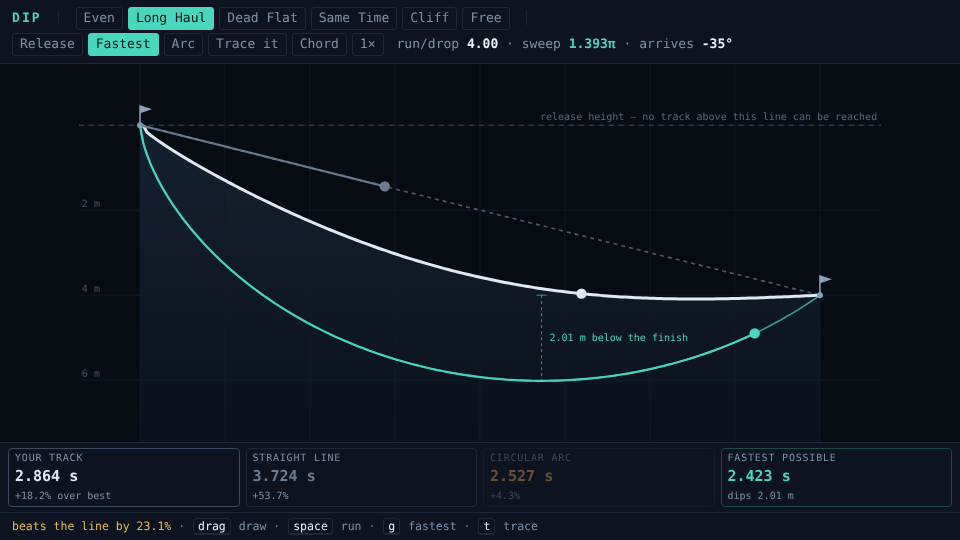
Dip
Draw a ramp between two pegs, release the sled, and find out that the fastest track to a point can go under it. The hinge is exact: at a run of π/2 times the drop the fastest curve bottoms out precisely at the finish and the sled arrives travelling horizontally, and past that ratio the curve dives below the flag and climbs back. Four numbers fall out. At a run of four times the drop the dive is 0.504 drops deep — 2.01 m under a flag that is only 4 m down — and the straight line, which never dives, takes 53.7% longer; at eight times it takes 97.6% longer, nearly double. On a cliff, a run a quarter of the drop, the straight line is 0.76% off and the whole trick is worth nothing. Galileo's answer, an arc of a circle, is never worse than 4.84% anywhere from 1:4 to 8:1 — which is how a wrong answer survived 58 years — even though at 4:1 it overshoots to 1.125 drops, more than twice as deep as it should. And the winning curve has a second property you can play against: on the π/2 arc a sled released anywhere reaches the bottom in 1.7376 s no matter what height it started from, so three sleds dropped at three heights land together, with 61 microseconds between them. None of the clocks are simulated — a polyline is a chain of constant-acceleration ramps, so a segment takes 2·ds/(v₁+v₂) exactly, which is why the time updates while your finger is still moving.
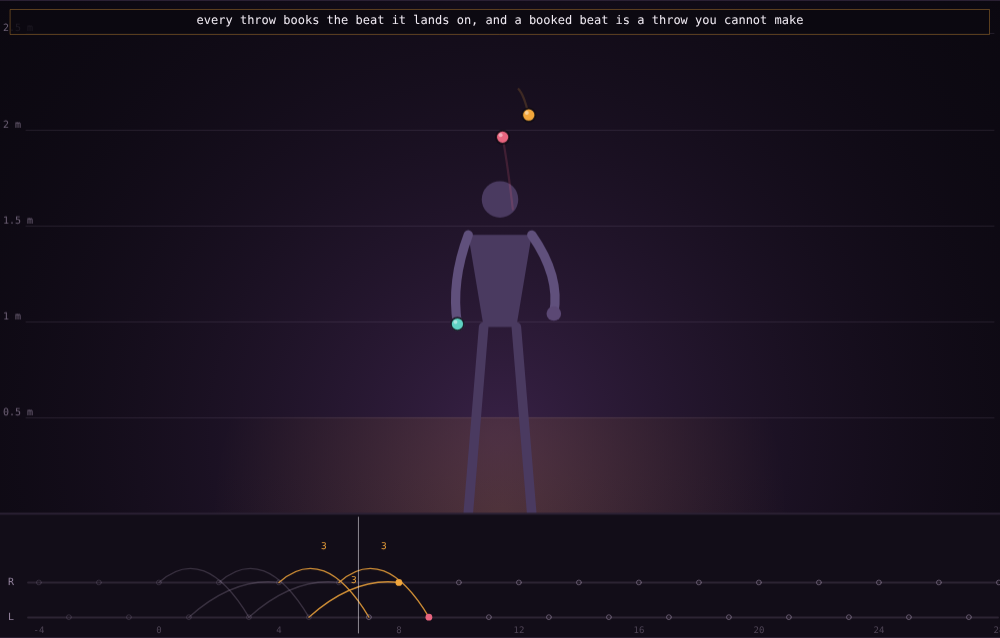
Air Time
Juggling, played as a booking problem. A throw of value h made on beat b lands on beat b+h, so a pattern is possible exactly when no two throws land on the same beat — and the mean of the values is the ball count, exactly, always. Four numbers fall out. At 2.5 throws a second a 3 is airborne 0.98 s and peaks 1.18 m above the hands, a 5 is 3.30× that height and a 7 is 6.93×, because the apex goes as the square of the air time. Keeping a 5 at the height of a 3 means 4.54 throws a second instead of 2.50 — 1.8× the hand rate — and keeping a 7 there would need 6.58/s, which no pair of hands has. Taking one hand out of the pattern doubles every value and so costs 4.95× the height, not 2×. And the arithmetic is not negotiable: throw one ball higher than its share and the demo will show you the exact later beat where the bill comes due, because the mean cannot move.
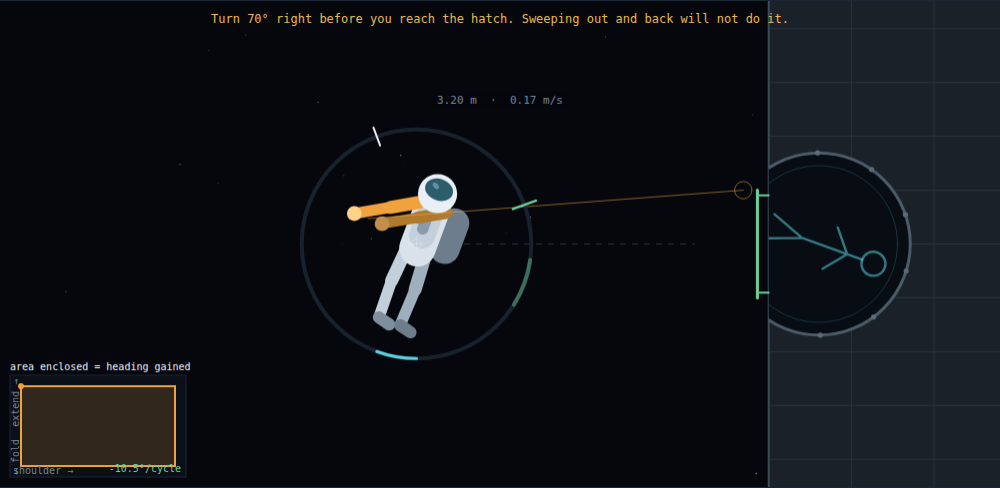
No Torque
A spacewalker who has let go has nothing to push against and no angular momentum to spend, and can still turn — but only by drawing a shape that encloses area. Four numbers fall out. Sweeping both arms through their entire 250° of travel and back, elbows locked, returns you to the heading you started on: not nearly, exactly, and for as many strokes as you care to spend. Fold the elbows on one leg of that same stroke and the identical 500° of shoulder travel buys 10.59° of heading — a 2.1% gear ratio, 8.5 cycles and 26 seconds to get 90°. The fold is not a dial: folding halfway gives up 71% of the gain to save 16% of the clock, so the honest options are all the way or not at all. And the one move that is genuinely fast is the one you cannot undo — a 1.2 kg tool thrown at 4 m/s buys 2.98 kg·m²/s and about 14°/s, which you then have forever, at a rate that drifts between 10.4 and 14.1°/s as your own shape changes under it.
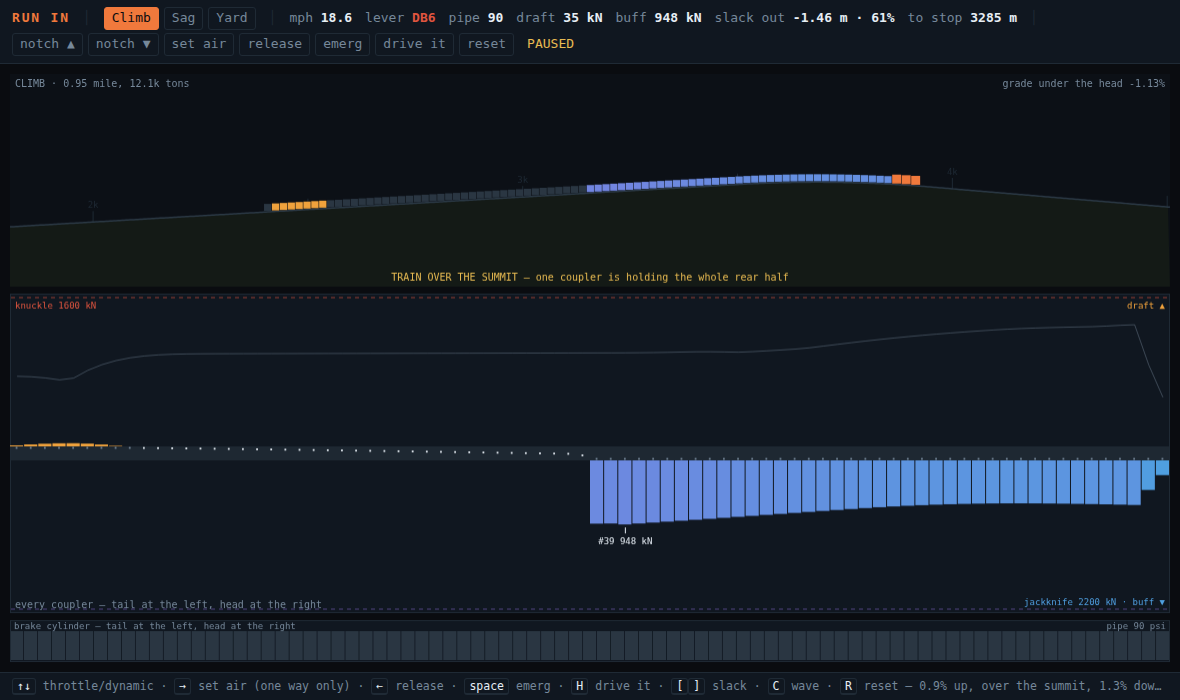
Run In
A mile of loaded freight handled from the one cab at the front, where the train is a chain with 5.21 m of lost motion in it and nothing in front of the engineer measures that. Four things fall out. The brake pipe is not a wire: a full service takes 5.50 s to reach the last car, and in that gap the tail is doing 2.03 mph more than the head, which closes 5.00 m of the 5.21 m available. The knuckle is a speed limit rather than a force limit — 3.27 mph of closing parts it, on a gauge that reads to 1 mph. Where you apply a brake matters more than how hard: 1200 kN all at the head runs the slack in at 1181 kN, the same 1200 kN spread over 80 cars does it at 435 kN, and the spread one stops the train faster. And the hidden state decides everything — the identical full service at 25 mph peaks at 861 kN with the slack stretched and 452 kN with it bunched. Meanwhile notch 8 up the 0.9% has already spent 72.5% of a knuckle before anyone touches anything, and because tractive effort is power-limited, the slower you get the less throttle you are allowed.
Get Out
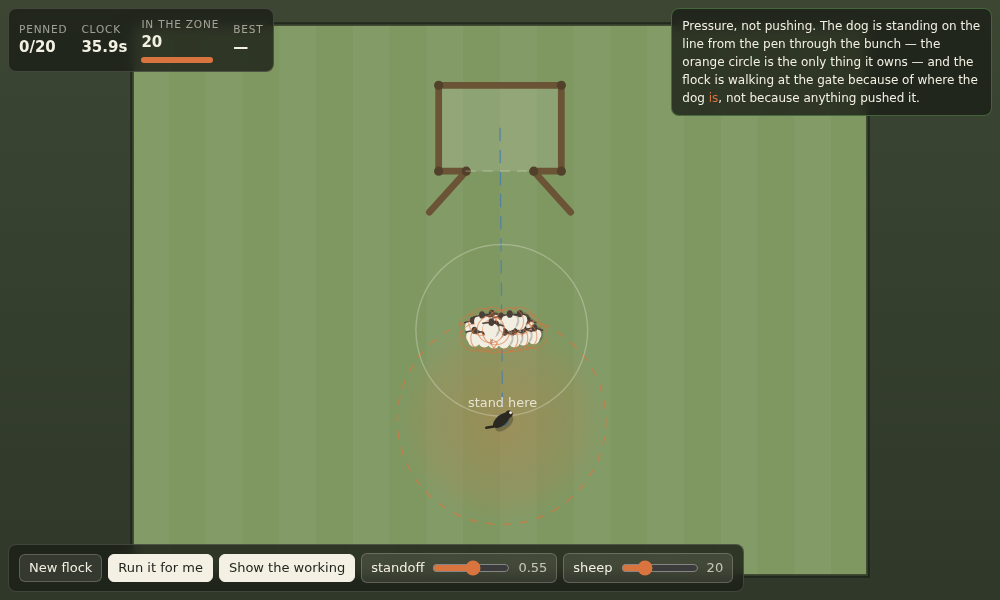
A sheepdog with one lever: sheep inside its 17 m flight zone move off, sheep outside it cannot tell the dog exists. That makes distance a switch rather than a dial — a dog holding station 9.4 m behind the flock drives it at 0.98 m/s, and the same dog 15.3 m back drives it at 0.029 m/s, which is the grazing drift of a paddock with no dog in it. Direction is pure position: standing still, over 130° of bearing, the flock leaves along the dog→flock line with a mean lean of 2.7°. Pressing closer is faster per success and worse per attempt — standoff 0.30 pens in 31.7 s but opens the flock up half the time and fails 22%, while 0.55 takes 42.3 s, pens 91% and wins on expectation. Standing still in the right place is worth about half a metre, because the rear sheep walks out of the zone and the lever disconnects. And the sport is named after the outrun, which this model will not pay for: running wide instead of barging through is worth a metre on the lift and nothing at all on the outcome.
Loose
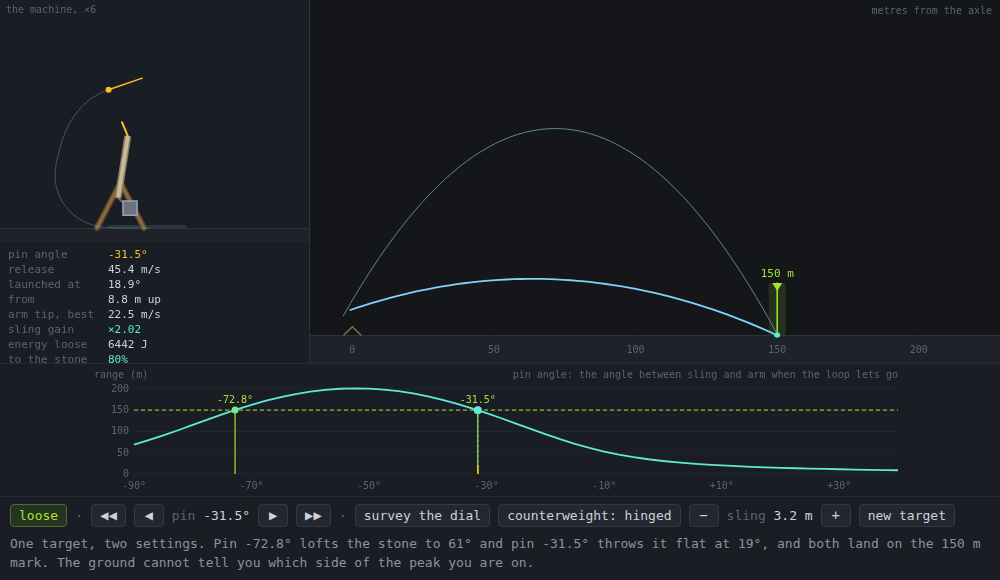
A counterweight trebuchet, where the only control worth having is the angle at which the sling's loop leaves the release pin — and it does not throw the stone, it points it. Across 130° of dial the launch direction follows the pin to within 0.69° of a straight line while the release speed moves 13.9%, so range against pin is a hump, and every range short of its 201.08 m peak has exactly two settings: 25.5° apart at 180 m, 61.5° apart at 100 m. The top of the hump is symmetric to 0.11% out to ±10° either way, so a short shot tells you nothing about which way to turn. 45° is wrong twice over — releasing 8.05 m up takes 1.12° off it and buying loft with speed takes another 3.98° — and the best shot leaves at 39.90°. Then the counterweight: the same half tonne bolted to the arm instead of hung from it releases 2.74× as much energy and throws 38.5% shorter, because 75.9% of that energy is still in the weight when the stone goes, and four times the bolted mass still only reaches 143.6 m against 201.1.
Half Again
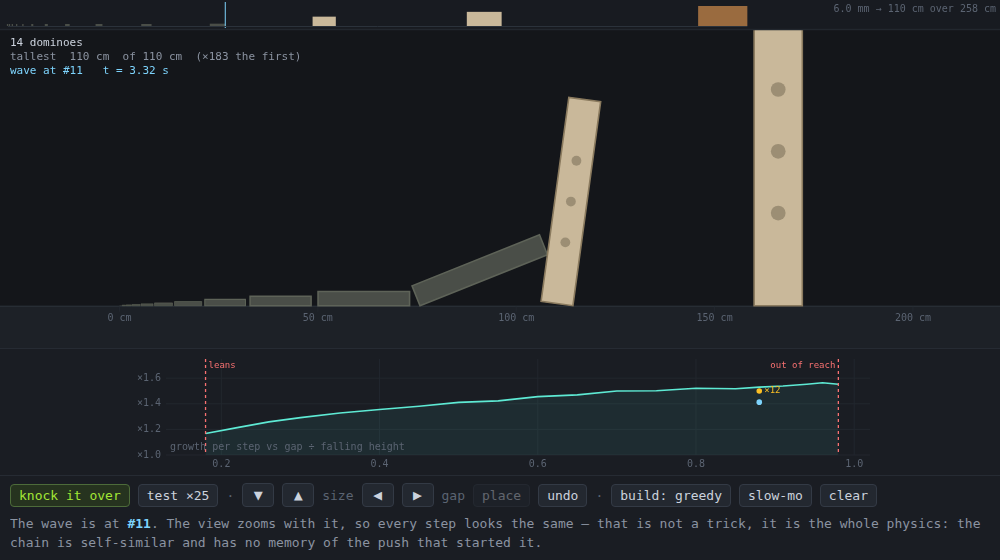
A domino amplifier, where energy says each one could be 2.90× the last, the collision says 1.56×, and the same 1.5× finishes 14 builds out of 25 at one spacing and 25 out of 25 at another — the gap nobody thinks about doing all the work.
Two Pulses
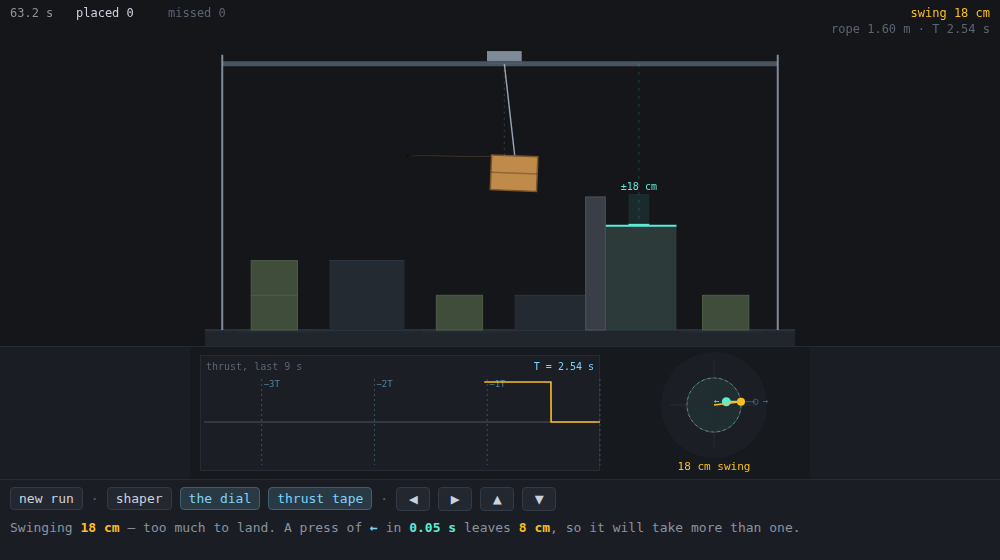
A gantry crane whose load is a pendulum you can only steer by the pivot — so the swing you arrive with was decided by two acceleration edges and the gap between them, and the only cure for a swinging load is a second mistake, timed.
Paid Out
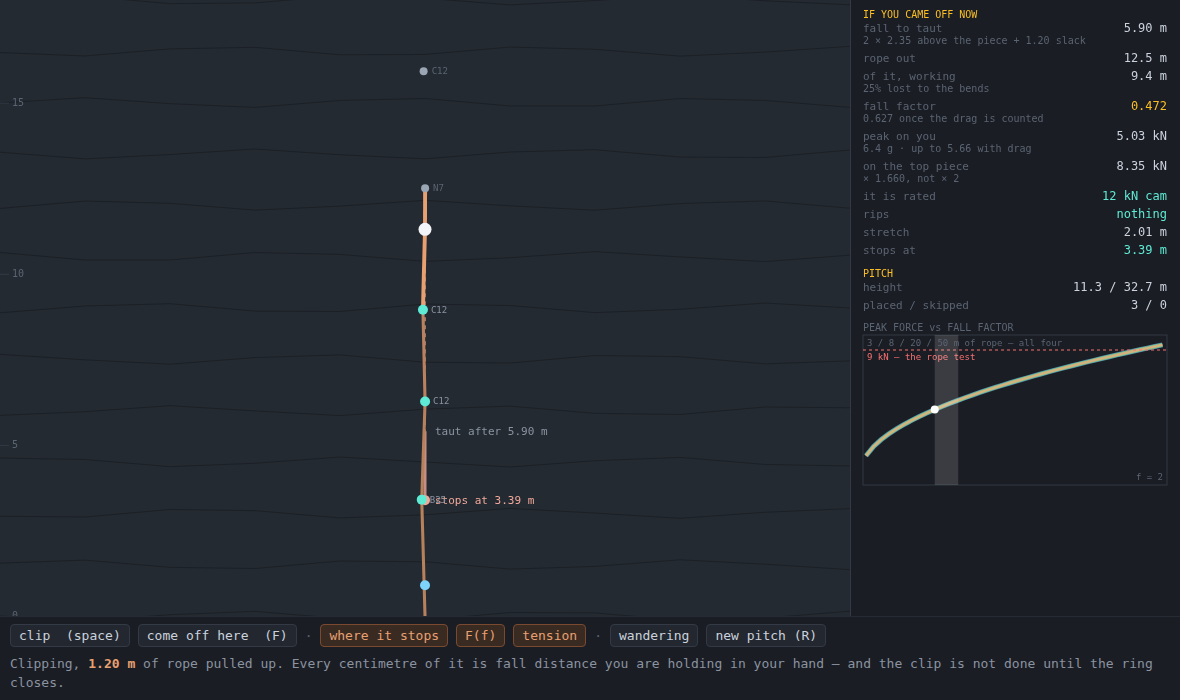
Lead climbing, where the rope has never once known how far you fell. A 2 m fall and a 60 m fall arrest at the identical 6.907 kN because the length cancels out of the algebra — and the two things that do decide the day are both invisible: a dead-straight pitch already throws away 31% of its rope at the top carabiner, and the rack's ordering is worth more than the rack, 0.0% of falls zippering against 16.6% on the same routes with the same gear in the other order.
Carrydown
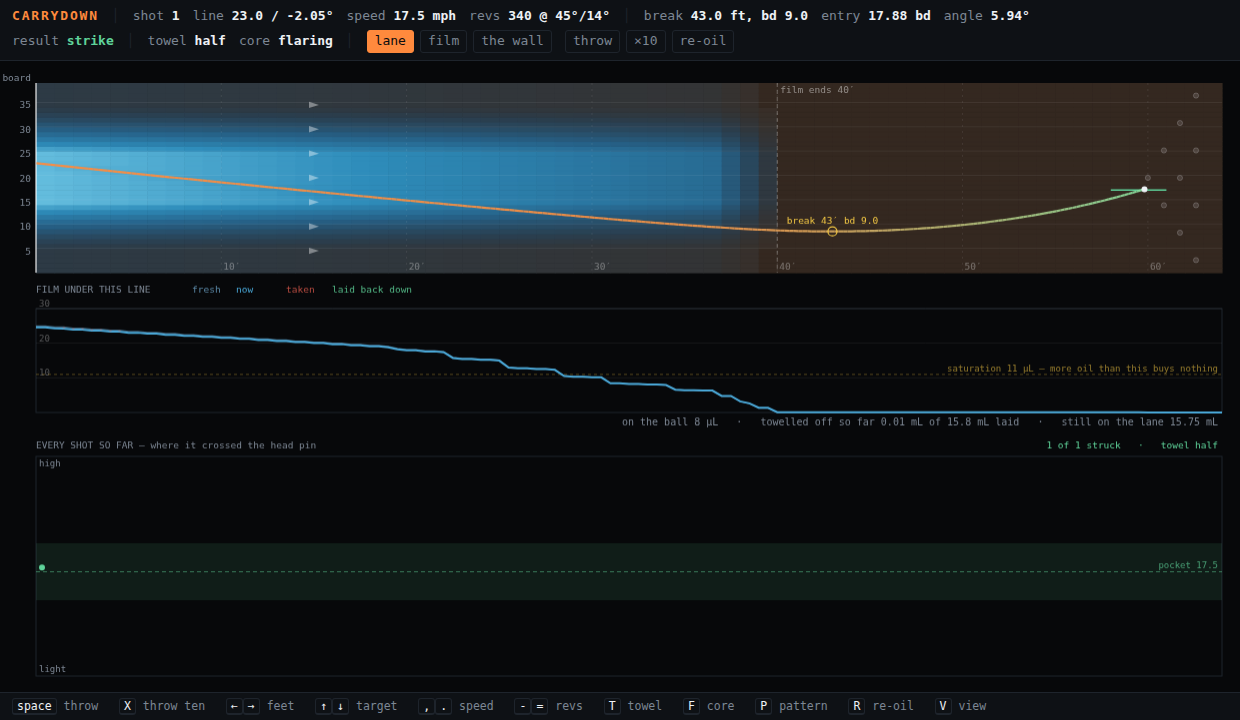
A bowling ball is a sphere sliding on a film it is editing as it goes. Two results fall out and neither is the one the sport teaches. First, for an inert sphere the whole turn is decided at release: friction moves the finish of it from 26.7 ft to 54.9 ft across a doubling of mu, and the finishing direction is the same 4.960 degrees in every case, so oil chooses where the ball turns and never how much. Second, the forgiveness everyone credits to the lane is a product, not a sum — a shaped pattern with an inert sphere gives 2.50 boards of miss room, a flaring core on a flat pattern gives 1.00, the same as no core at all, and the two together give 4.75. Then the lane starts moving. Forty shots down one line and the towel decides the sign of the breakdown: never wipe and the ball finishes 7.67 boards light with its entry angle halved, wipe every shot and it finishes 0.97 boards high — 6 strikes against 26, and the entire difference is 0.53 mL of oil, three percent of what the machine laid down.
Dwell
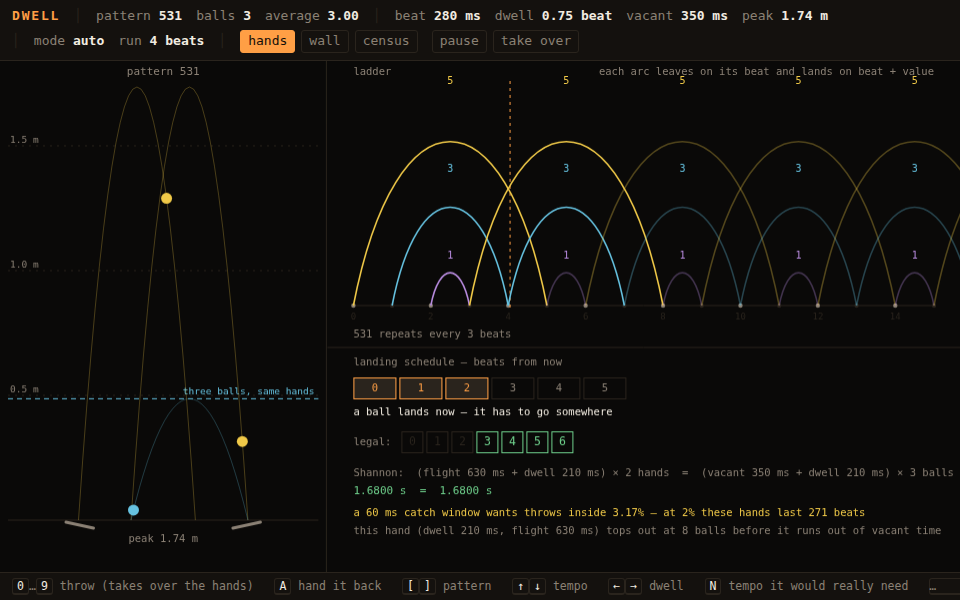
Juggling is a booking system with a ballistics problem bolted on. The average of your throws is the ball count — exactly, in all 1270 small patterns checked — so every high throw is a debt you pay in low ones, and from a three-ball cascade a 1 or a 2 is not a throw you are allowed to make. Then the physics: height goes as (balls − dwell)², so at a fixed hand rhythm five balls is four times the height of three and never the 1.67 everyone assumes, and the thing that actually runs out is not the arm. A 300 ms dwell caps a 1.50 m pattern at nine balls no matter how good you are; 100 ms less buys four more, and buying those four with height instead means throwing 3.34 m.
Inversion
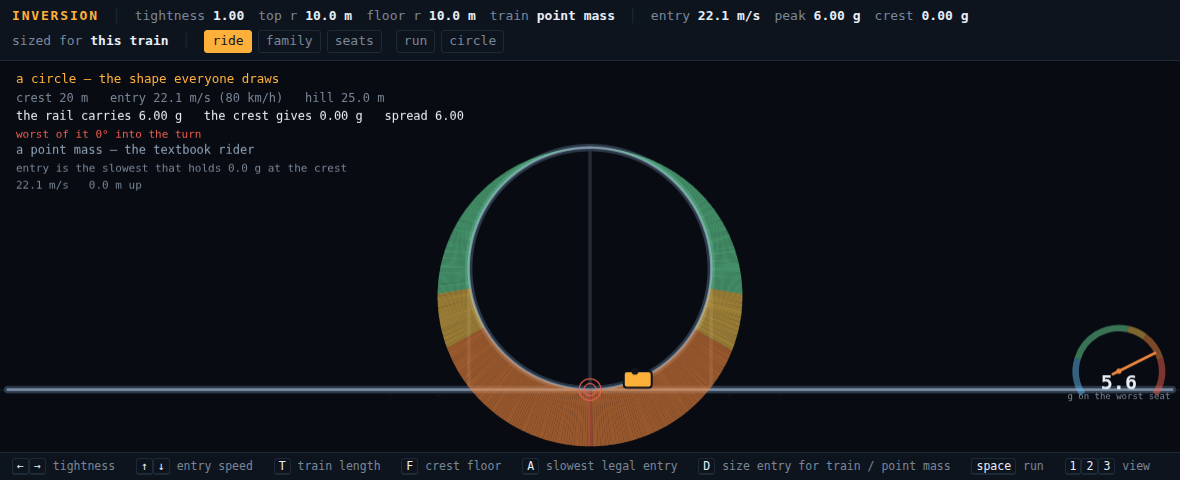
A vertical loop you shape yourself. The circle everyone draws charges the rider exactly 6 g — the same 6 at four metres and at forty, at any speed, for every circular loop ever built — and the fix is to make the top sharper, not gentler. The shape that takes 48% off then spreads the riders 1.66× apart by which row they sat in, and the worst moment of the ride is 122° into the turn, where nothing is supposed to be happening.
Crosswind
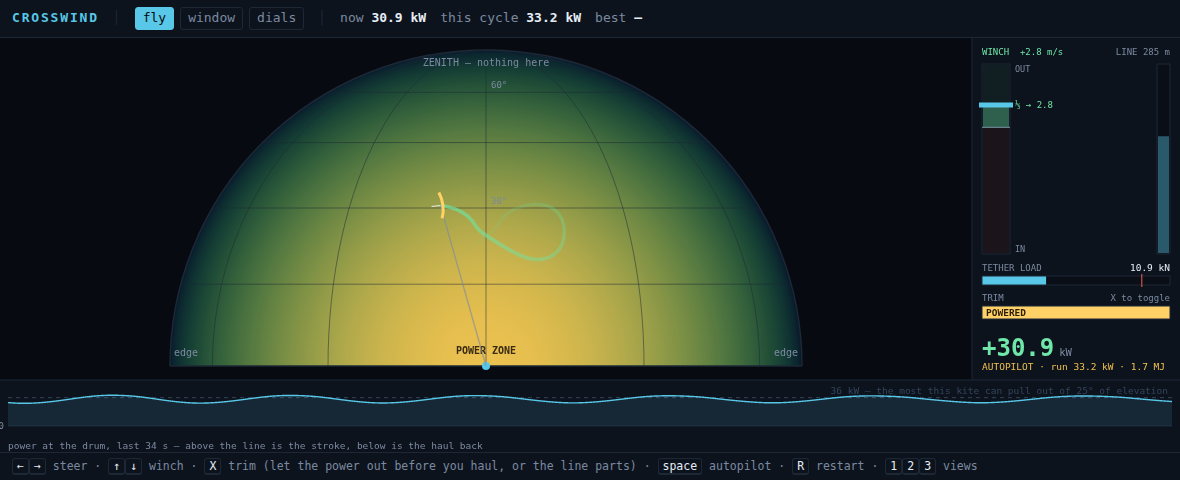
A kite power plant flown as a pumping cycle, where the tether load is set by how fast the kite is crossing the sky and not by how hard the wind is blowing — sweeping instead of parking is worth 26×, the reel-out speed that makes the most power is a third of the wind whatever kite you hang on the end, and the control worth 2.3× the whole plant is the one that generates nothing.
Double Cross
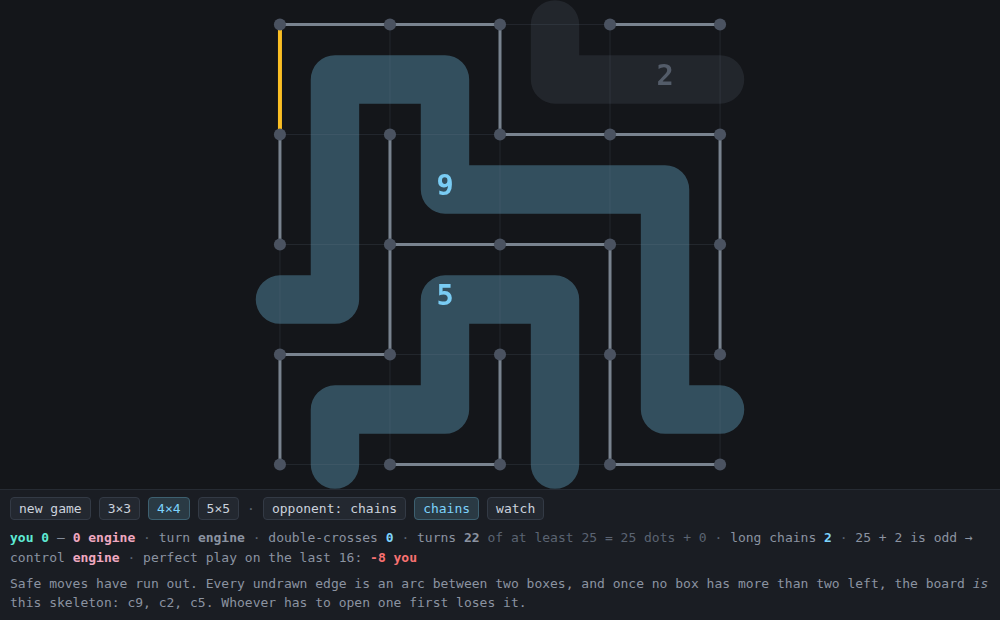
Dots and Boxes, where the winning move is handing your opponent two free boxes — because turns = dots + double-crosses is an identity, not a tendency, the famous long chain rule is that identity with exactly one substitution made in it, and a mistake in this game always costs an even number of boxes.
Full Lock
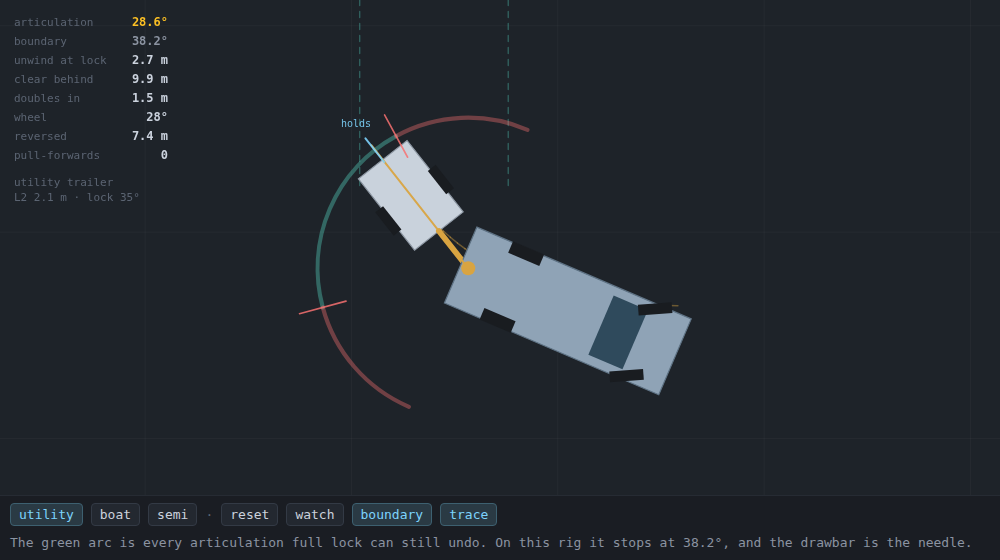
Reversing a trailer, where the wheel on the stop stops being a fix at 38.2° on a 7-foot box and never stops being one on a 48-ft semi — same driver, same hands, and the difference is four numbers about the rig that nobody is allowed to change mid-manoeuvre.
Roll Out
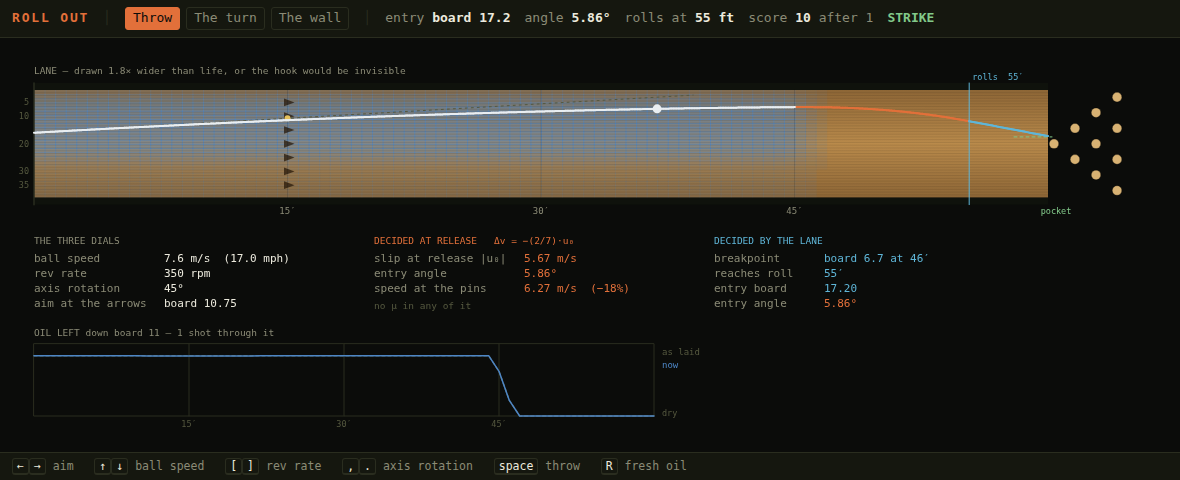
A bowling ball turns by exactly −(2/7) of the slip it was released with, and there is nothing on the lane that can add to that or take it away. Same throw on a house shot, a short pattern and a stripped lane: 23.4 boards apart at the pins, 0.002° apart in entry angle.
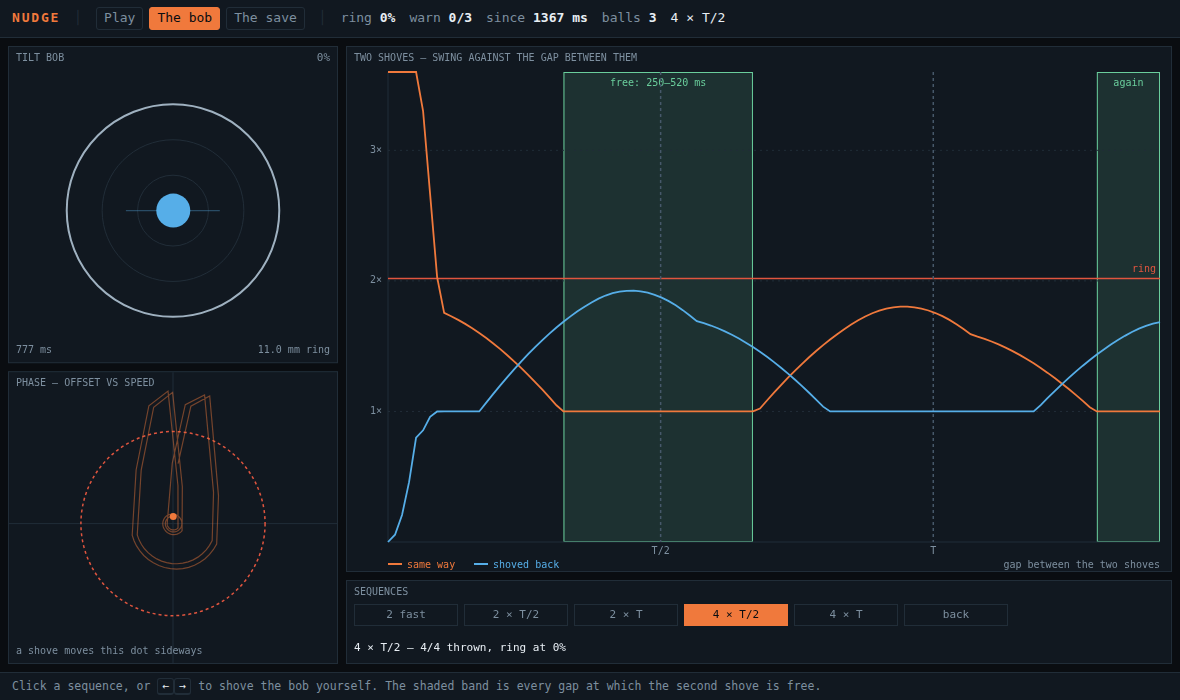
Nudge
Shove a pinball machine and you drive two things at once: a ball that forgets in a second, and a plumb bob that forgets nothing. Two identical shoves 250 ms apart cost you nothing at all; the same two 780 ms apart are 1.76× the swing, and four of them is a tilt.
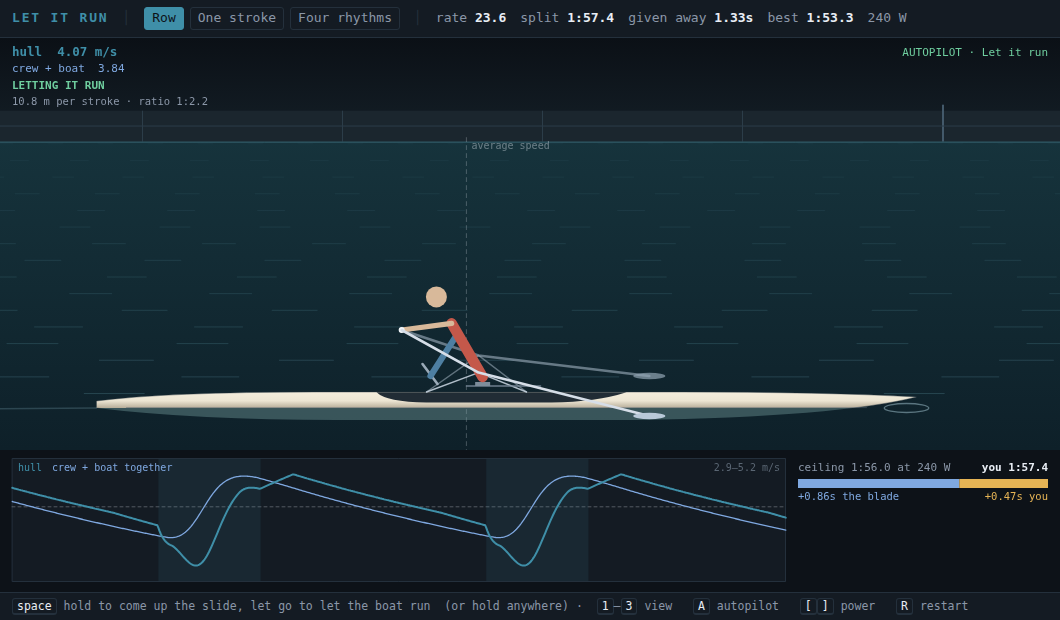
Let It Run
One verb: how you come back to the catch. The engine is pinned at 240 W so no rhythm can win by pulling harder, and the fastest one turns out to be the rhythm where the cost of the boat coasting and the cost of your own body sliding about come out exactly equal.
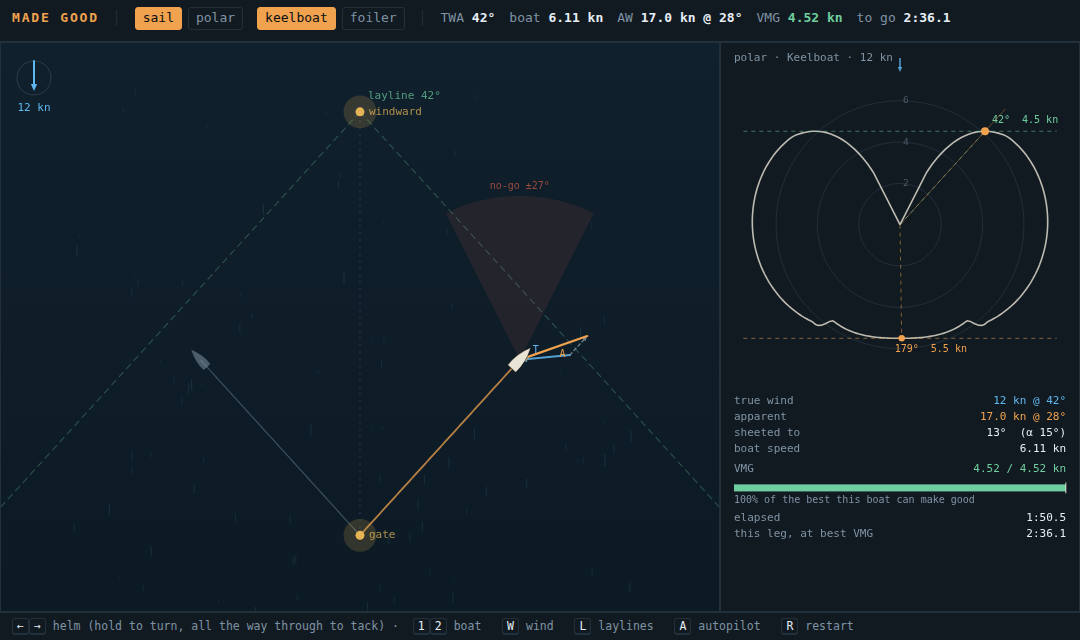
Made Good
Steer for a mark you are not allowed to point at. The heading that feels closest to it is the slowest way there, the heading that makes the boat fastest makes almost no progress at all, and on a foiler the quickest course downwind is fifty degrees off the mark — at 114% of the wind's own speed.
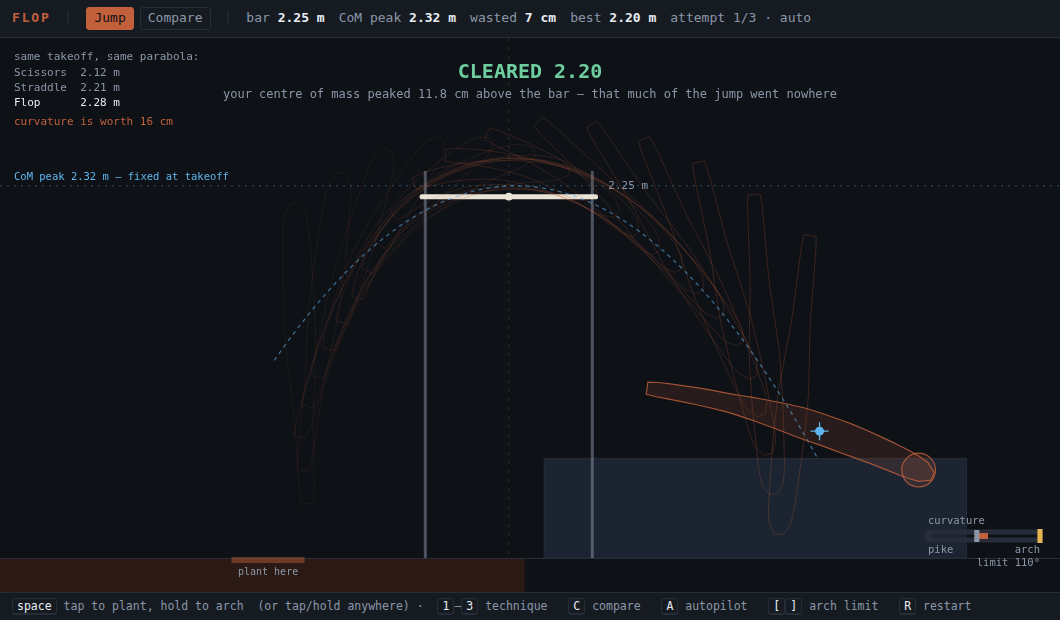
Flop
A high jump where the only verb is the sign of your curvature. The takeoff commits your centre of mass to a parabola nothing in the air can move, and every technique is just a different way of arranging a body around a point that is already decided. Same jump, three shapes: 2.12 m piked, 2.21 m flat, 2.28 m arched.
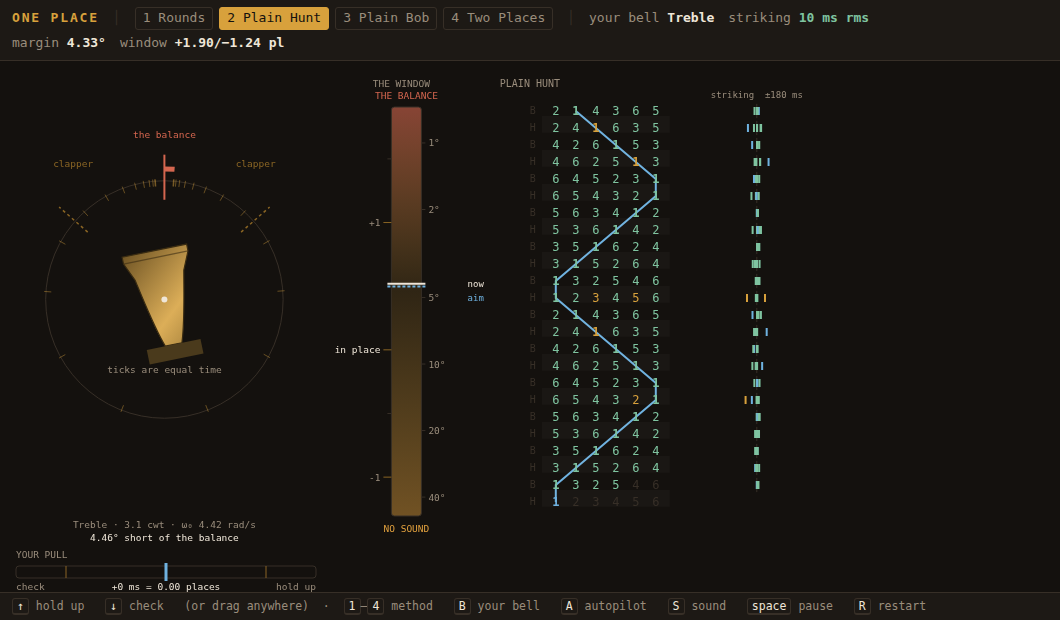
One Place
Ring a tower bell in a band of six. The control is inverted — pull harder and the bell arrives LATER — it is lagged by a whole stroke, and it is logarithmic, so every 165 ms of hold costs half of what is left between the bell and the balance. The window is three places wide and one place deep, and that is why change ringing is permutations instead of tunes.
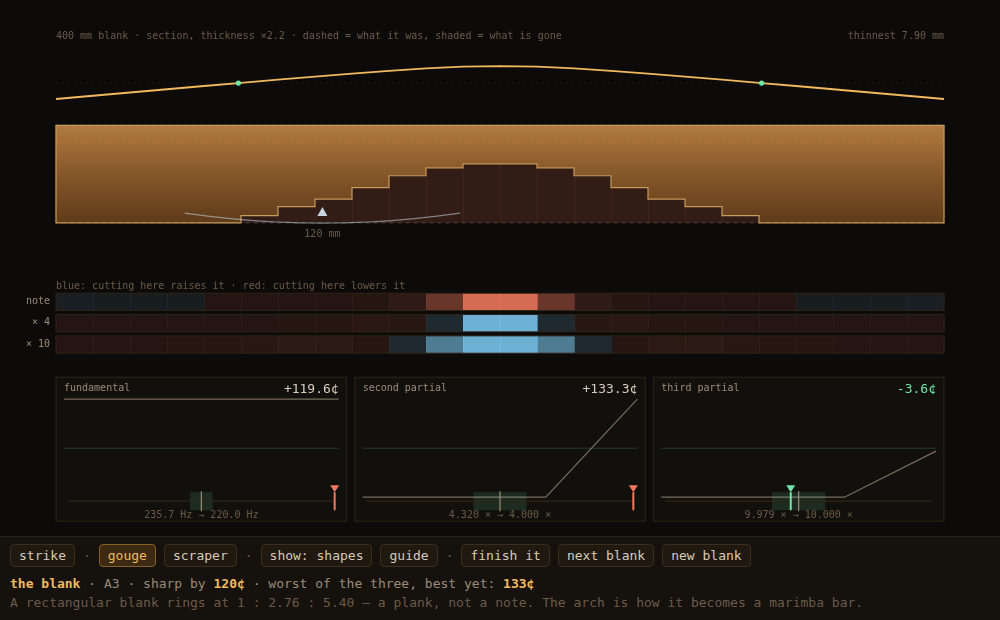
Undercut
Tune a marimba bar by removing wood you can never put back. A rectangular blank rings at 1 : 2.76 : 5.40 and has to end at 1 : 4 : 10, and the arch everyone thinks raises the second partial does not touch it — it lowers the first one past it. Cut 1 mm too deep at the throat and the bar is scrap; the identical millimetre anywhere else costs nothing.
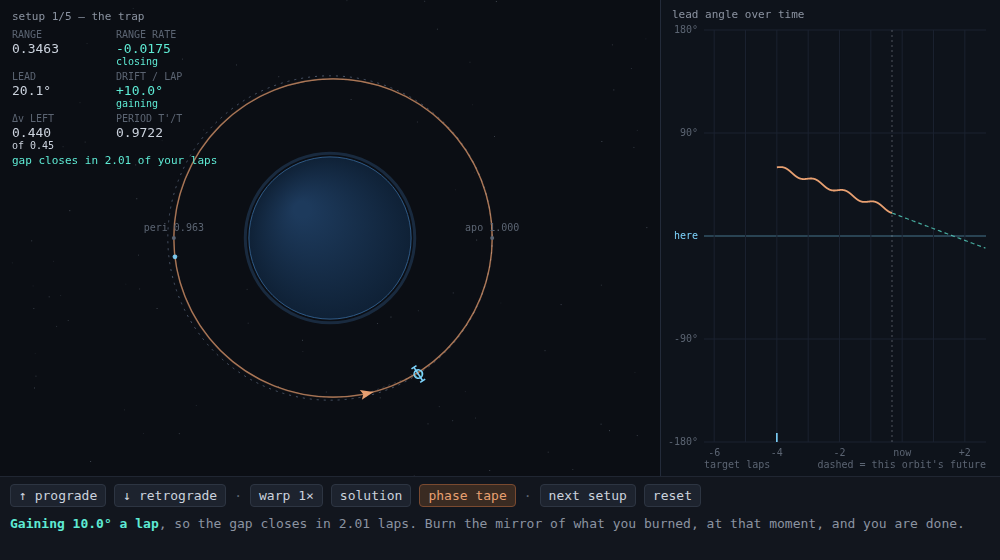
Rendezvous
Catch a station in the same orbit as you, with the one control you have — a throttle that is not a speed control but a clock. Burning toward the target reports 86.6% of your impulse as closing speed and then makes you 10.8° later every lap, and the fix everyone quotes ("to catch up, slow down") has a ceiling at 126.17° and stops being the cheap answer at 105.62°.
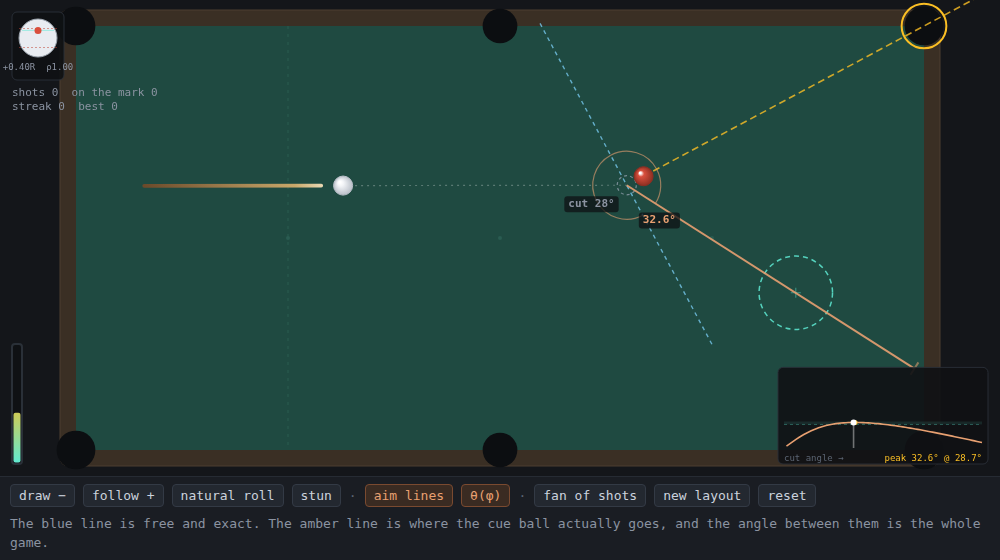
Tangent
Pot the ball and stop the cue ball on a mark, with the two rules every pool player is handed — the tangent line and "thirty degrees" — turned back into the one fraction they both came from, which is 2/7, and which sets a ceiling of 33.75° that nothing you do with a cue can get past.
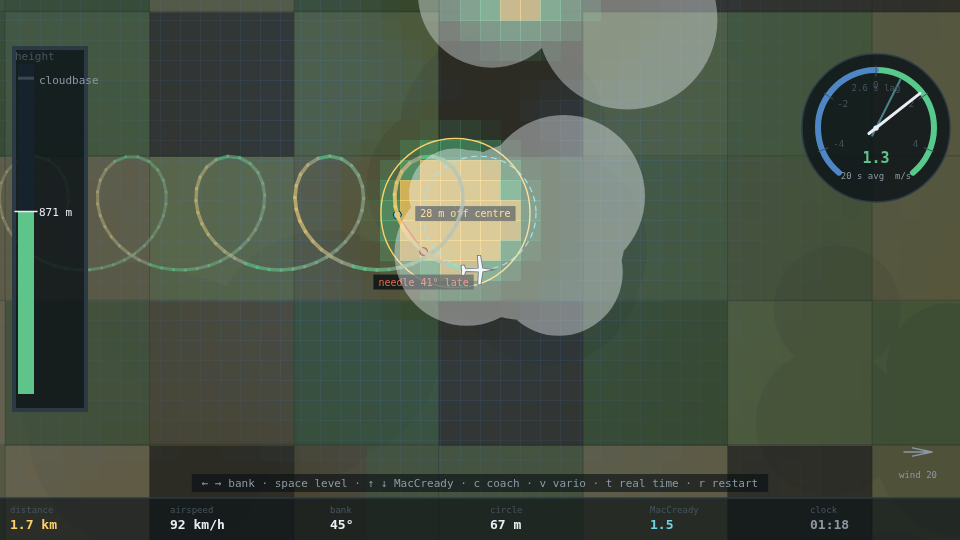
Centering
A glider, a column of rising air you cannot see, and one instrument to find it with — which reports where you were rather than where you are, by about as many degrees of turn as you have degrees of bank.
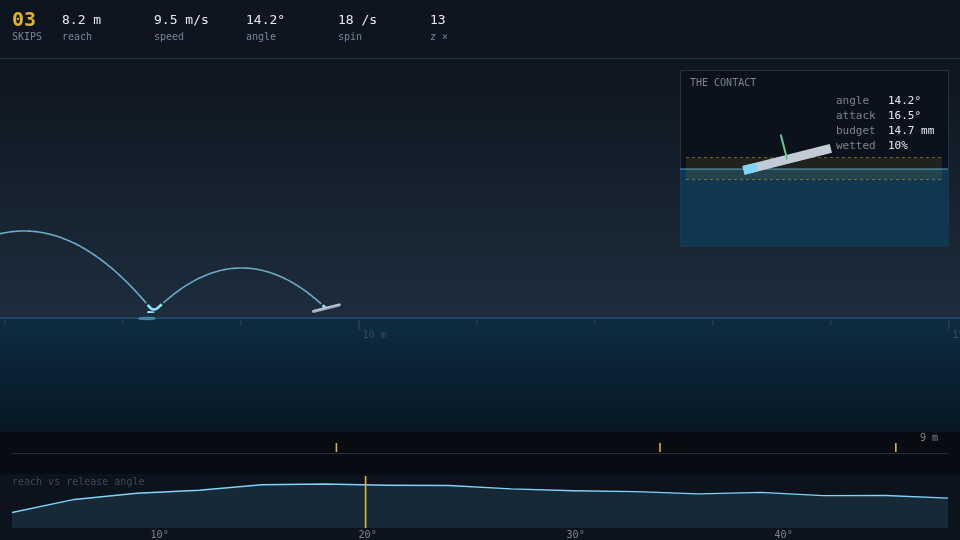
Skipstone
A stone skipping on flat water, where the two controls that decide the throw are both ones you cannot feel — and the one that kills you leaves a perfect first skip behind as evidence that nothing went wrong.

Overhang
Bricks off the edge of a bench, where the same greedy rule — always take the furthest legal spot — reaches 0.500 lengths applied upward and 1.748 applied downward, with the same bricks and the same physics. The build order is the whole game.
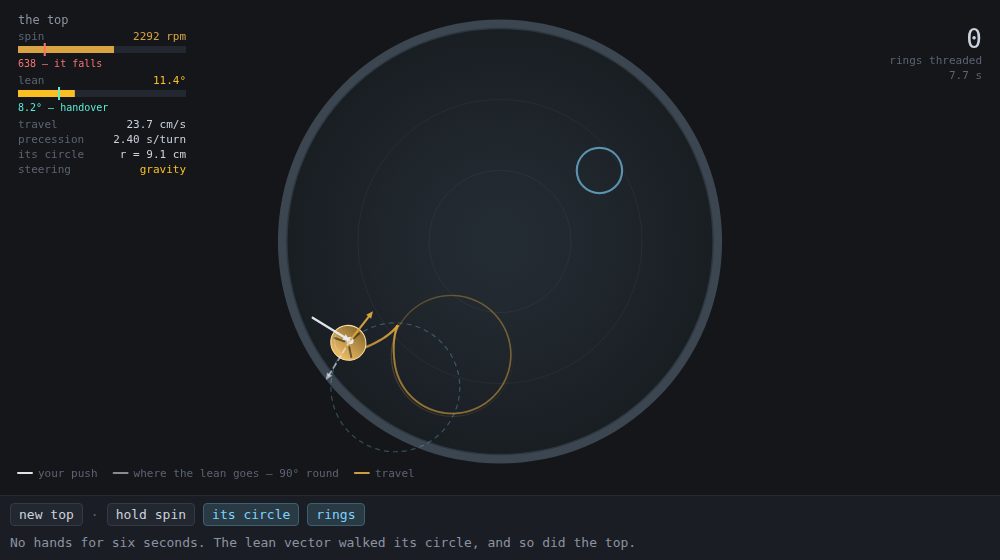
Precession
Steering a spinning top, where push north means go west — and the one lean angle at which your finger and gravity turn the thing equally hard, 8.2°, is where the score peaks without anything in the game being told to put it there.
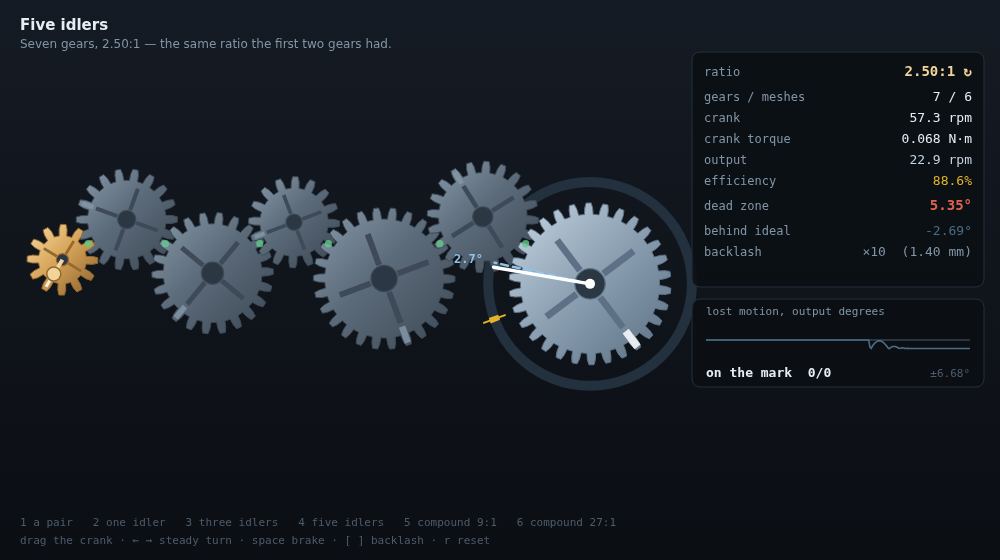
Idler
A gear train where every gear in the middle is worth exactly nothing — the ratio is the first tooth count over the last, no matter what you put between them — and the measurement of what those free gears actually charge you: 0.09° of lost motion each, and 1.8 points of efficiency, every time.
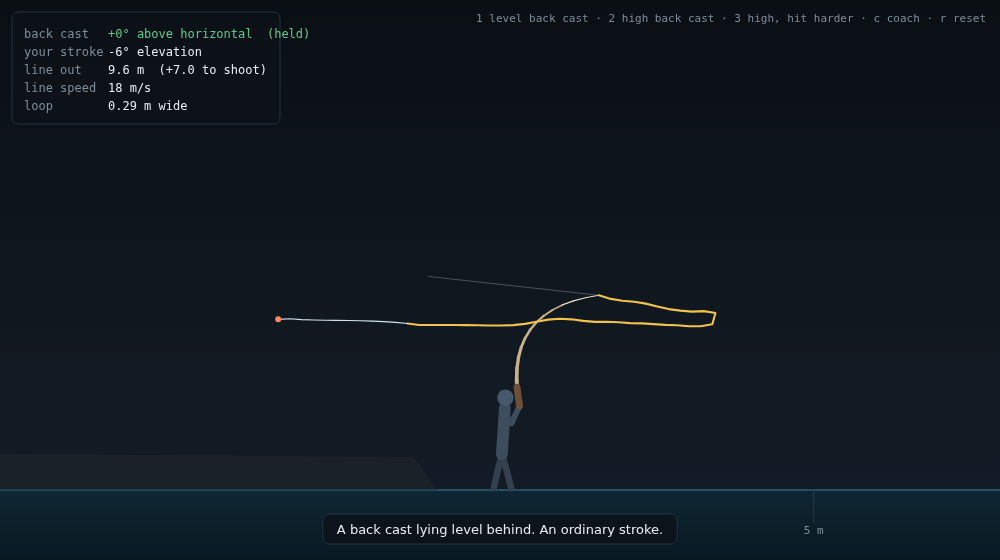
Backcast
A fly line simulated as an inextensible chain, and the measurement nobody wants — every dial you are consciously turning during the forward cast is worth less than a metre, and the half of the cast happening behind your head is worth seven.
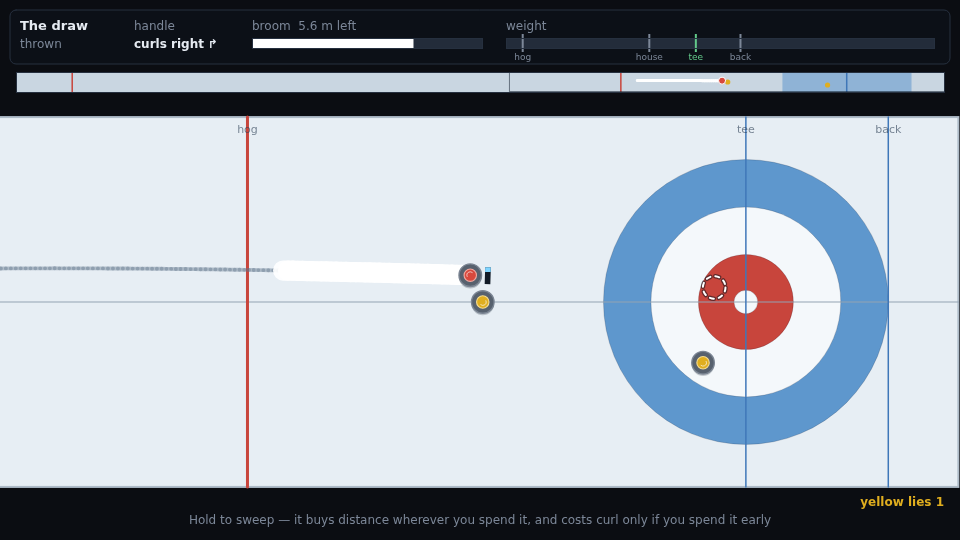
Sweep
A curling stone, and the one thing about the broom nobody tells you — every metre of it buys the same 15 cm of distance no matter when you spend it, and only the curl knows the difference.
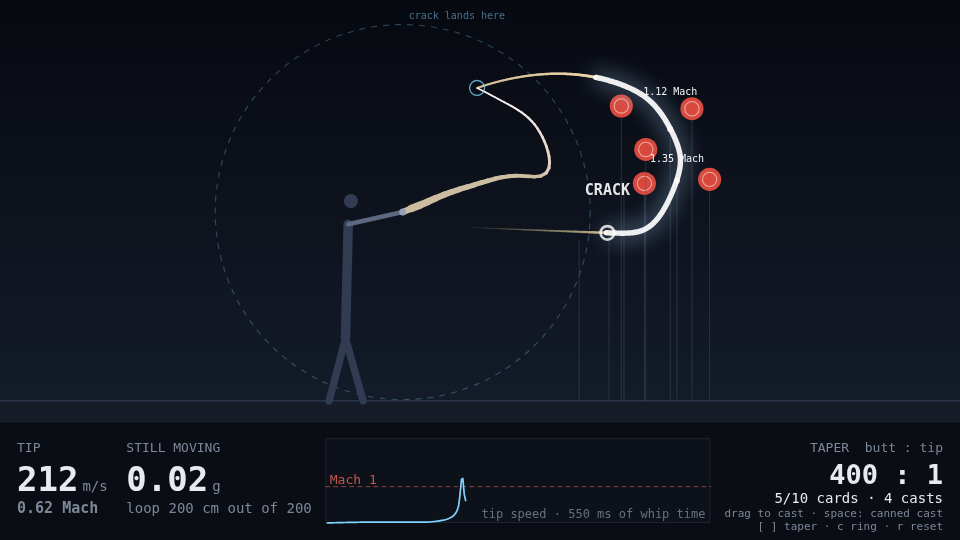
Taper
A whip as an inextensible chain whose mass runs out — the loop you throw goes supersonic not because your arm is fast but because there is almost nothing left in front of it, and the crack lands at 69% of the whip whatever you do.
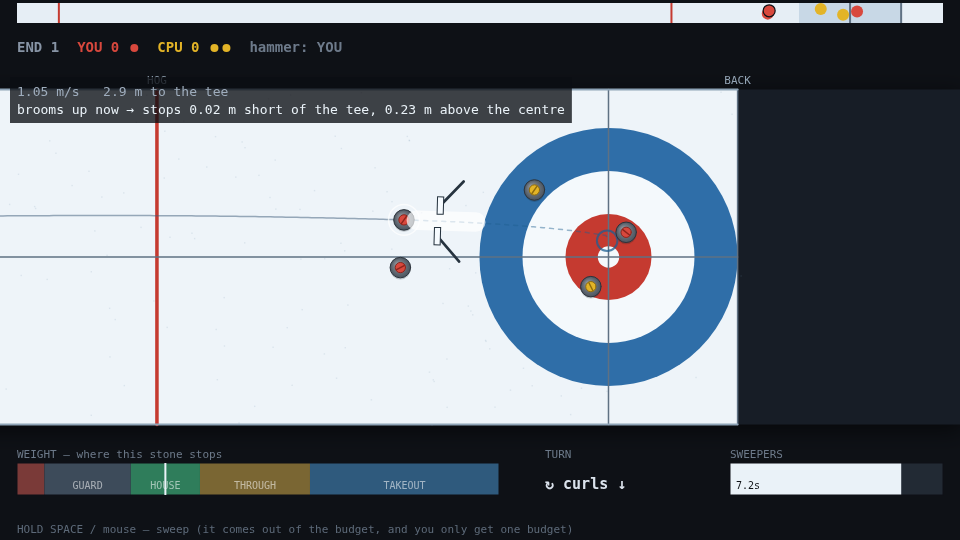
Draw Weight
Curling, where the only control that still matters is the one you use after you have let go — a sweeping budget you spend on a stone already committed, on real pebbled-ice friction and a curl that is nearly all in the last three metres.
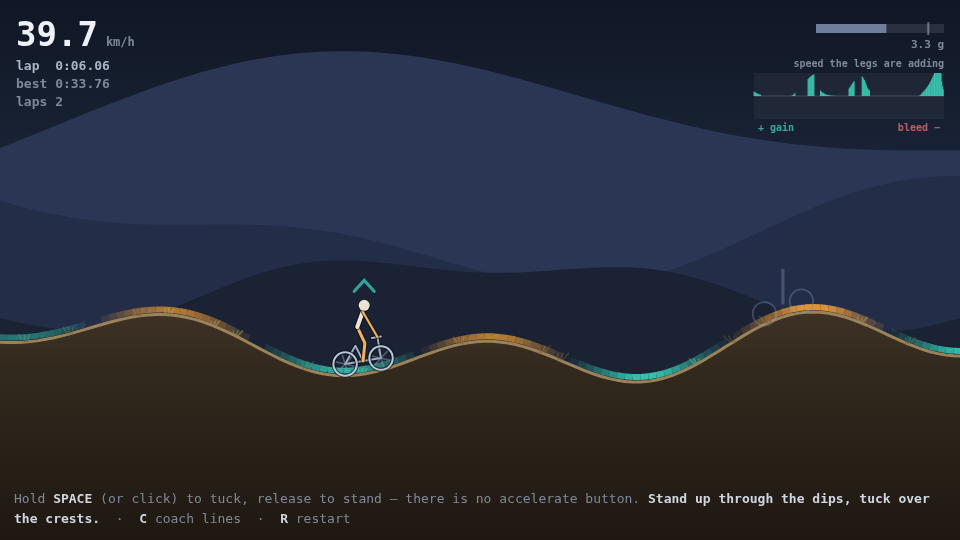
Pump Track
A rider with no accelerate button — all your speed comes from standing up through the dips and tucking over the crests, on the real work-against-the-normal-force physics.
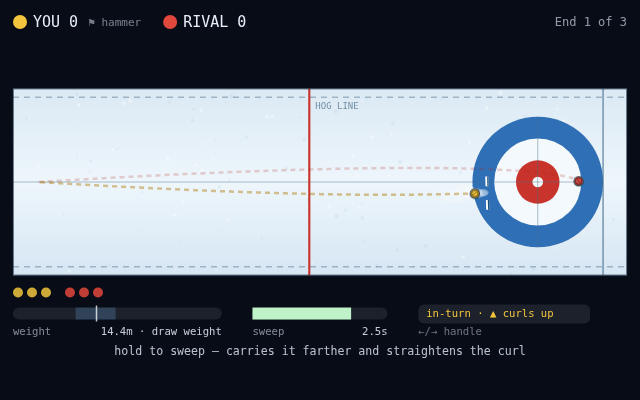
Hammer
Curling delivery — line, weight, handle, and live sweeping over real friction-and-curl physics, with near-elastic granite collisions.
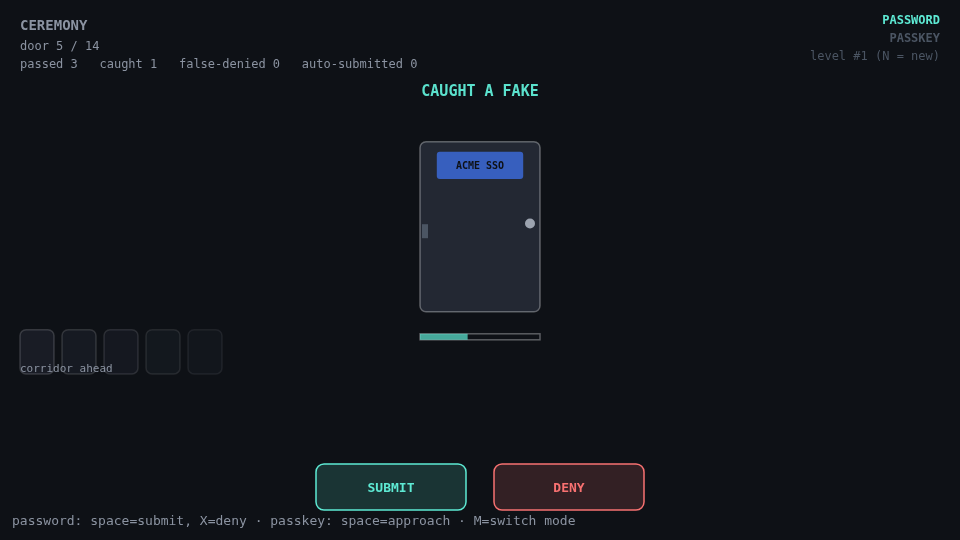
Ceremony
The same corridor of doors, played twice — once trusting your eye to spot a phished lookalike, once trusting a die that simply won't stamp one.
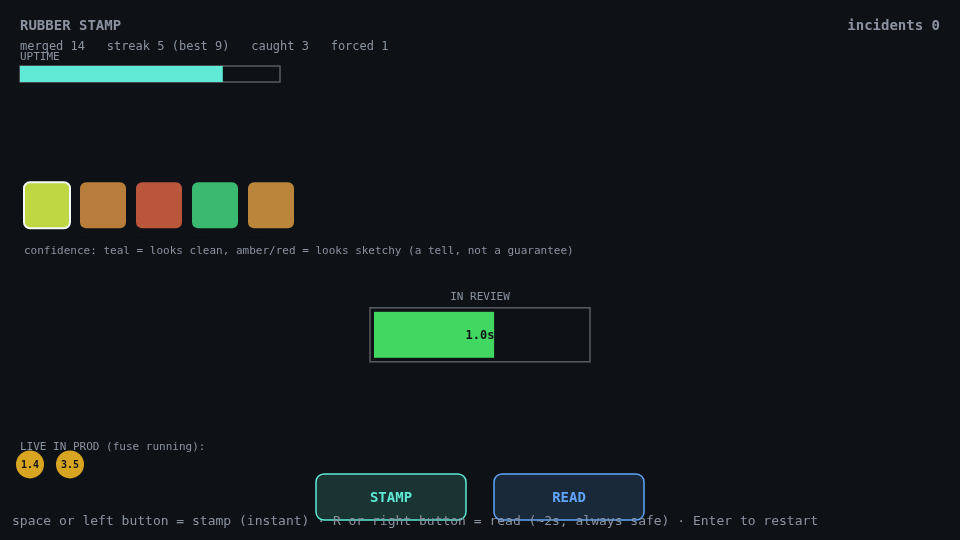
Rubber Stamp
A code-review triage mechanic — stamp a PR through instantly or spend ~2s reading it; unread defects merge clean but plant a fuse that detonates as a production incident later.
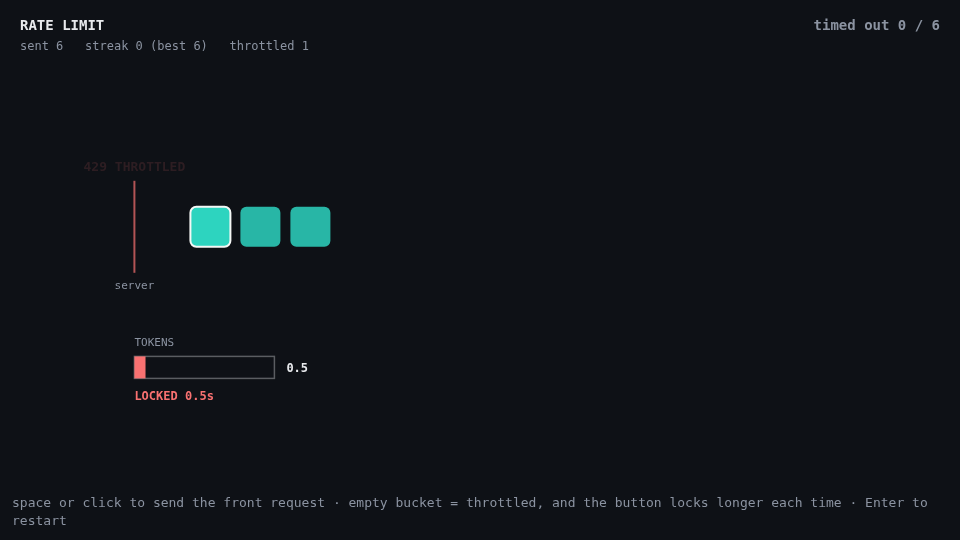
Rate Limit
One-input token-bucket mechanic — send the front request or let it wait, since an empty bucket gets you throttled and locked out for an escalating backoff.
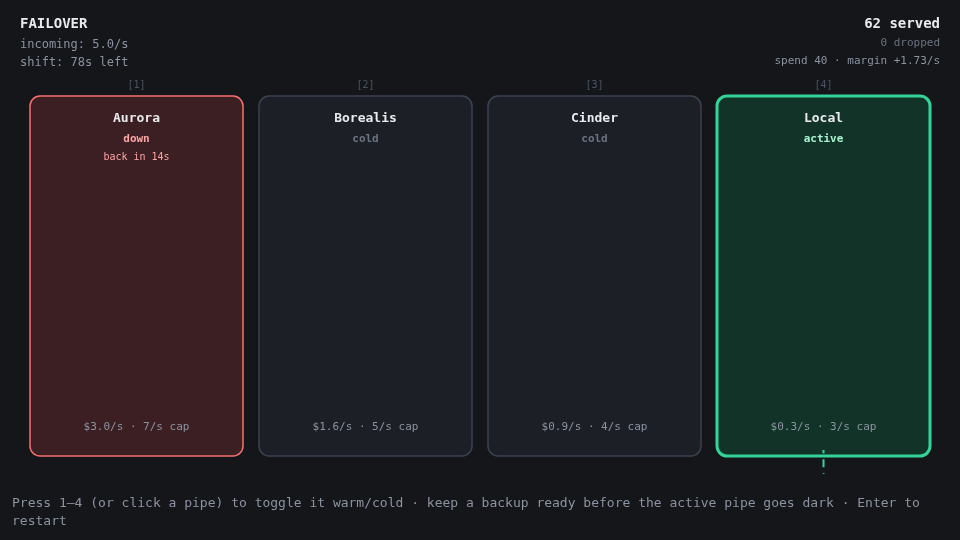
Failover
Route one stream of traffic across a bank of provider pipes that go dark without warning — failover is only instant if a backup was already warm, and warm capacity bills every tick whether or not it's carrying anything.
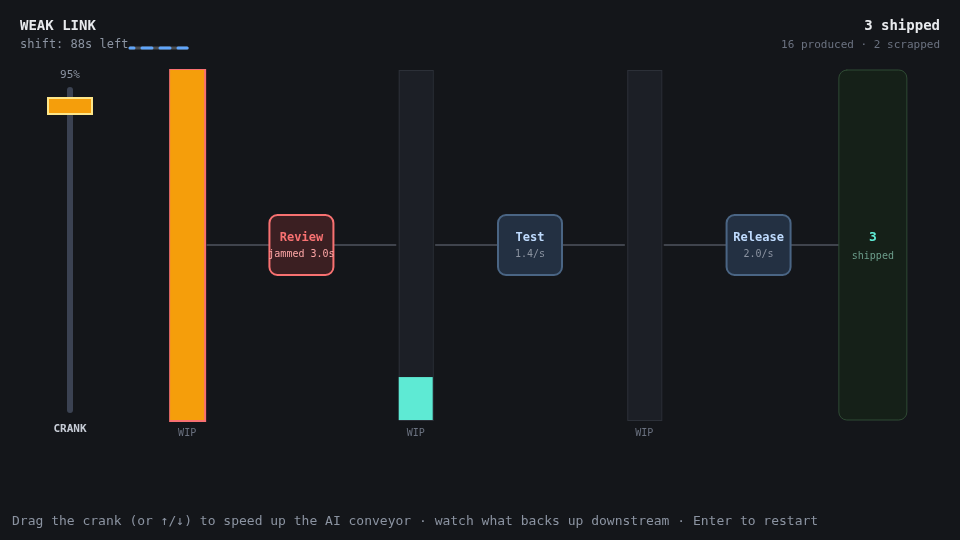
Weak Link
Crank an AI conveyor as fast as you like — score only counts what ships out the far end of three fixed-pace human stations, so overrunning the bottleneck just piles up work-in-progress until something jams.
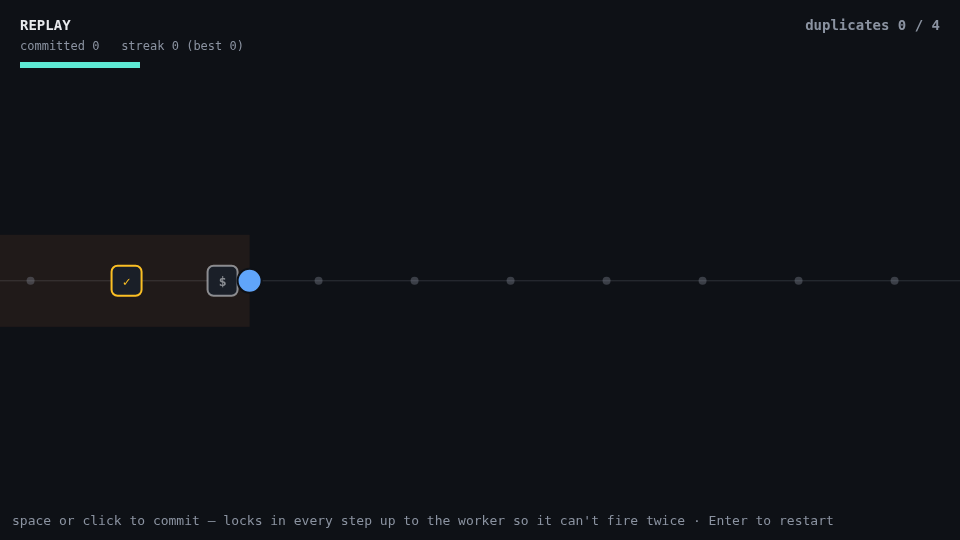
Replay
One-input durable-execution mechanic — commit a checkpoint before the next crash, or a re-run fires an already-emitted side effect twice.
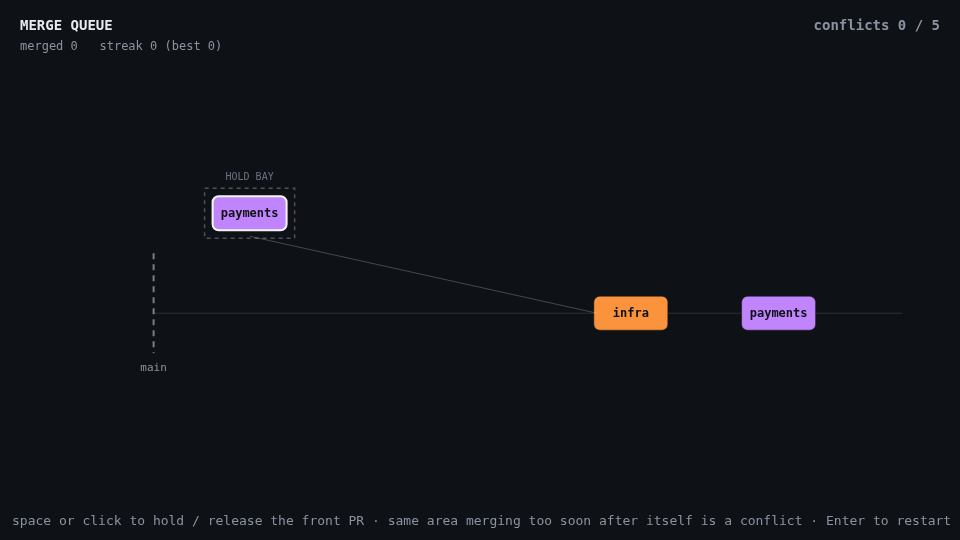
Merge Queue
One-input merge-queue mechanic — hold the front PR aside or release it, since two PRs from the same area landing too close together is a conflict.
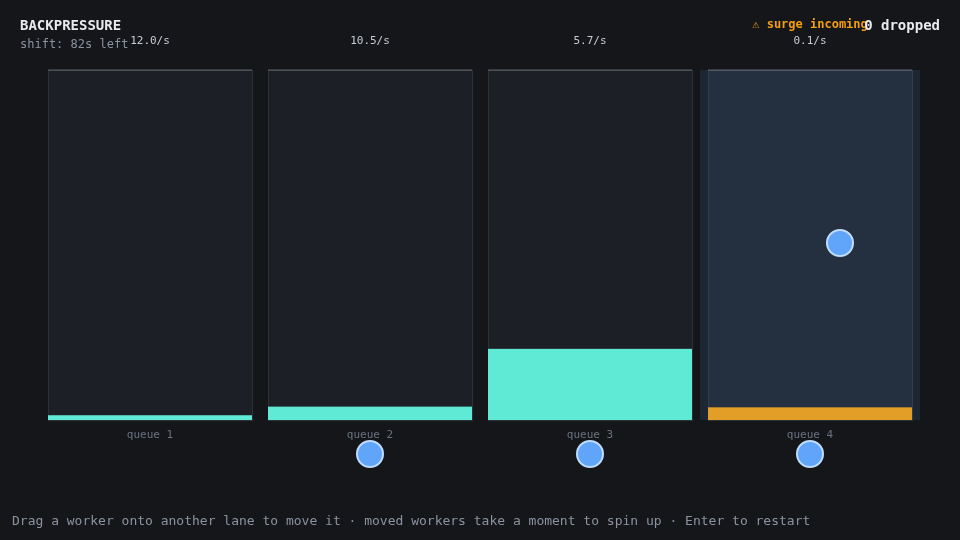
Backpressure
Drag a fixed pool of workers between job queues that spike on their own schedules — moving one costs a warm-up beat, so reading the coming surge beats chasing the one that already landed.
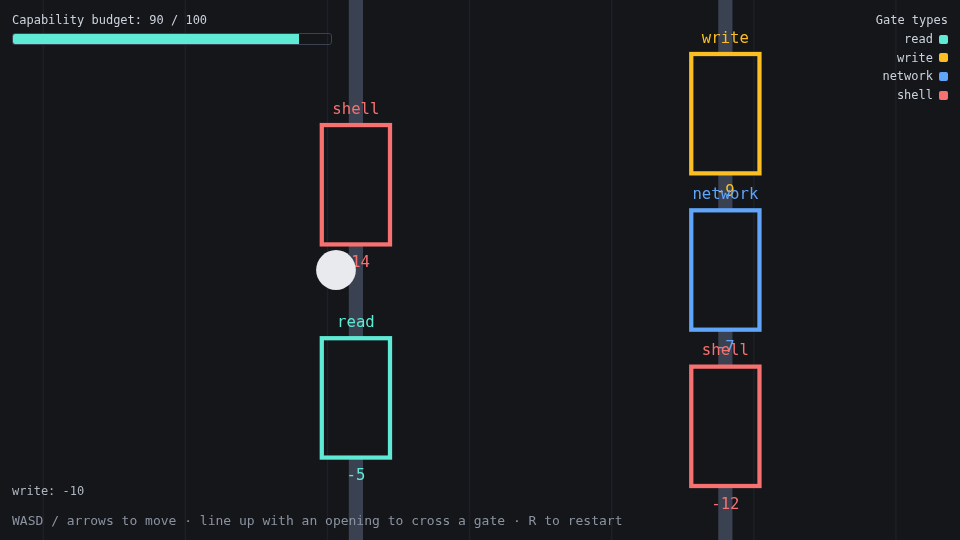
Capability Run
Cross a corridor of tool gates spending from a shrinking capability budget — some gates are disguised, costing more than declared.
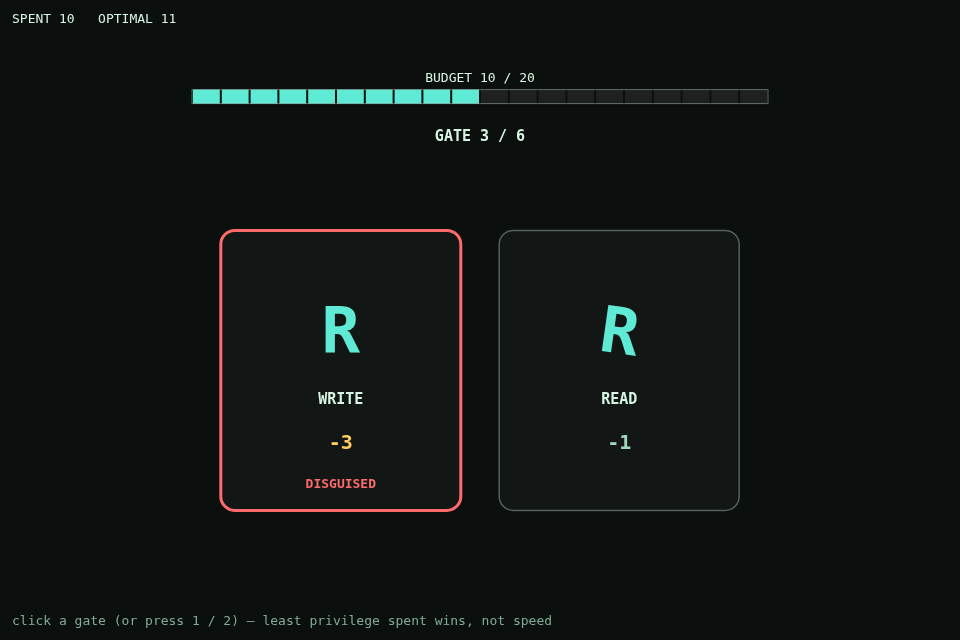
Capability Budget
Cross a run of tool-call gates on a shrinking capability budget — some gates are disguised, claiming less privilege than they actually charge.
Gate Run
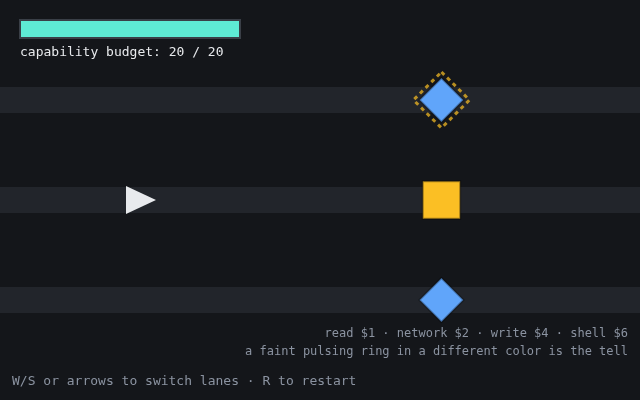
Cross a run of capability gates on the least budget spent — some gates are disguised as cheaper than they are, and the only tell is a faint ring in their true color.
Match Point
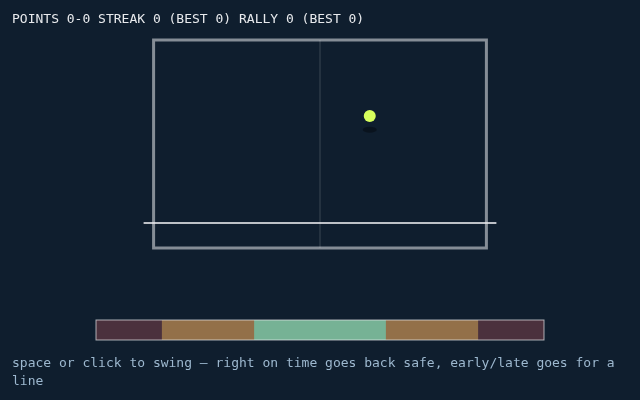
One-input tennis rally mechanic — swing timing alone decides the shot, dead-on-time going back safe and central, early or late peeling off toward a line.
Robo Swerve
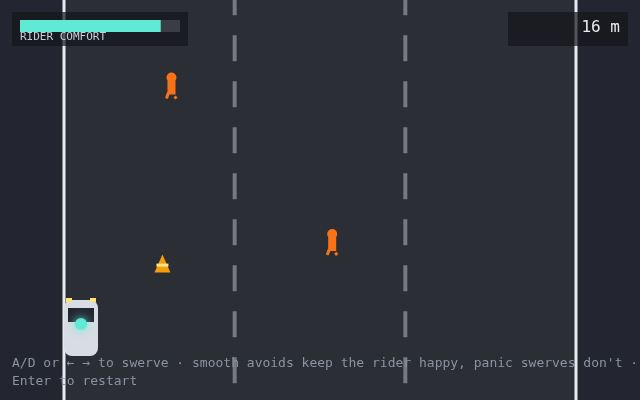
Lane-swerve driving with a passenger-comfort meter — smooth, early avoidance is free, but a late panic swerve costs the ride.
Stolen Base
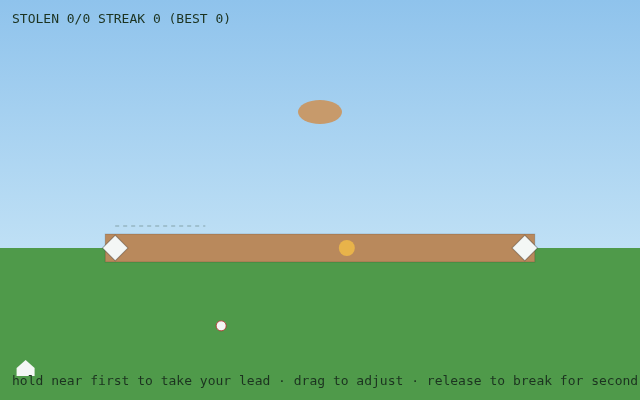
Risk mechanic built around the secondary lead — creep off first for a faster jump to second, but a pickoff throw can snap at any moment with no warning.
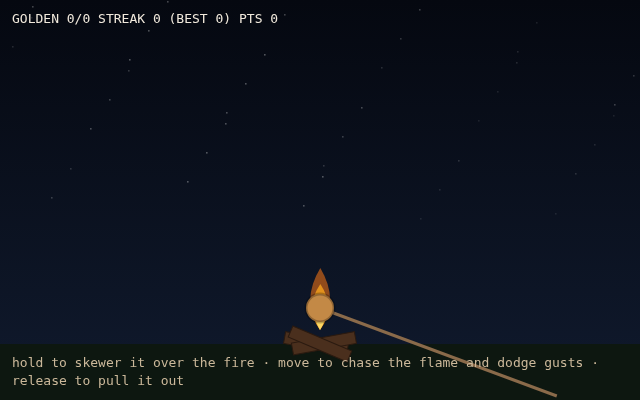
Marshmallow Roast
Chase a wind-buffeted campfire flame with a skewered marshmallow, pull it out golden before it catches — timing and positioning under drift.
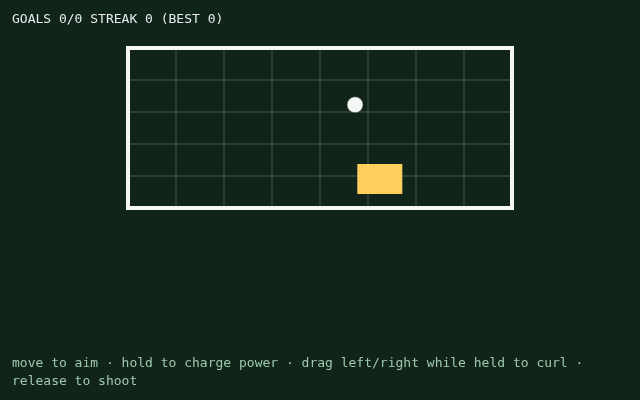
Penalty Kick
Aim-and-curl penalty mechanic — charge power, curve the shot, beat a keeper who reads where the ball is heading, not where it lands.
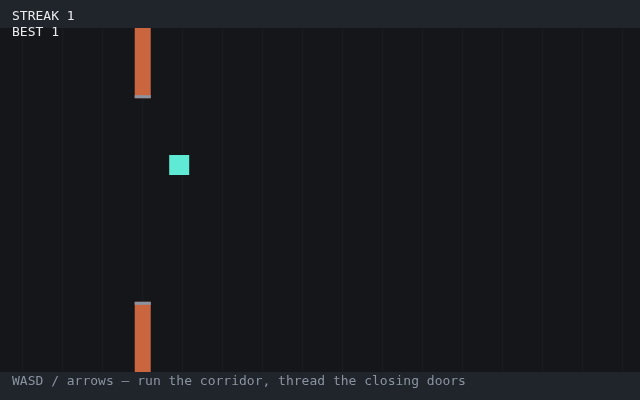
Closing Doors
Threading a shrinking gap on a timer — a closing-gate cycle plus a pure fits-through-the-gap collision test, arcaded into an endless corridor run.
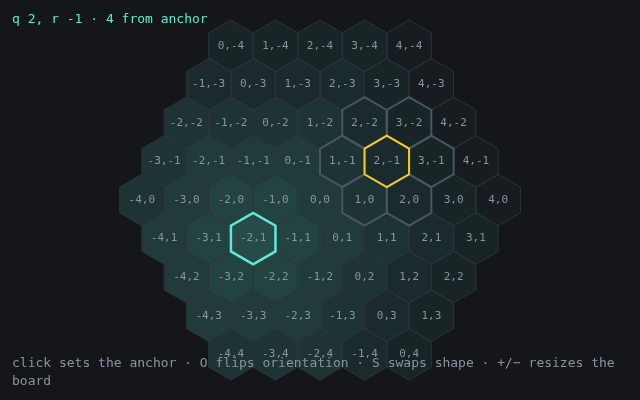
Hex Grid
Hexagon grid base layer for board prototypes — axial coordinates, pixel↔hex mapping, neighbors, distance.
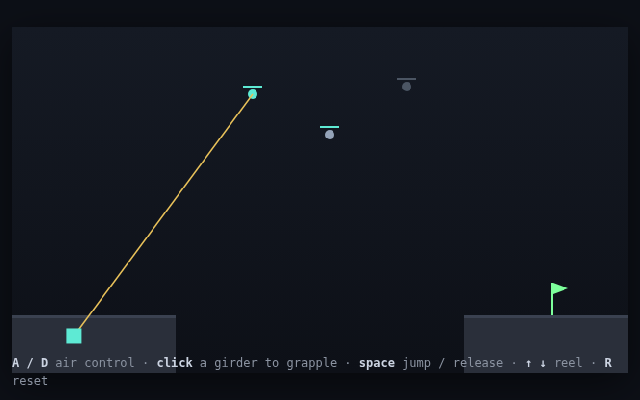
Grapple Swing
Grapple-hook swing mechanic — rope constraint turns momentum into a pendulum arc, release to sling free.
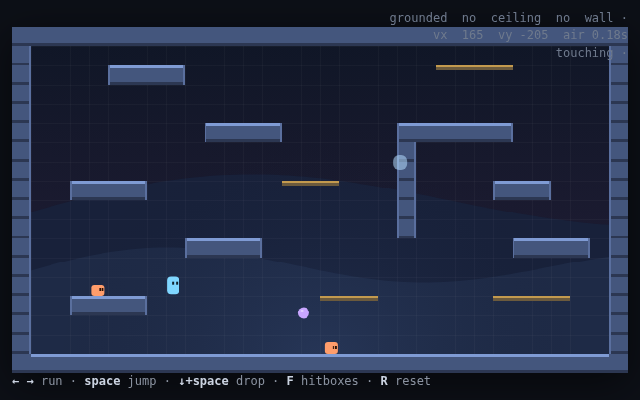
Platform Arena
A tile-based 2D platforming test bed — solid floors and walls, one-way platforms, and a collidable mixin every new entity composes with.
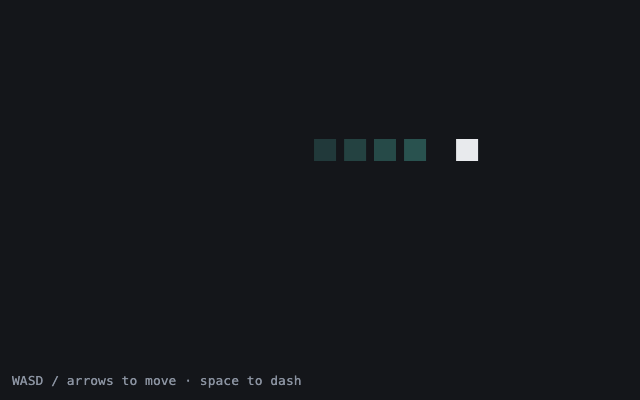
Dash Trail
Dash movement with fading afterimage trail — snappy burst, ghost images, brief input lock.