workshop
Latest
Cheap At Forty
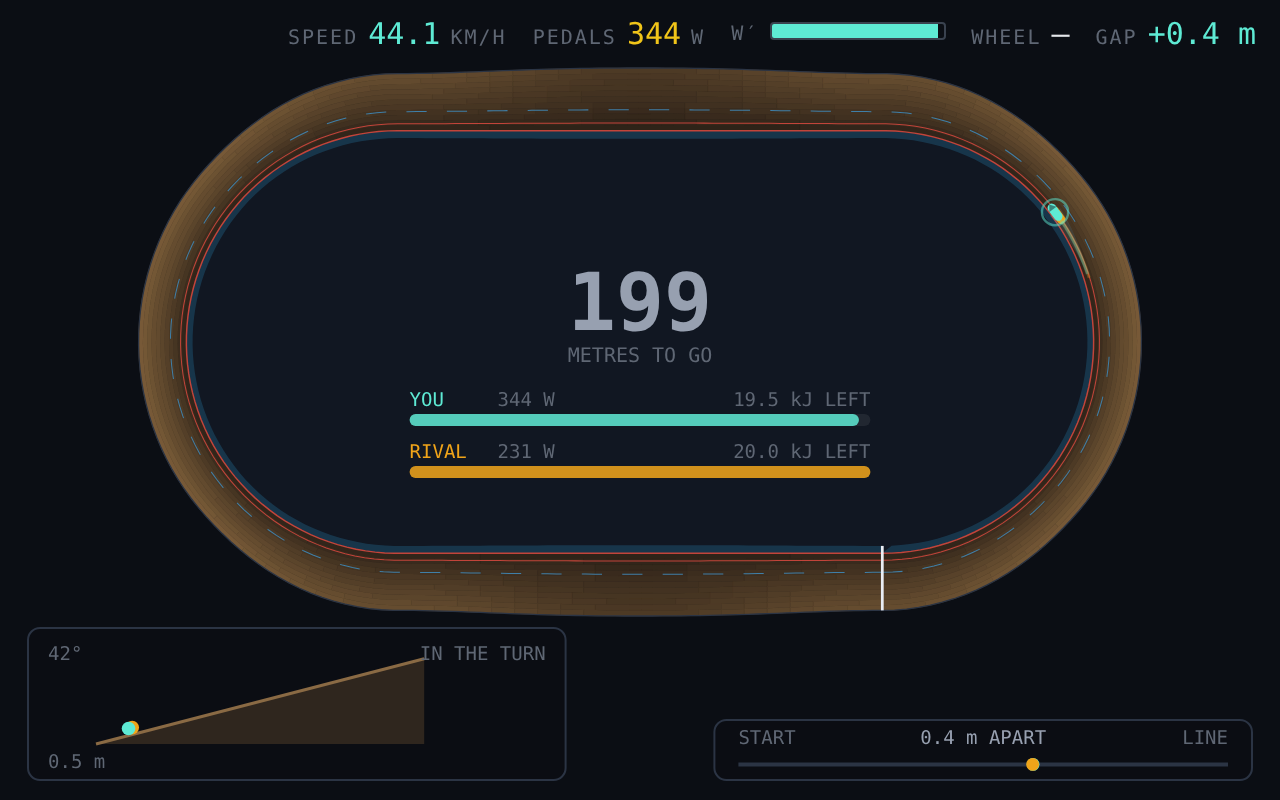
A two-up match sprint on a 250 m velodrome, where the wheel you are towing is worth 88 W at 40 km/h and 378 W at 65 — the cube of the speed, exactly — so the rider on the front is the one who decides what the rider behind them is getting. Lead it at 46 and jump at 200 m and you win 16 times out of 16, having done 81% of the work.
Resync
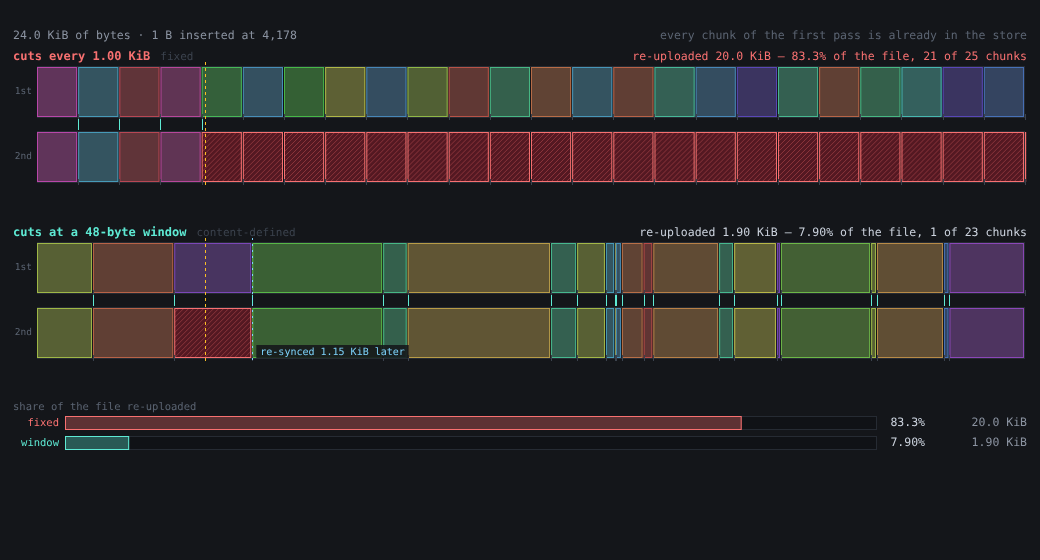
One byte inserted at the front of a 1 MiB file re-uploads 100% of it under fixed 4 KiB chunks and 1.37% under a rolling-hash boundary — and not because the hash knows anything about the content. A cut is decided by a 48-byte window and nothing else, so two passes re-agree the moment the window clears the edit: one expected chunk later, whether the file is 256 KiB or 16 MiB. Swap the window for a hash of every byte so far — still entirely content-defined, no longer local — and it fails exactly like fixed chunking, at 100%.
Coyote
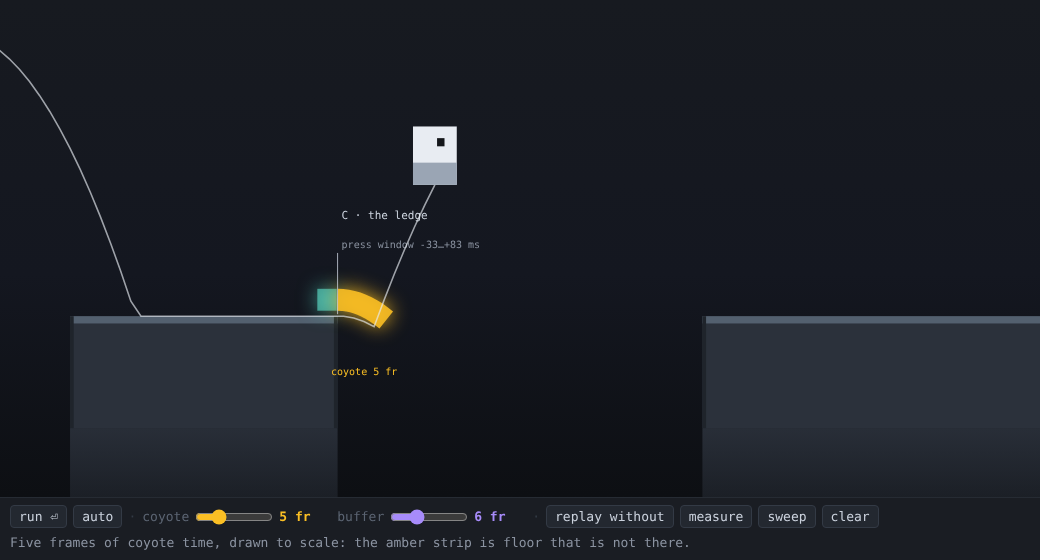
A one-button auto-runner where the only input is when, built to measure what the two famous platformer forgiveness timers are actually worth — coyote time moves a ledge jump from 39.5% to 79.9% and an input buffer moves it by exactly nothing, 89.5% of winning runs die when the same presses are replayed with the timers off, and a player with zero timing error clears the course 0% of the time.
Half Each
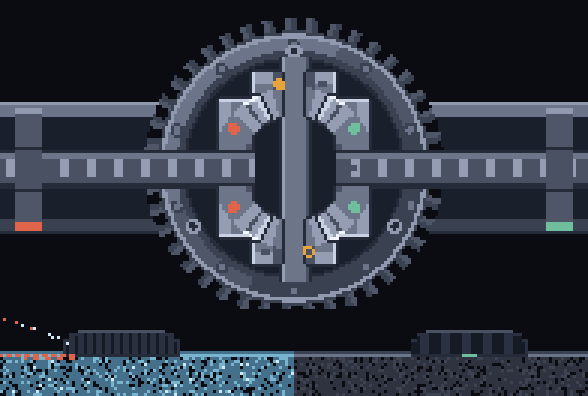
196×132 pixel differential in section with five loops. A differential does not decide how to split torque between the two wheels — it is a lever with equal arms and it cannot split it at all. Each wheel gets exactly half, always, so the axle is capped at twice its worse tyre: one wheel on ice hands the dry one 129 N·m of the 1,160 it could have held, and a wheel lifted clear of the ground drops the whole axle to zero with nothing broken. The fix is not a better differential. It is a worse one.
Snap
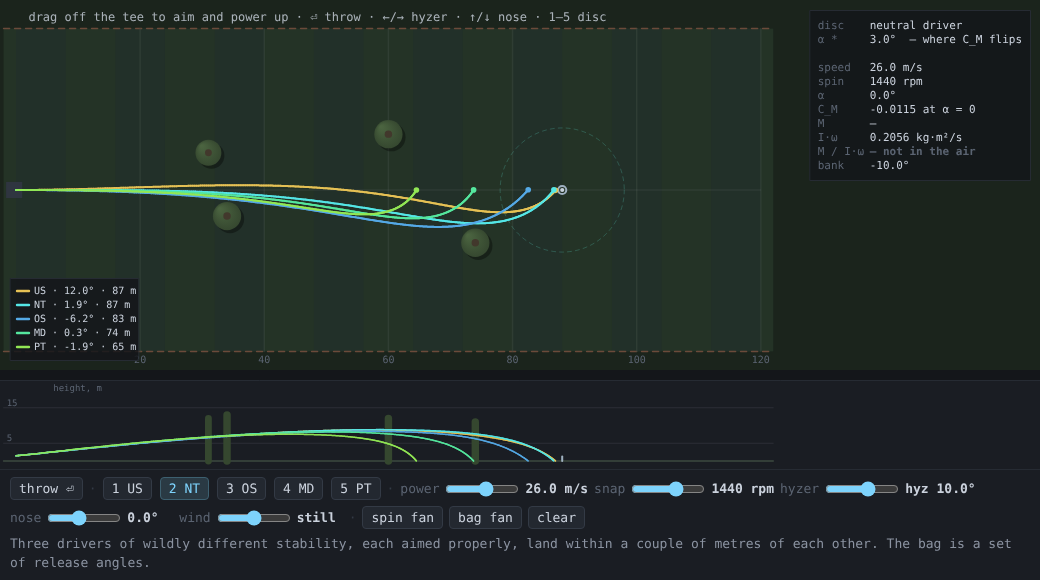
A flying disc, where turn and fade are not two behaviours but one coefficient on either side of a sign change, divided by spin — so the 35.7 m that snap is worth to a flat release is worth 2.6 m to a thrower who re-aims for it, and three drivers of wildly different stability, each released on the angle that aims it, land within 4.4 m of each other.
Unlink
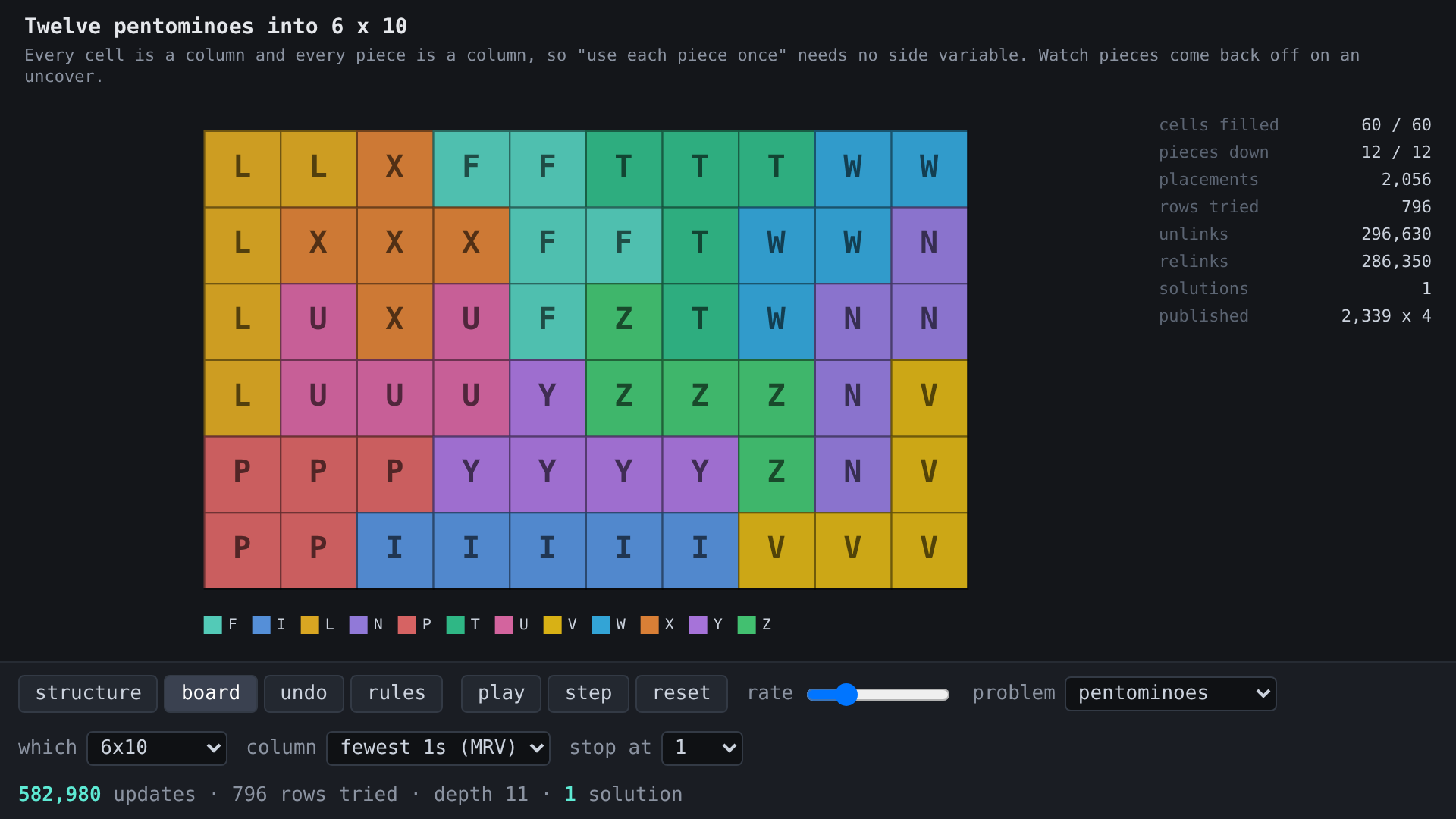
Dancing Links drawn from its own pointers, because the trick is that there is no undo log — cover writes to a node's two neighbours and never touches the node, so the removed node still points into the list and uncover just reads it back. A 2.4-billion-update pentomino enumeration allocates nothing and hands the matrix back bit-identical.
Cheap At Forty
A two-up match sprint on a 250 m velodrome, where the wheel you are towing is worth 88 W at 40 km/h and 378 W at 65 — the cube of the speed, exactly — so the rider on the front is the one who decides what the rider behind them is getting. Lead it at 46 and jump at 200 m and you win 16 times out of 16, having done 81% of the work.
Good Roller
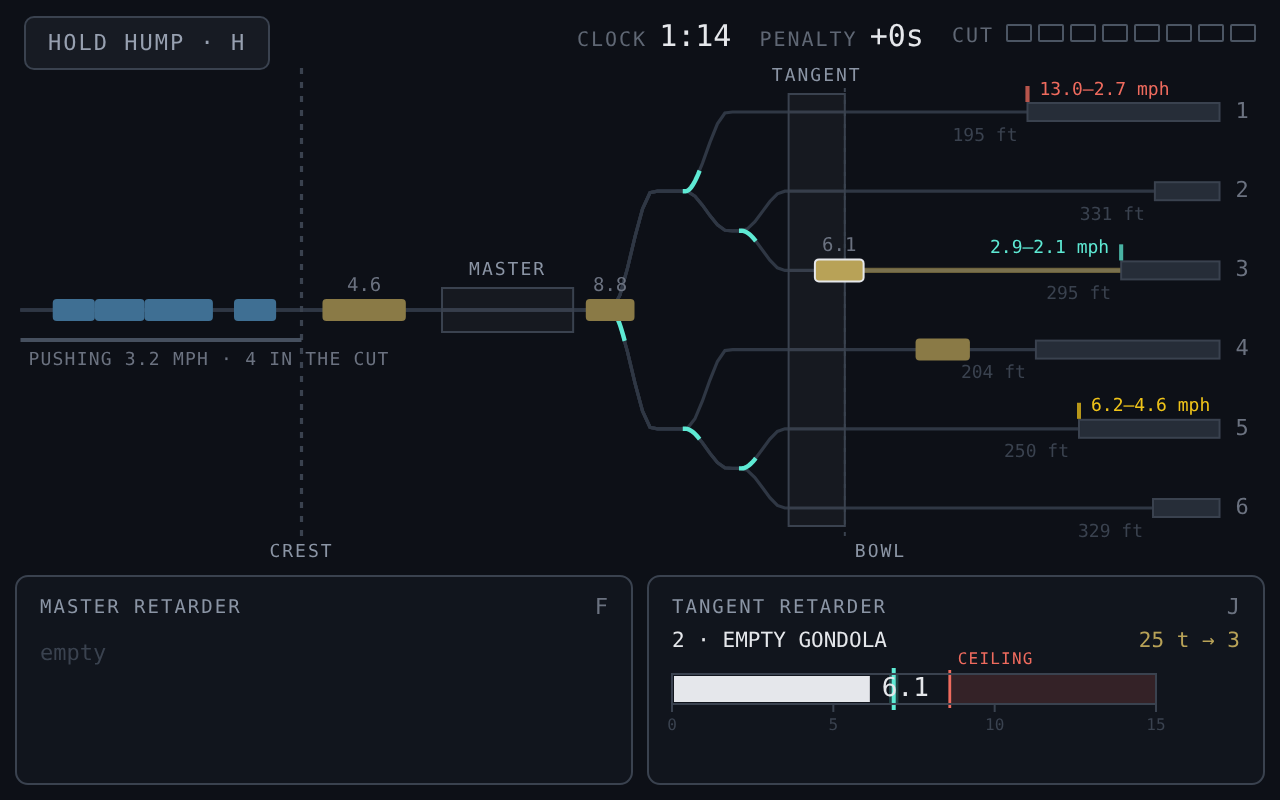
A hump yard where gravity does the pushing and two retarders are the only things you own. A 1% grade is worth exactly 20 lb per ton, the bowl falls at 0.12%, and whether that is downhill or uphill depends on a number about the car that nothing in the yard can measure.
Backing
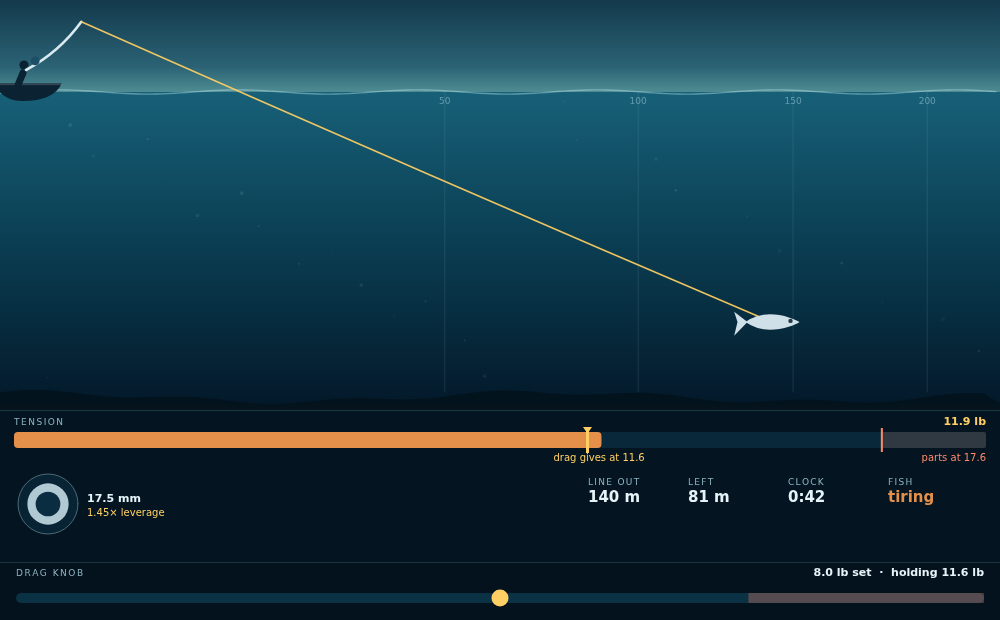
A drag is a friction clutch, so what it holds constant is a torque — and the line leaves from a radius the fish spends the whole fight making smaller. On this reel that is 2.43× between the lip and the arbor, so a 6 lb knob is 6 lb at the rod tip and 14.4 lb two hundred metres later, with nothing on the reel to say so. Against a 48 lb fish in open water that leaves exactly one fixed setting, 7 lb, that lands all twelve — and it wins by being spooled to within 5 m of the knot. Eleven pounds, a drag that is lighter than the winning one for the first 113 m of every run, parts the line 12 times out of 12 at an average of 133 m. Wind the knob down as the line leaves so the tension at the fish never moves, and 14.5 lb — never once lighter than the setting it beats — lands 40 out of 40, takes 37% off the fight and keeps 45 m more on the spool. The other half of the lesson is that the softest spring in the system is the line you have out: 20 lb braid at 150 m needs the fish to move 4.04 m to part it, and the same braid at 15 m needs 0.48.
Bind
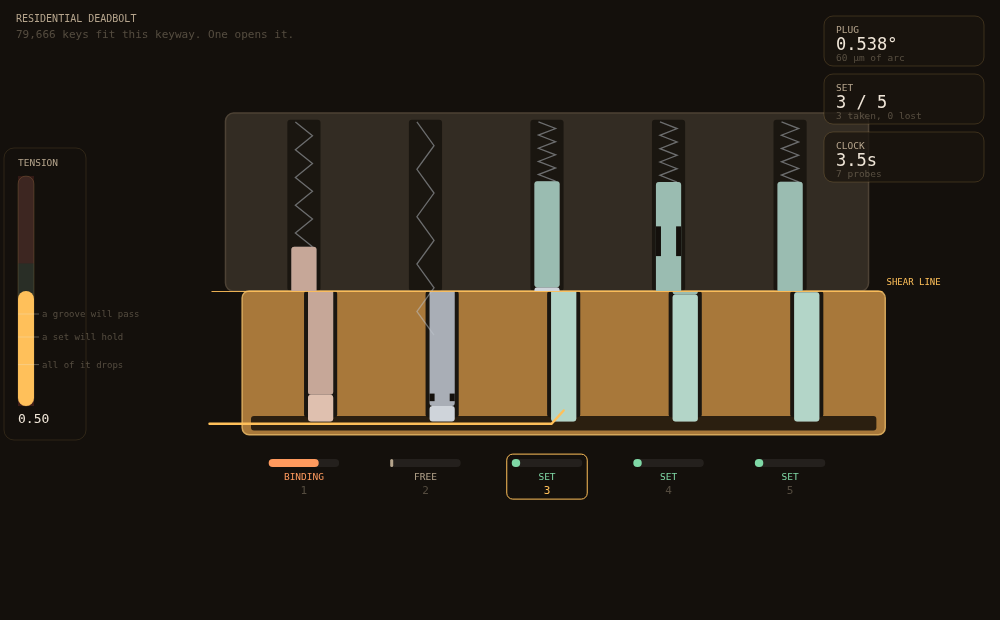
A lock has no partial credit — five pins at ten depths is 79,666 legal keys and 79,665 of them do exactly as well as a stick. Then the factory drills the chambers a thousandth of an inch out of line, one pin takes the whole load, and 39,833 median guesses collapse into about fifty moves. Tighten the shear line to stop that and the key fails first, because the key has to land all five at once and the pick lands them one at a time.
Egress
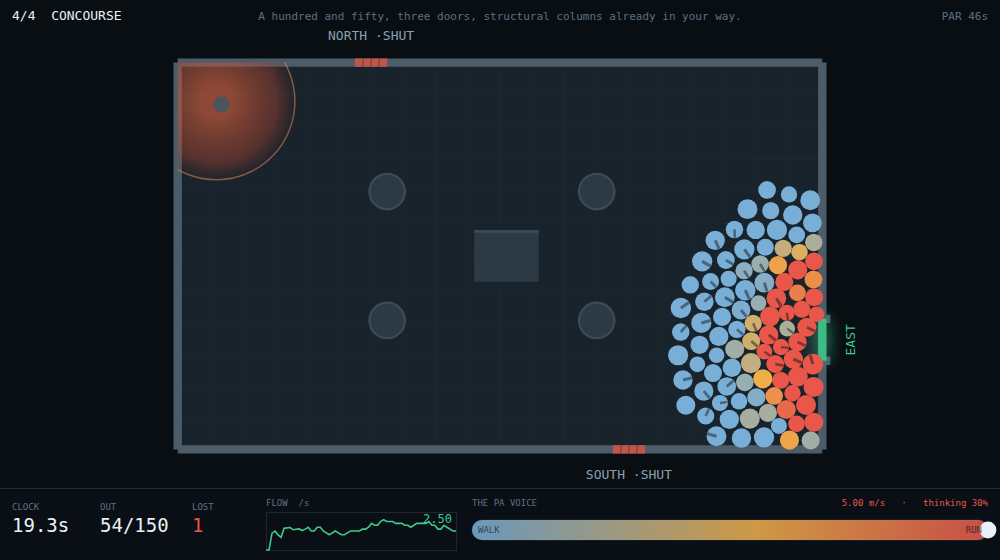
You are the voice on the PA and the only dial you have says how hard everyone is trying — which moves their walking speed and how well they still follow a route, both at once. Underneath is a Helbing social-force crowd on an Eikonal floor field, and it disagrees with the poster. Wrecking the crowd's navigation costs nothing measurable (112 s against 115); over-urging costs 9.6%; and leaving the dial at a stroll costs 74%, so the instinct worth distrusting is politeness, not panic. The door decides everything else: the same hundred people clear 1.50 m in 25 s and 0.80 m in 123 s, because throughput goes as width^2.24 rather than linearly — a 2.4 m door carries 12.6x what a 0.8 m one does on 3x the width, which is also why splitting one opening into two doors of half the width is 1.8x to 2.8x slower than leaving it whole. And one bollard beats a bare doorway by 16.7% when it sits 0.6 m upstream and a full metre off the centreline, while 11 of the 36 places you could put it seal the room and nobody gets out at all.
Oche
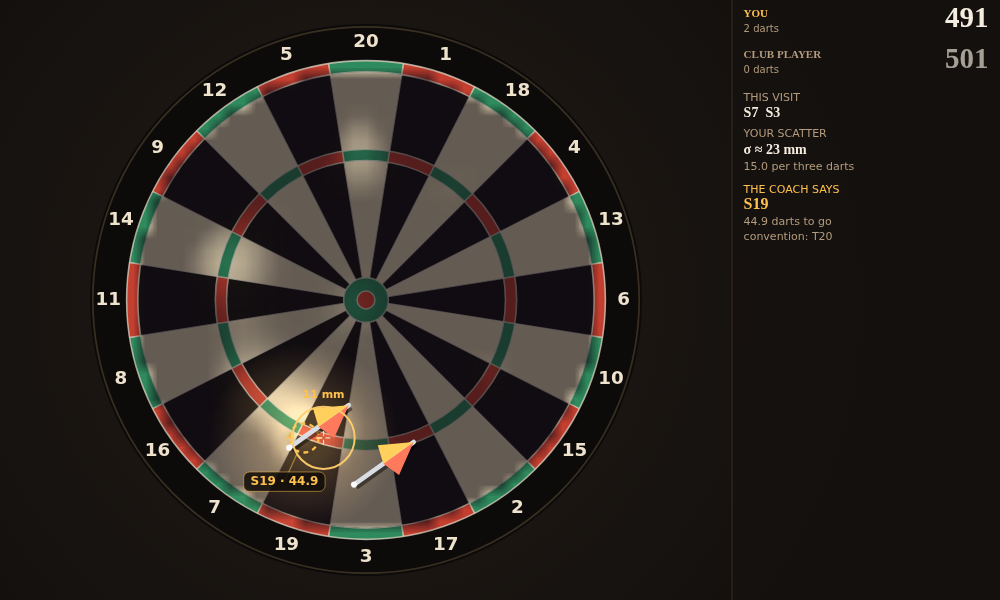
A dartboard is not a target, it is an arrangement, and the 20 is flanked by the 1 and the 5 — the meanest pair of neighbours on the board. Below 16.88 mm of scatter the treble twenty is the best place to aim and above it nothing is, so the piece measures how straight you actually throw and then plays your leg of 501 from there, one aim point at a time.
Sink
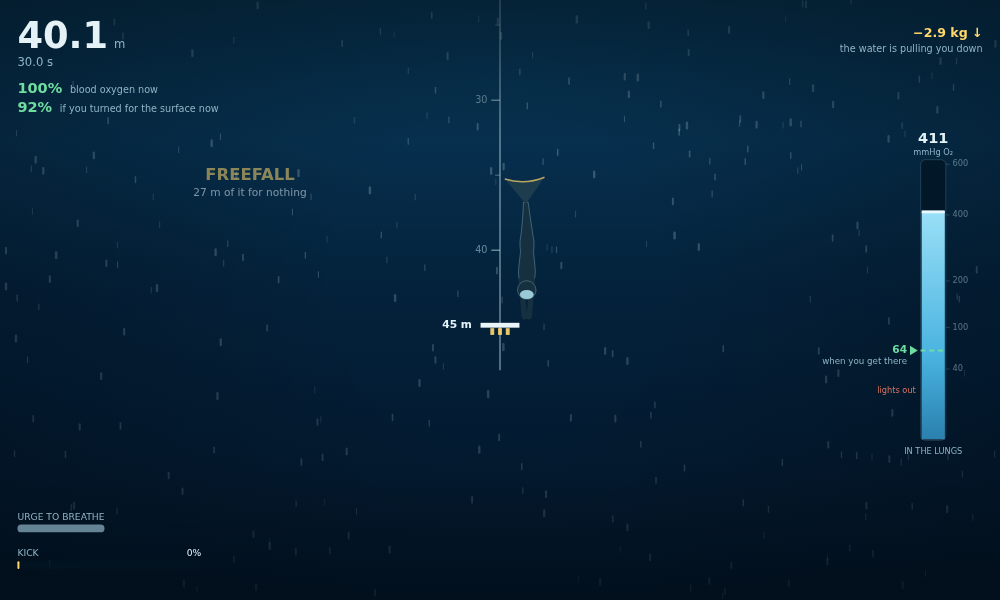
Ten metres down your lungs are half the size they were and you stop floating, so the rest of the way to the plate is free. The oxygen gauge in your chest then reads its best number of the whole dive at the bottom — because it is a fraction multiplied by a pressure you are about to give back — and 59% of the blackouts land in the last ten metres of a dive that went to fifty.
Flare
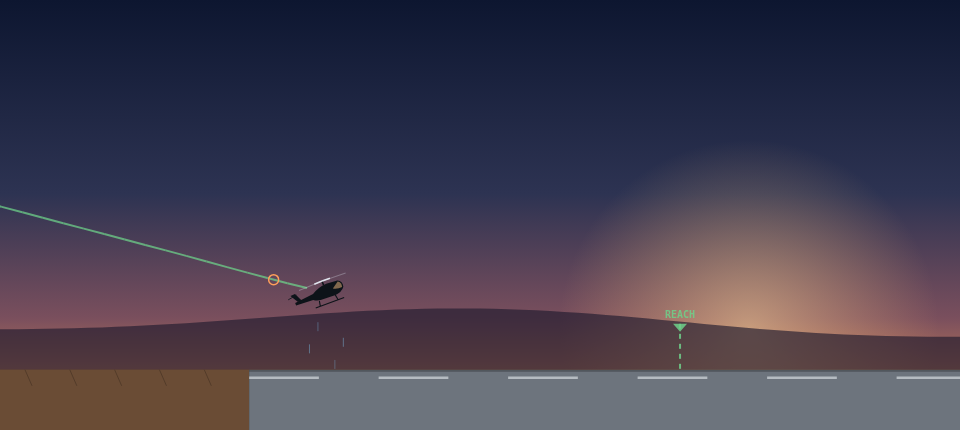
The engine is gone and the rotor is a flywheel with about a megajoule in it. Everything you do from here spends it, you only get to spend it once, and the landing is the last two seconds — so the whole game is refusing to buy anything comfortable on the way down.
Send
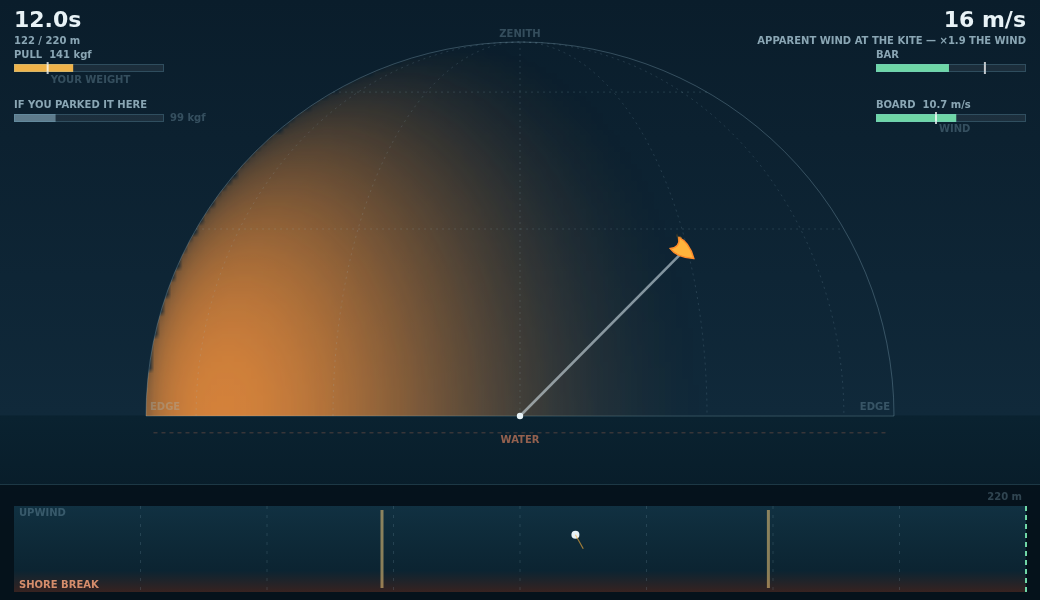
A nine-metre kite on twenty-four-metre lines, and one fact holding the whole thing up — a kite that is sitting still pulls with the wind, and a kite that is moving pulls with its own apparent wind, which is several times bigger and enters squared. Two hundred and twenty metres of beach, one hand on the bar, and nowhere to put the kite down.
Resync
One byte inserted at the front of a 1 MiB file re-uploads 100% of it under fixed 4 KiB chunks and 1.37% under a rolling-hash boundary — and not because the hash knows anything about the content. A cut is decided by a 48-byte window and nothing else, so two passes re-agree the moment the window clears the edit: one expected chunk later, whether the file is 256 KiB or 16 MiB. Swap the window for a hash of every byte so far — still entirely content-defined, no longer local — and it fails exactly like fixed chunking, at 100%.
Unlink
Dancing Links drawn from its own pointers, because the trick is that there is no undo log — cover writes to a node's two neighbours and never touches the node, so the removed node still points into the list and uncover just reads it back. A 2.4-billion-update pentomino enumeration allocates nothing and hands the matrix back bit-identical.
All At Once
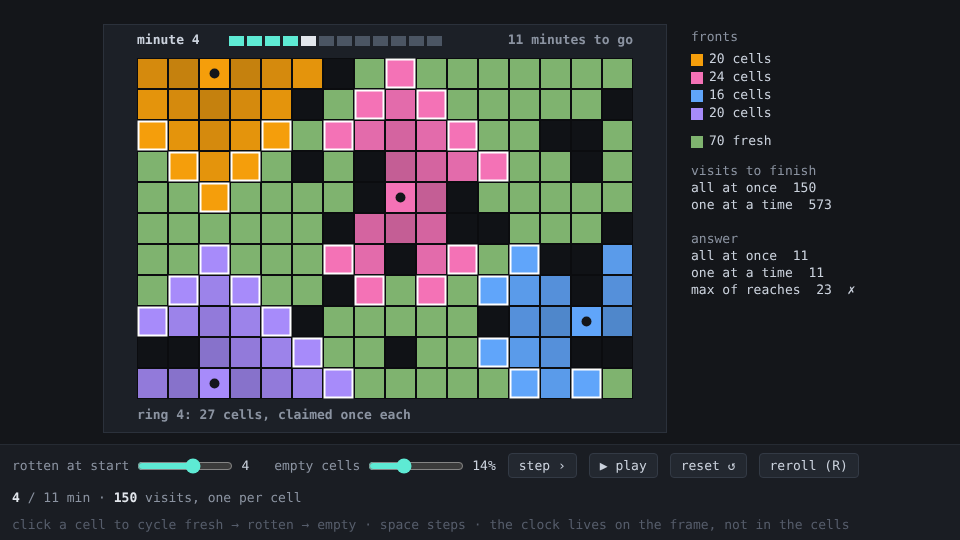
Rot spreading across a grid of fruit one ring per minute from four origins at once — the queue is seeded with every rotten cell before the first step, the clock sits on the frame rather than in the cells, and the seams where fronts meet are the proof that no cell is ever claimed twice.
Even Odds
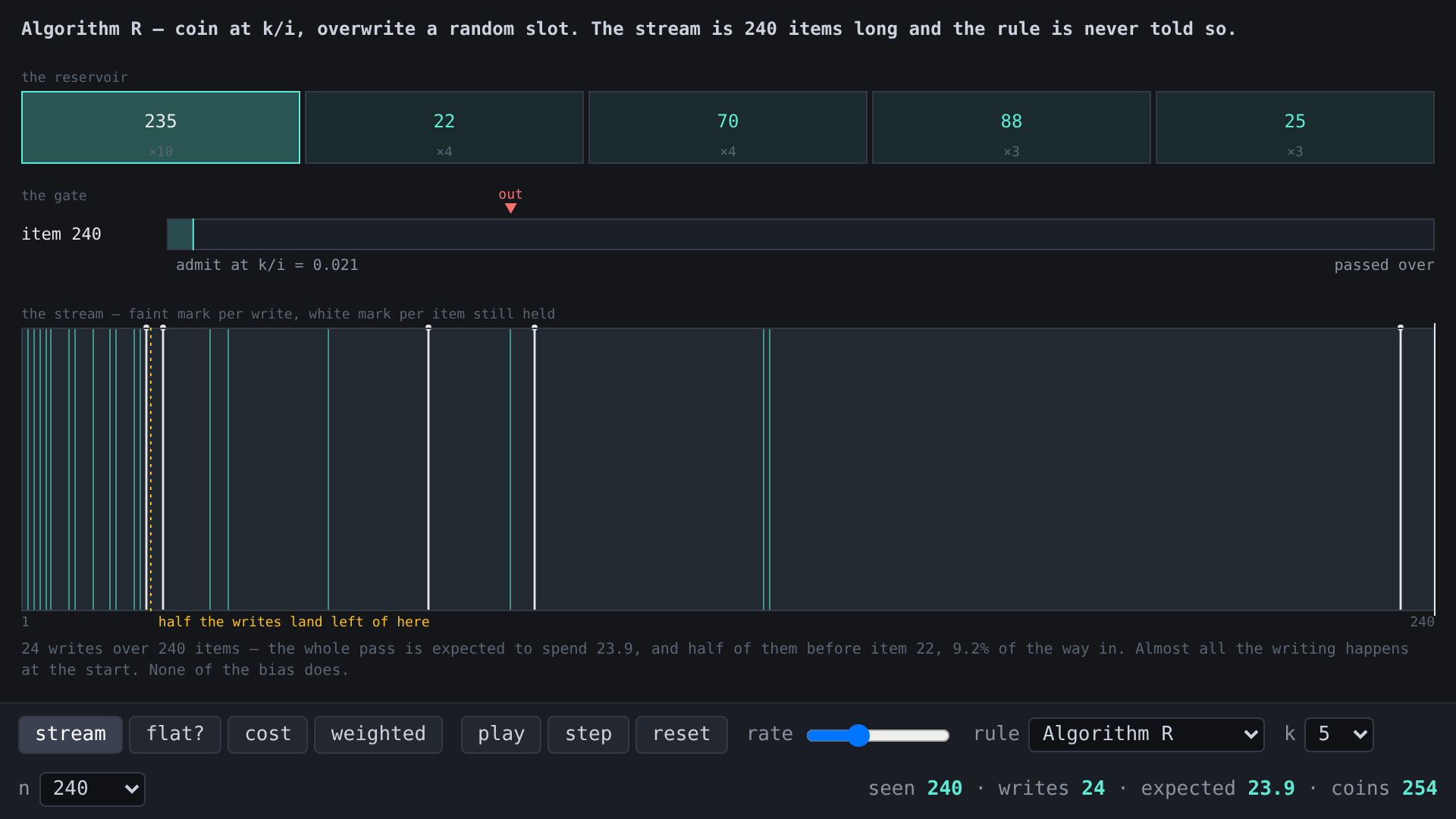
Reservoir sampling keeps k items from a stream it cannot count or rewind, and the rule looks obviously unfair: item 1 is taken for certain, item 1,000,000 is taken at odds of 5 in a million. It is exactly fair, because admission k/i and survival i/n multiply to k/n and the i cancels. Measured over 20,000 passes, Algorithm R's worst position sits 1.1× its 3σ band. Its rivals fail in four distinct ways, and the weighted version — the one everybody cites as proportional — is proportional only at k = 1, running 17% short on the heaviest item by k = 12.
Survivors
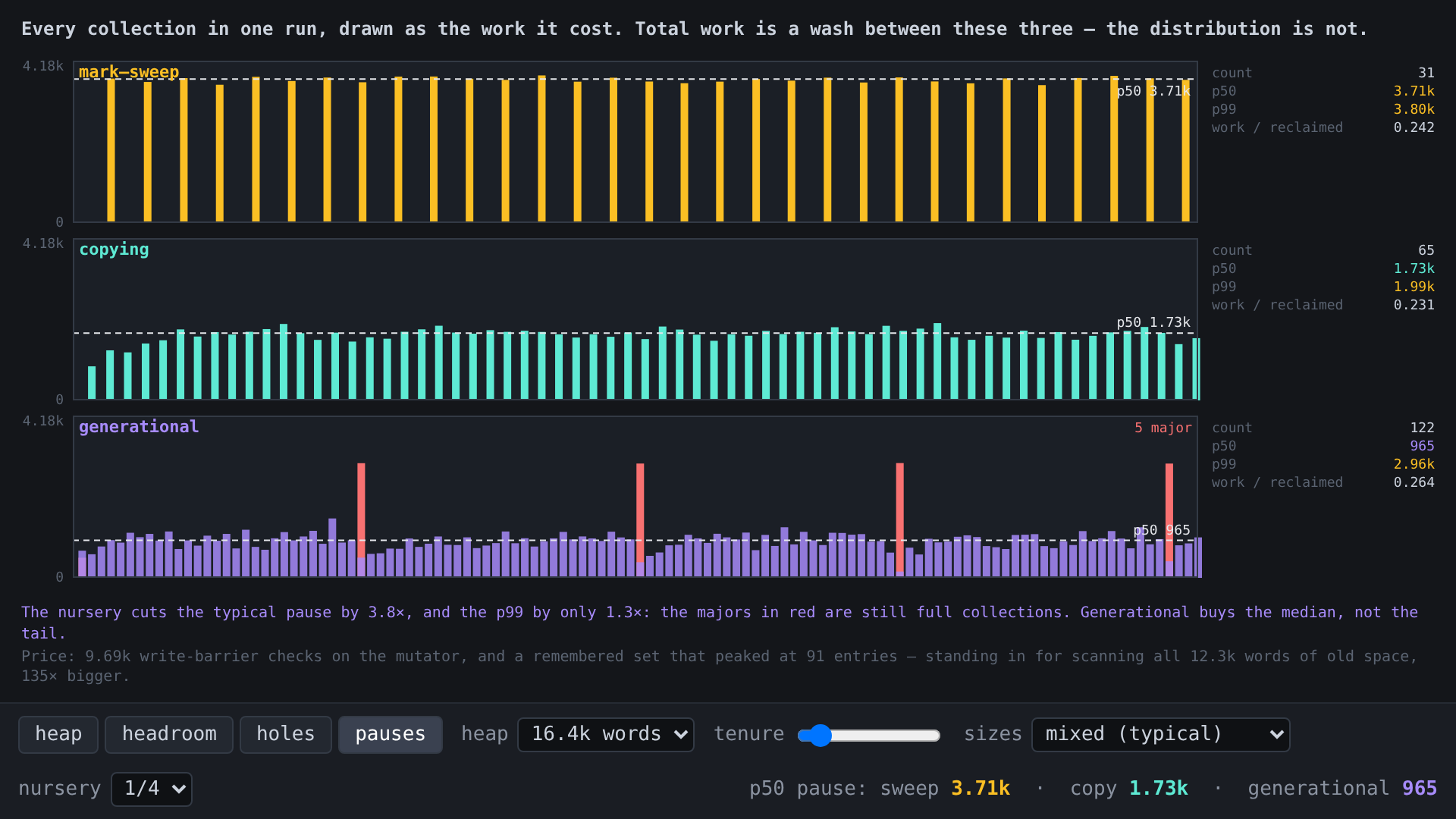
A garbage collector's work is proportional to what lives, not to what died — so buying memory drives a copying collector's cost to zero and cannot do the same for a sweeping one. Three collectors run one program and every word they touch is billed. Copying costs 2s/(1−s) per word reclaimed; sweeping costs that plus one visit per corpse, a floor of 0.190 words it never gets below. They cross at s = 16.2%, which is why the nursery is copied and the old generation is swept.
Squint
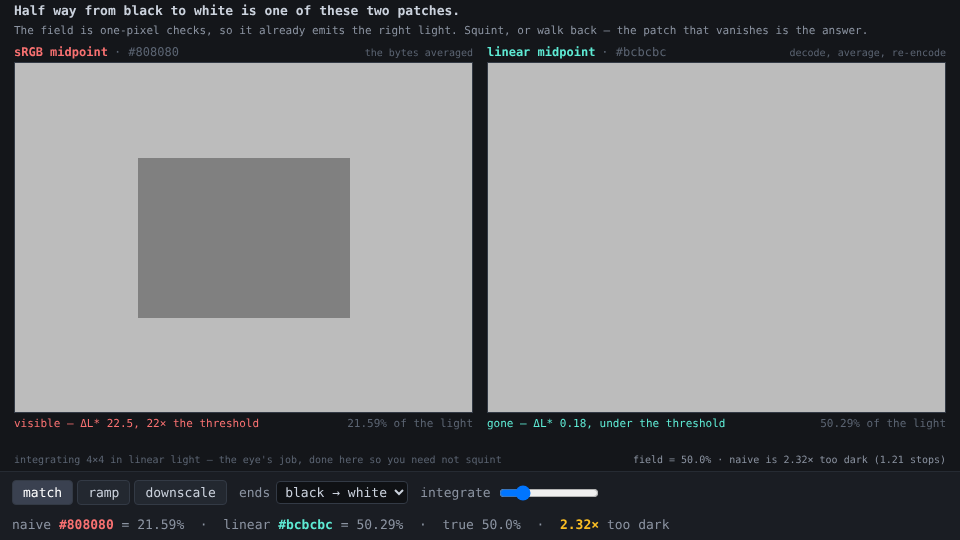
Half way from black to white is byte 188, not 128, and the test is not an argument — it is a checkerboard you can look at. Byte 128 emits 21.59% of the light where half was asked for: 2.32× too dark, 1.21 stops, ΔL* 22.5 against a threshold of 1. Run one box filter in the two spaces and one-pixel hairlines come out at 21.59% or 50.29% of the light they went in with; a field of one-pixel dots loses 91.7% of its light to the filter that averaged the bytes.
Reach
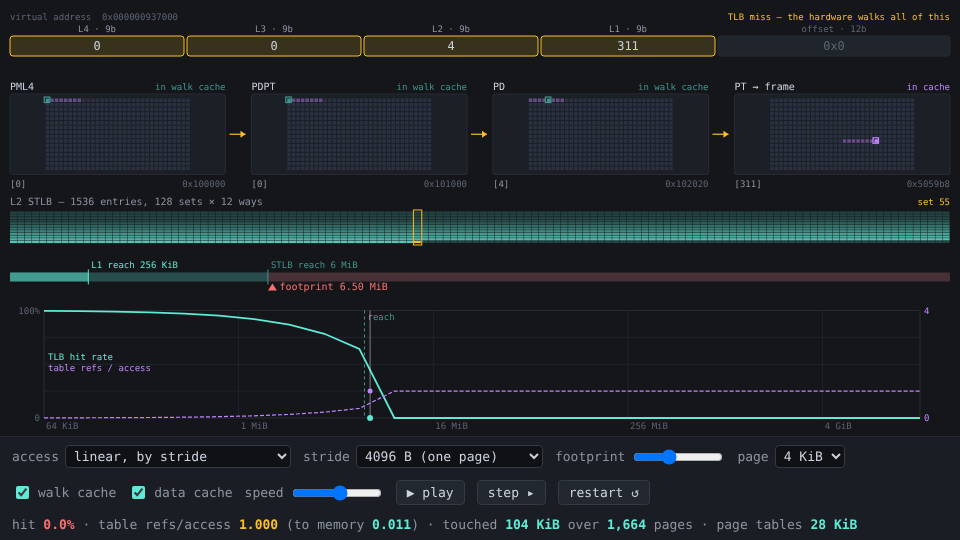
An x86-64 address translation drawn at the size the hardware actually works at — four tables of 512 entries, and a 1536-entry TLB whose whole job is that you never read them. The TLB covers 6 MiB, and the collapse past it is 512 KiB wide and made of associativity rather than capacity: 1536 pages hit 92.32% and 1664 pages hit exactly 0.00%, because 1664 is 128 sets times 13. The stream that misses every single time is also the one touching the least data — 104 KiB of it.
High Water
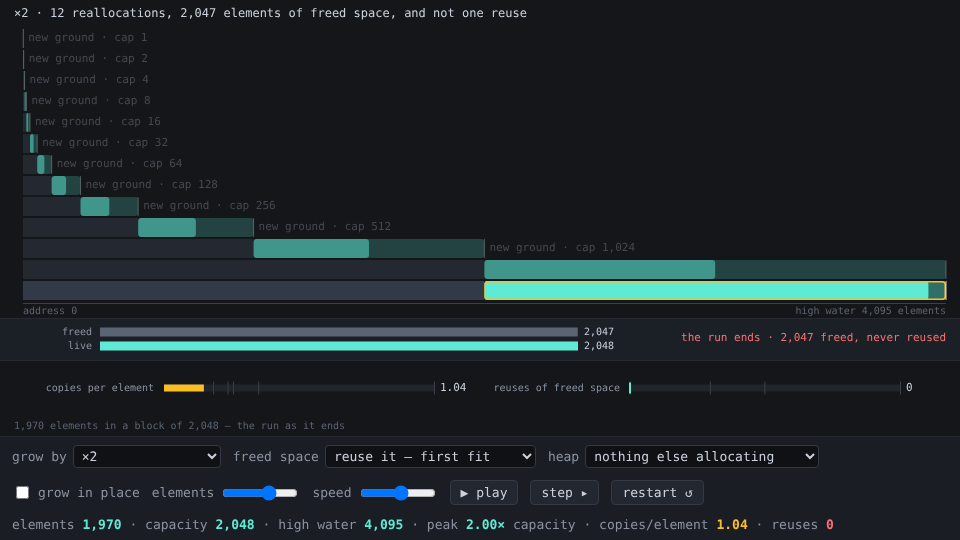
A growable array over a real allocator, so the growth factor can be charged for both of the things it costs. Doubling copies each element 1.3 times and never — at any n, for an arithmetic reason — takes back one element of the 131,071 it has freed. ×1.25 takes them back 23 times and copies each element 4.8. The threshold between the two is the golden ratio, close enough that rounding the new capacity up instead of down is what decides which side you are on.
Evict
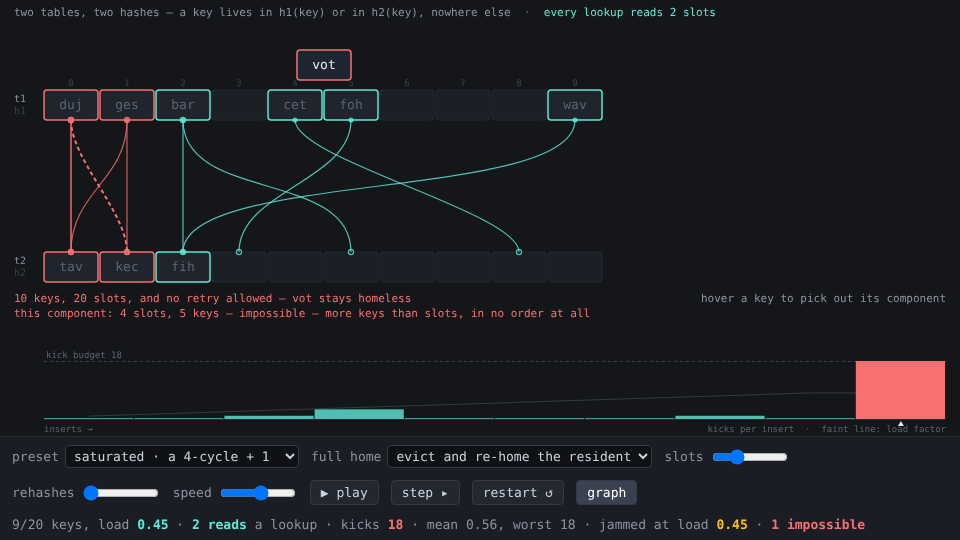
Cuckoo hashing drawn as the two claims it actually makes — every lookup reads exactly two slots at any load factor, and the entire cost of that moved into insert, where a chain of displacements either reaches a free slot or goes round forever. Read the table as a graph, one vertex per slot and one edge per key, and the jam stops being bad luck in the insertion order: it is a component holding more keys than it has slots, which no order places.
Half Each
196×132 pixel differential in section with five loops. A differential does not decide how to split torque between the two wheels — it is a lever with equal arms and it cannot split it at all. Each wheel gets exactly half, always, so the axle is capped at twice its worse tyre: one wheel on ice hands the dry one 129 N·m of the 1,160 it could have held, and a wheel lifted clear of the ground drops the whole axle to zero with nothing broken. The fix is not a better differential. It is a worse one.
Notched Up
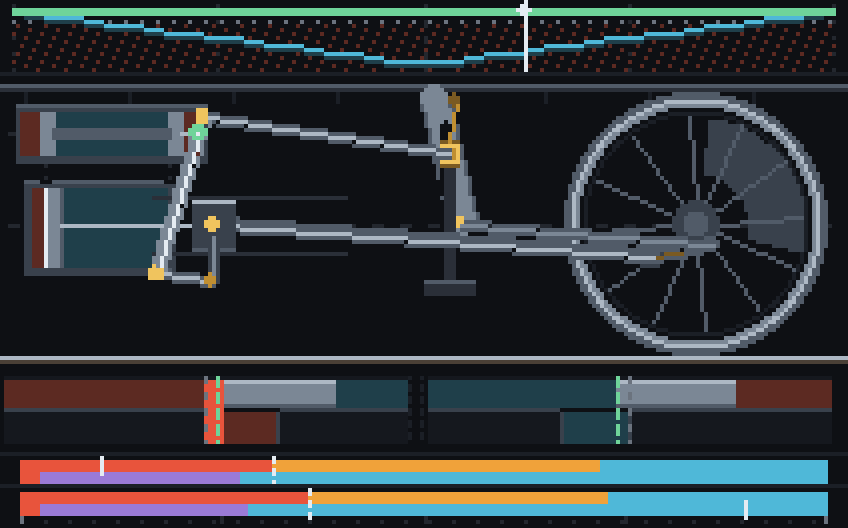
212×132 pixel Walschaerts valve gear in side elevation with five loops. Notch the reverser from 84% cutoff down to 9% and the lead moves by three thousandths of an inch — because the eccentric is set at exactly 90°, and the lap and lead come off the crosshead, which the reverser cannot reach.
Double Step
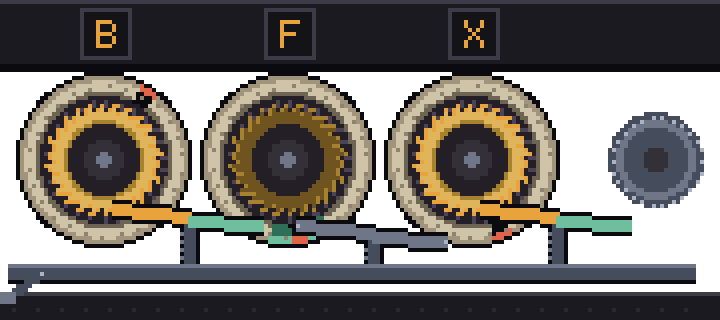
180×80 pixel Enigma stepping gear with three loops — three ratchets, three notched rings, three pawls on one bar. A pawl sitting in a notch is not a follower, it is a driver, and because one pawl does two jobs the middle rotor sometimes moves twice in a row. The odometer that should run 17,576 keys runs 16,900, and 650 of its positions can never occur.
Half Past
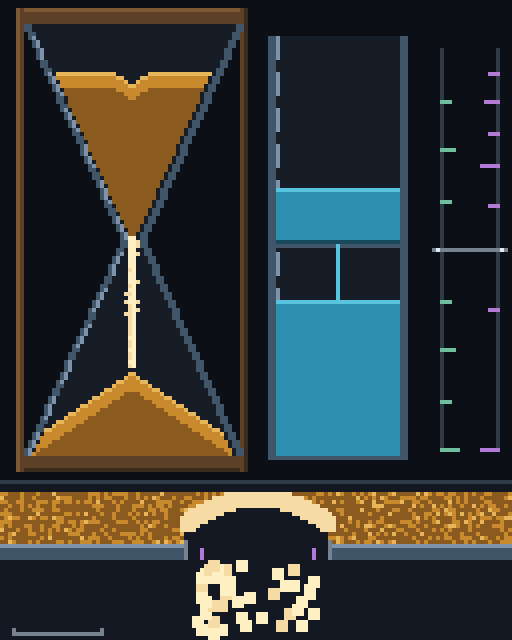
128×160 pixel hourglass and a water clock of the same 18.33 cm³, five loops, one timeline. Sand's discharge has no head term in it — Beverloo gives Q = C·ρ·√g·(D−1.4d)^(5/2) and nothing else — because the grains above the hole arch, and what leaves is dropped 0.34 mm rather than pushed. So every eighth of this glass takes 22.83 s, while the matched water column spends 11.80 s on its first eighth and 64.57 s on its last: a spread of 5.47× across one drain. The exponent is the bill. Five halves on the aperture means ±1 s wants the 1.6 mm neck held to ±3.5 µm, which nobody bores — so you weigh the sand instead, where ±1 s is ±154 mg — and 0.1 mm of wear costs 32 seconds. The same arch is also the floor: below about five grain diameters it stops breaking on its own, and the 0.680 mm hole that makes the water take 182.6 s is 2.7 grains across. The two clocks cannot share a hole.
Coned
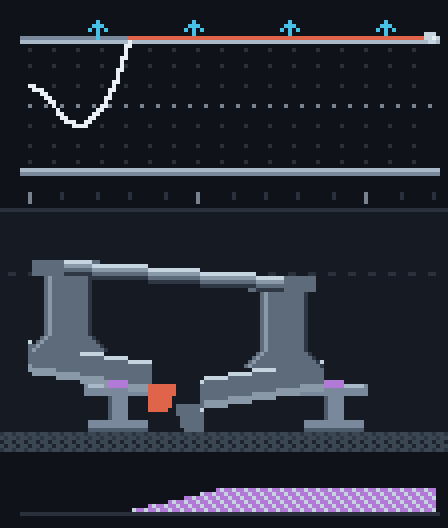
112×132 pixel wheelset with five loops: the weave it traces, the two contacts it rides on, and what it slides. A train has no differential — two wheels welded to one axle — so the only steering it owns is the 1:20 cone on the tread. Three things fall out. It weaves, at a wavelength of 14.48 m that is a fact about distance and not about speed, so the same shape runs past at 0.96 Hz on a subway and 2.76 Hz on a mainline. It is unstable: a free wheelset with creep forces grows from a 0.3 mm nudge to flange contact in 150 m, while the same wheelset sprung, let go hard against a rail, comes back down a clean exponential at 2.6 to a swing — what makes a train stable is not the cone but the springs. And it runs out almost at once — 7 mm of play against a cone that needs 35.39 mm to steer a 150 m curve, so the tightest radius it manages unaided is 758 m. Past that the steering is the flange: a 150 m curve asks the contact for 0.995% creepage, the cone can give 0.197%, and the 0.798% left over is 1.88 m of tread slid through a quarter circle by a force 4.7 times what friction can hold. Grind the cone steeper and the curves come back — 1:3.3 steers 126 m — and the model's critical speed falls from 330 km/h to 131.
Too Wide
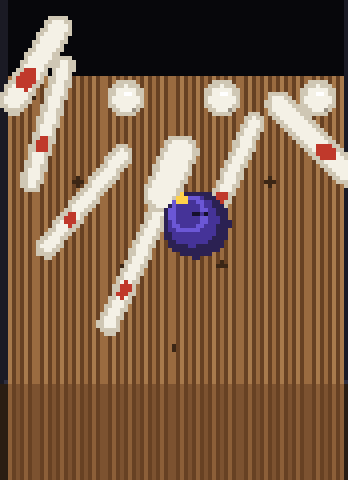
87×120 pixel tenpin deck in plan with four loops. Two pins are 12 in apart and 4.766 in thick, so the clear air between them is 7.234 in and the ball is 8.500 — too wide by 1.266. Flood the ball's configuration space and five of the ten pins turn out to have no position it can ever touch them from. It is not an energy problem: toppling a pin costs 0.0280 ft·lb and the ball arrives with 144.9, which is 518 times the whole rack. At the book pocket the ball touches three pins and the 1-3 door is 11.26 in wide by the time it gets there; take the entry angle out and the door is still 6.57, the ball has to shove, and it leaves the 8.

Detached
238×120 pixel Swiss lever escapement in plan with four loops. The balance is connected to the rest of the watch for 7.5 ms of every 125 ms beat — 6% of the time — and the other 94% is what the whole mechanism is for.
Low D
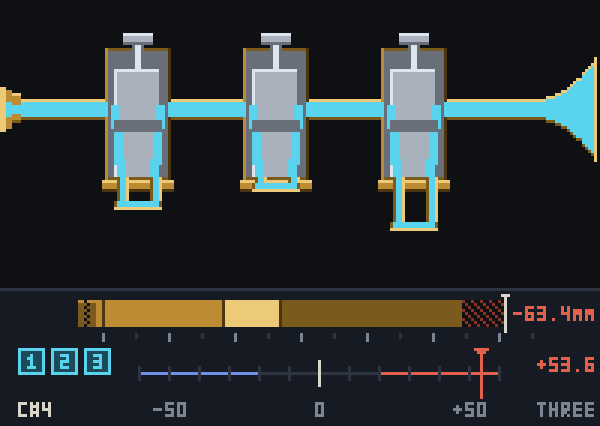
200×142 pixel trumpet valve block in section with five loops. Each of the three loops is cut exactly right, and together they are 63.40 mm of tube short — 53.56 cents, a quarter tone and then some, on written low C#. The error is not an approximation of anything; it is precisely the four cross terms you throw away when you expand a product as a sum. And it cannot be engineered out: the flattest three tubes that exist are still 16.32 cents wrong, which is why the instrument has a ring on it instead.
Standout
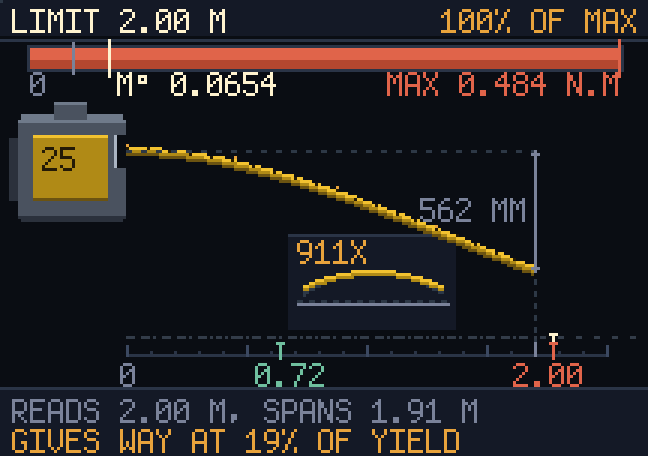
216×152 pixel tape measure with five loops. The blade is a strip of steel bent cold into a 20 mm arc, and that arc is worth 911 times the same strip flat. It stands out to 2.00 m, folds with no warning at 19% of yield, and then will not stand up again until you have wound it back to 0.72 m — a hysteresis of 2.77 that everyone who owns one has met and nobody is told the reason for.
Coyote
A one-button auto-runner where the only input is when, built to measure what the two famous platformer forgiveness timers are actually worth — coyote time moves a ledge jump from 39.5% to 79.9% and an input buffer moves it by exactly nothing, 89.5% of winning runs die when the same presses are replayed with the timers off, and a player with zero timing error clears the course 0% of the time.
Snap
A flying disc, where turn and fade are not two behaviours but one coefficient on either side of a sign change, divided by spin — so the 35.7 m that snap is worth to a flat release is worth 2.6 m to a thrower who re-aims for it, and three drivers of wildly different stability, each released on the angle that aims it, land within 4.4 m of each other.
Sidecut
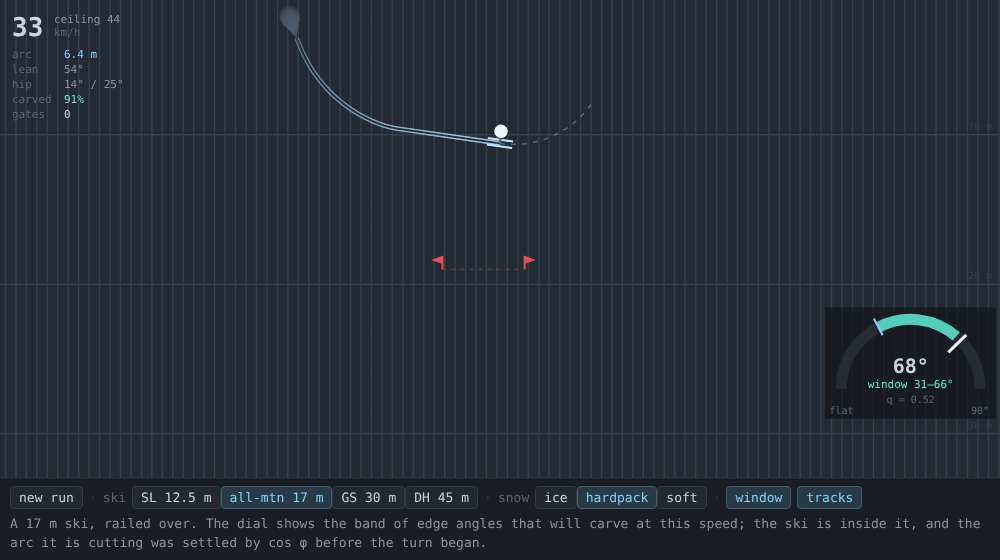
A carved ski turn where you never get to pick the arc — R = R_sc·cos φ picks it — and where the edge angle that will hold is pinned to your speed by sin φ = v²/g·R_sc, so a 17 m ski simply stops carving at 44 km/h and no amount of leaning moves that.
Pin
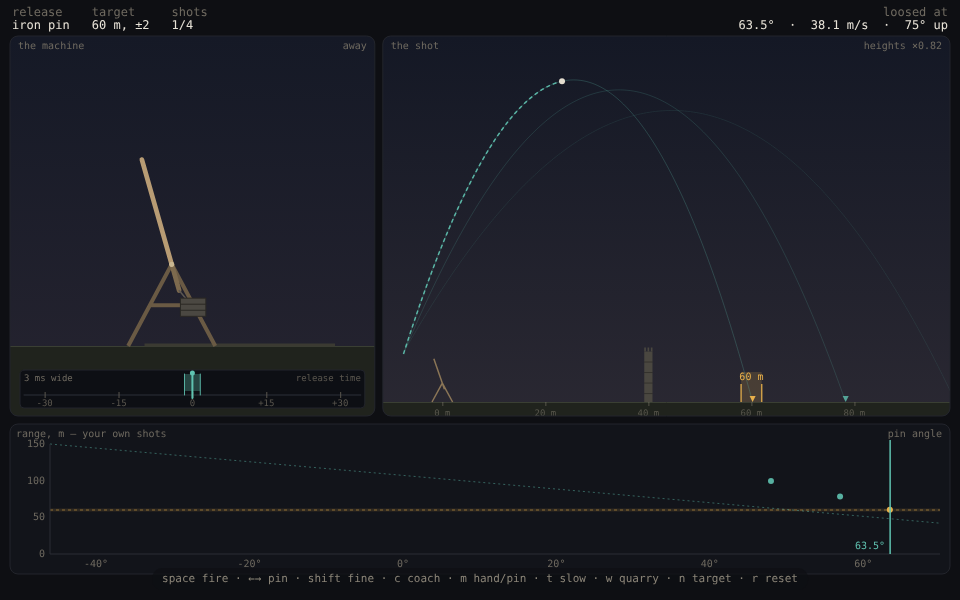
A trebuchet whose whole shot is decided in a five-millisecond window, and the medieval answer to that — a bent iron hook that is no more accurate than your hand, only repeatable, which turns out to be the thing you actually aim with.
Dead Pull
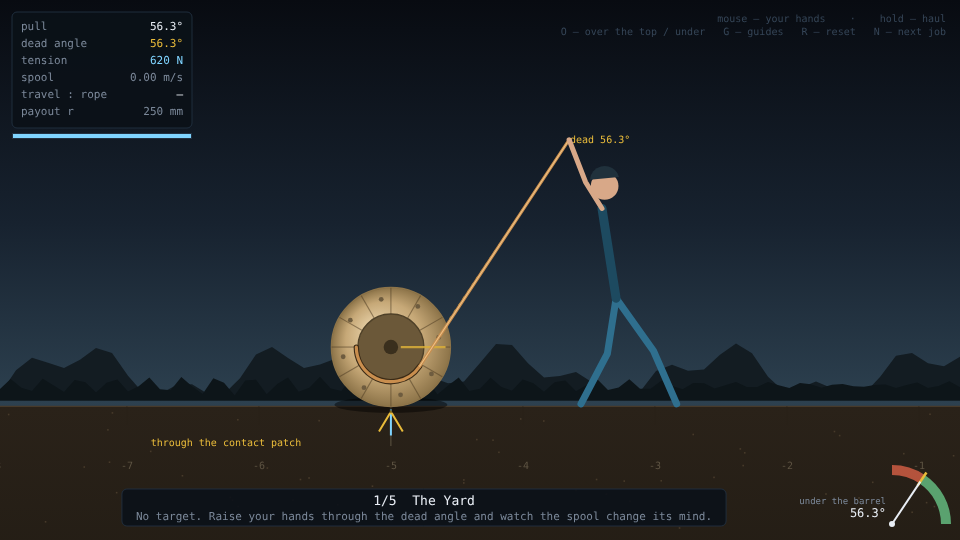
A 900 mm cable spool on a 500 mm barrel, a rope choked round it, and one pull angle — 56.25° — at which no tension on earth moves the spool, because the rope's line of action runs exactly through the contact patch. Below it the spool comes to you and outruns your rope 2.25 : 1; above it the same rope on the same barrel backs it away. Take the rope over the top instead and the dead angle disappears completely, at the price of 0.643 m of spool per metre hauled — a real 1.556× force advantage, and also a governor, because a pair of hands gathers about 1.10 m of rope a second, so under the barrel the spool can run at 3.09 m/s and over the top it can never beat 0.88. The same 8 m takes 3.54 s and 2.34 m of rope under the barrel and arrives at 3.29 m/s; over the top it takes 8.67 s and 11.60 m of rope and arrives at 0.75, which is the only one of the two a 220 mm chock will stop. The dead angle will not hold still either: 24 mm rope piling in one place takes the payout radius from 250 mm to 329 mm in six metres and the dead angle from 56.25° to 42.99°, so a pull that was hauling becomes one that is shoving with nothing changed but the spool — hold 40° and walk and the haul stalls after 4.59 m of rope and reverses after 7.37. And on a 4° ramp the angle that holds it is not the dead angle but a second one that moves with how hard you pull: 65.67° at 620 N, 74.99° at 300 N, and no angle at all below 160 N — and none you could actually reach below 310.
Fill Line
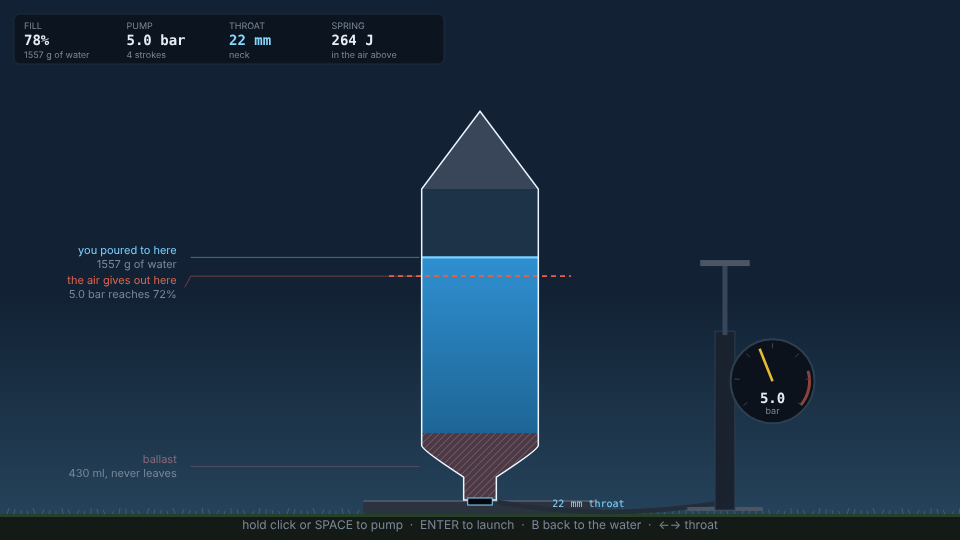
A two-litre bottle, a bicycle pump, and the dial everybody turns the wrong way — because the load with the most energy in it is not the load that flies highest, and it is not close.
Dip
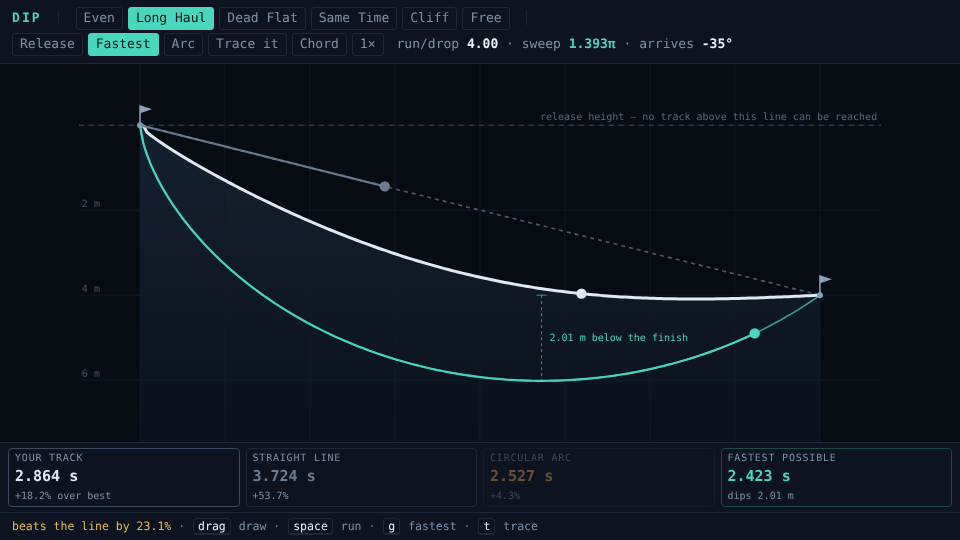
Draw a ramp between two pegs, release the sled, and find out that the fastest track to a point can go under it. The hinge is exact: at a run of π/2 times the drop the fastest curve bottoms out precisely at the finish and the sled arrives travelling horizontally, and past that ratio the curve dives below the flag and climbs back. Four numbers fall out. At a run of four times the drop the dive is 0.504 drops deep — 2.01 m under a flag that is only 4 m down — and the straight line, which never dives, takes 53.7% longer; at eight times it takes 97.6% longer, nearly double. On a cliff, a run a quarter of the drop, the straight line is 0.76% off and the whole trick is worth nothing. Galileo's answer, an arc of a circle, is never worse than 4.84% anywhere from 1:4 to 8:1 — which is how a wrong answer survived 58 years — even though at 4:1 it overshoots to 1.125 drops, more than twice as deep as it should. And the winning curve has a second property you can play against: on the π/2 arc a sled released anywhere reaches the bottom in 1.7376 s no matter what height it started from, so three sleds dropped at three heights land together, with 61 microseconds between them. None of the clocks are simulated — a polyline is a chain of constant-acceleration ramps, so a segment takes 2·ds/(v₁+v₂) exactly, which is why the time updates while your finger is still moving.
Air Time
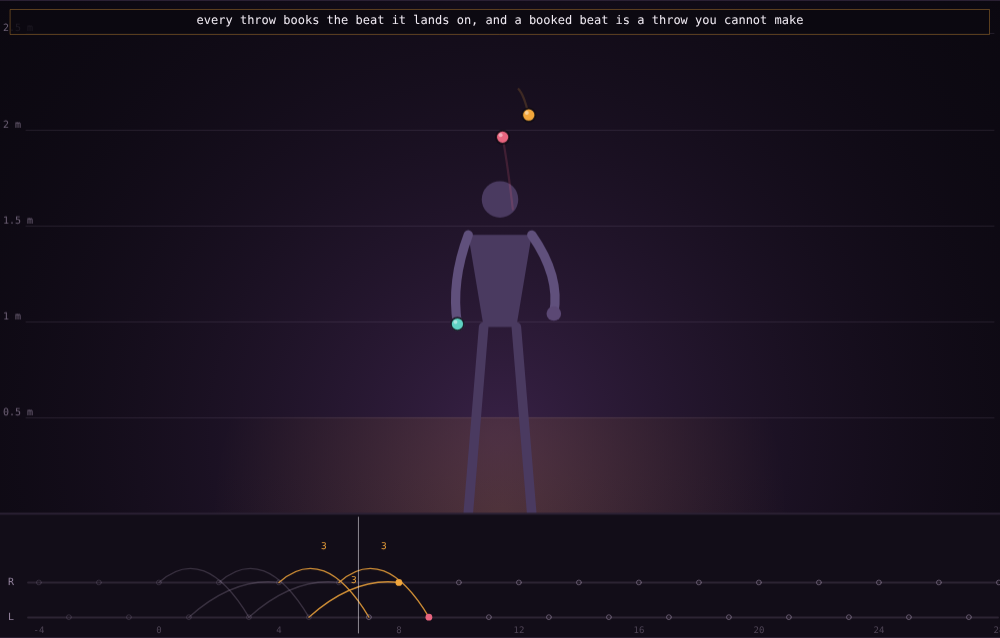
Juggling, played as a booking problem. A throw of value h made on beat b lands on beat b+h, so a pattern is possible exactly when no two throws land on the same beat — and the mean of the values is the ball count, exactly, always. Four numbers fall out. At 2.5 throws a second a 3 is airborne 0.98 s and peaks 1.18 m above the hands, a 5 is 3.30× that height and a 7 is 6.93×, because the apex goes as the square of the air time. Keeping a 5 at the height of a 3 means 4.54 throws a second instead of 2.50 — 1.8× the hand rate — and keeping a 7 there would need 6.58/s, which no pair of hands has. Taking one hand out of the pattern doubles every value and so costs 4.95× the height, not 2×. And the arithmetic is not negotiable: throw one ball higher than its share and the demo will show you the exact later beat where the bill comes due, because the mean cannot move.
No Torque
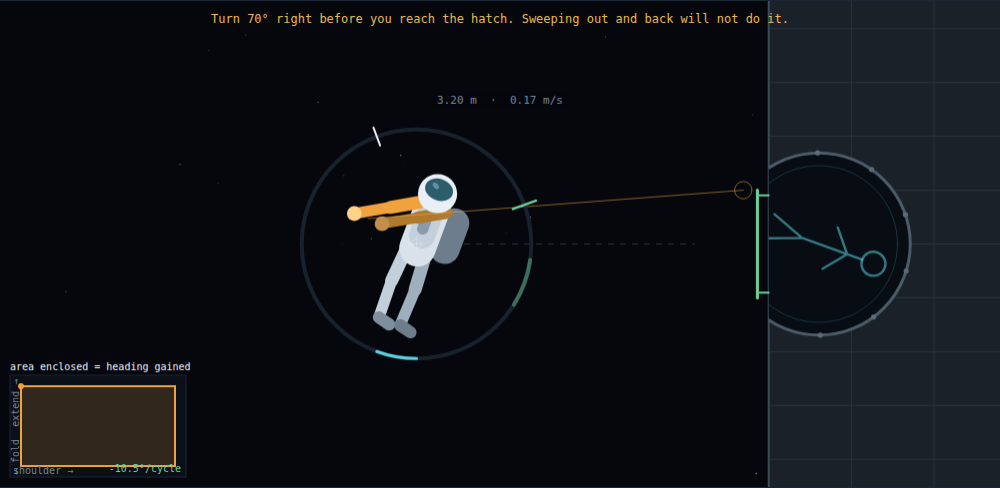
A spacewalker who has let go has nothing to push against and no angular momentum to spend, and can still turn — but only by drawing a shape that encloses area. Four numbers fall out. Sweeping both arms through their entire 250° of travel and back, elbows locked, returns you to the heading you started on: not nearly, exactly, and for as many strokes as you care to spend. Fold the elbows on one leg of that same stroke and the identical 500° of shoulder travel buys 10.59° of heading — a 2.1% gear ratio, 8.5 cycles and 26 seconds to get 90°. The fold is not a dial: folding halfway gives up 71% of the gain to save 16% of the clock, so the honest options are all the way or not at all. And the one move that is genuinely fast is the one you cannot undo — a 1.2 kg tool thrown at 4 m/s buys 2.98 kg·m²/s and about 14°/s, which you then have forever, at a rate that drifts between 10.4 and 14.1°/s as your own shape changes under it.